
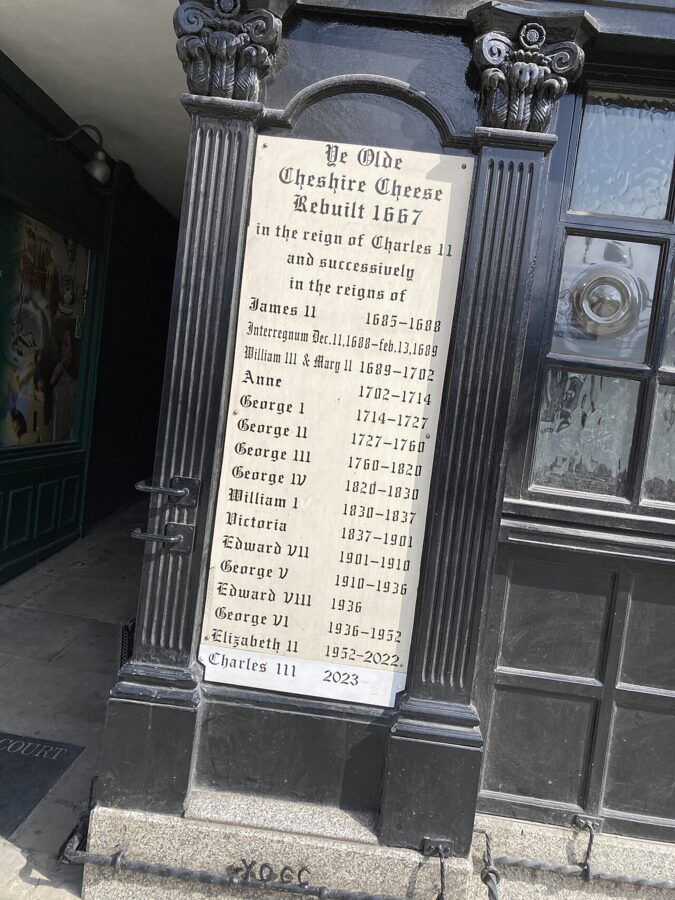
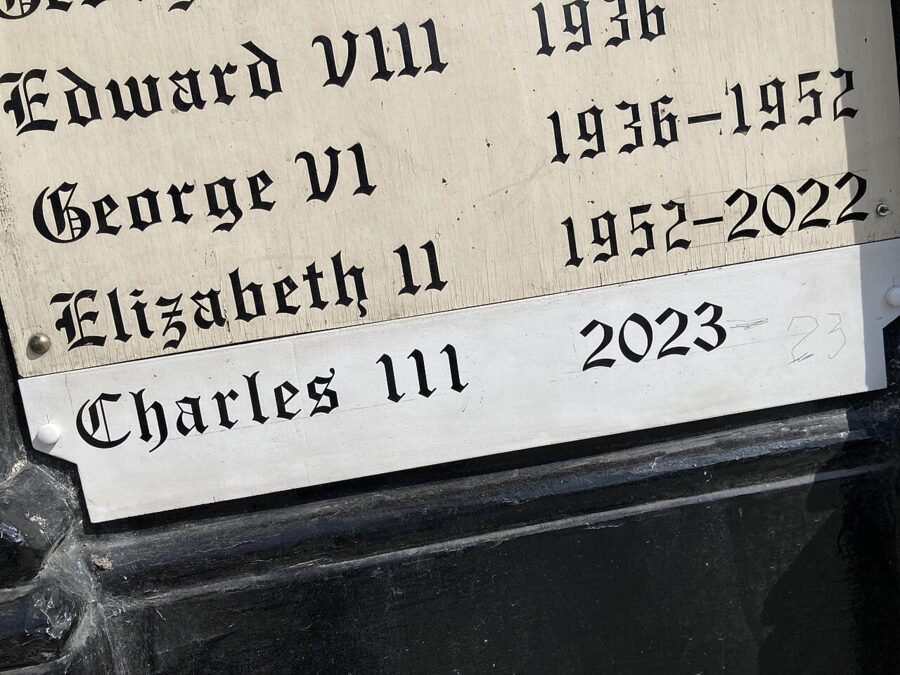
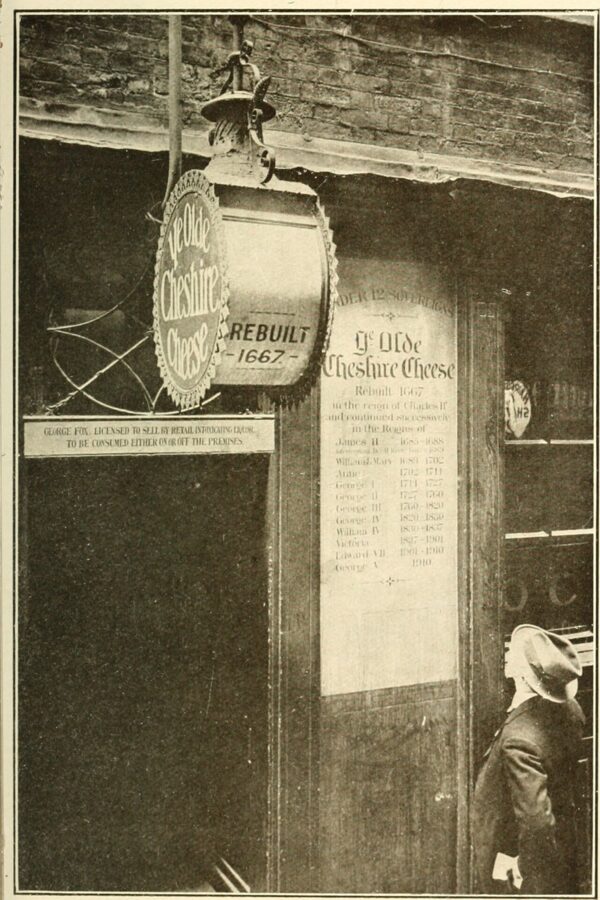
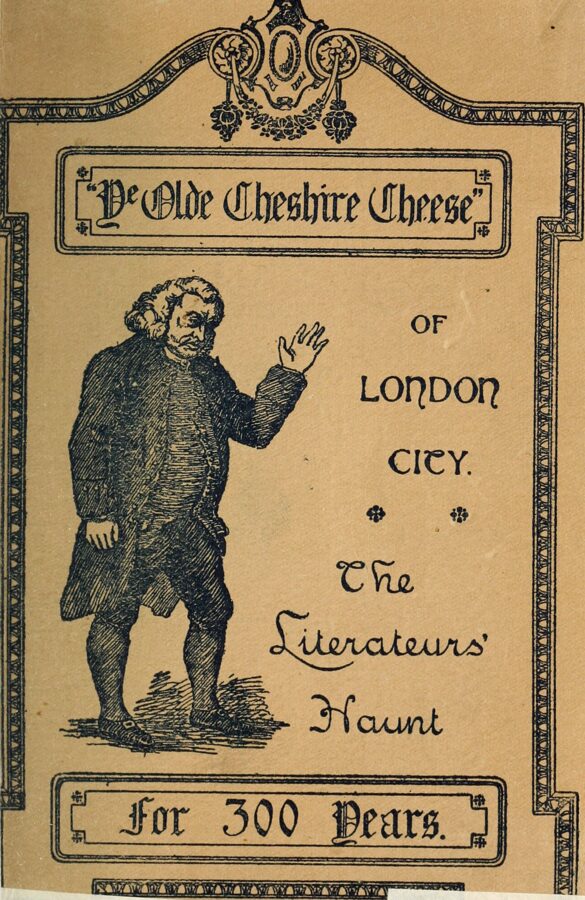
Beside the door of Ye Olde Cheshire Cheese hangs a painted board listing every monarch who has reigned since the place was rebuilt in 1667. When Charles III was added in 2023, the signwriter gave him the date 2023, the year of his coronation rather than the year he became king. It is a small slip, and it is the most useful thing in the building, because it tells you how to read everything else here: lovingly, and with a pencil in your hand.

The Cheese, as regulars have called it for well over a century, sits up a dark passage off the north side of Fleet Street. It is a Samuel Smith’s house now, which means one cask beer, no music and no telly. It is also a warren of at least nine drinking areas on five levels, with sawdust in two rooms, a stuffed parrot over the bar and more literary ghosts per square foot than anywhere else in London.

I have written about the Cheese alongside its neighbours in my guide to the oldest pubs in London. This is the long version: what is genuinely old and what is Victorian scene-setting, which famous names really drank here, where to sit, what to eat and when to avoid it.


On this page
Finding the door
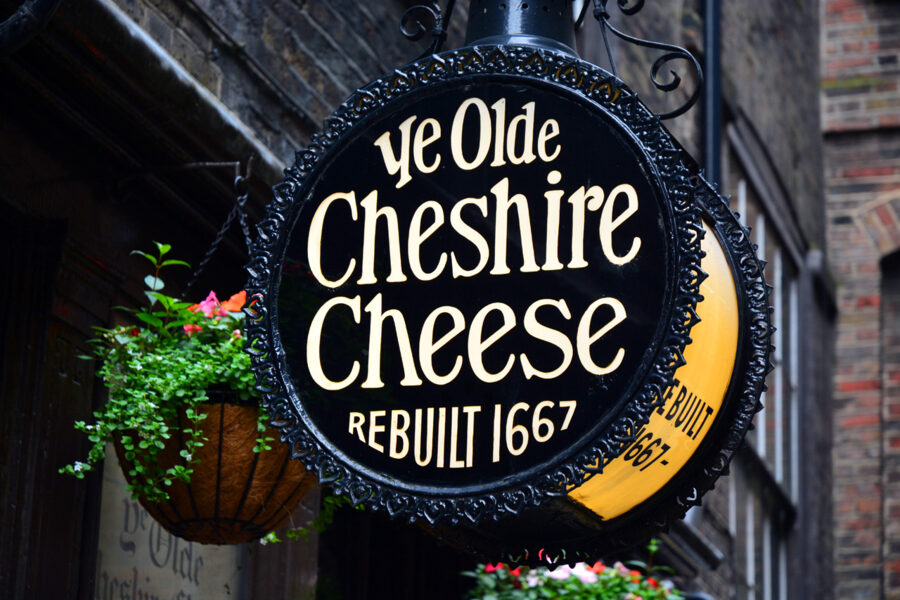
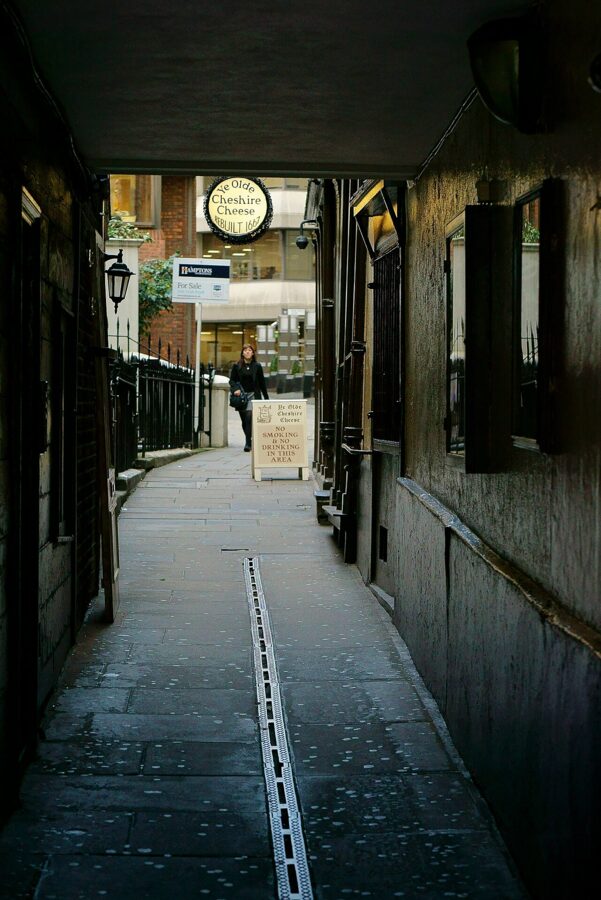
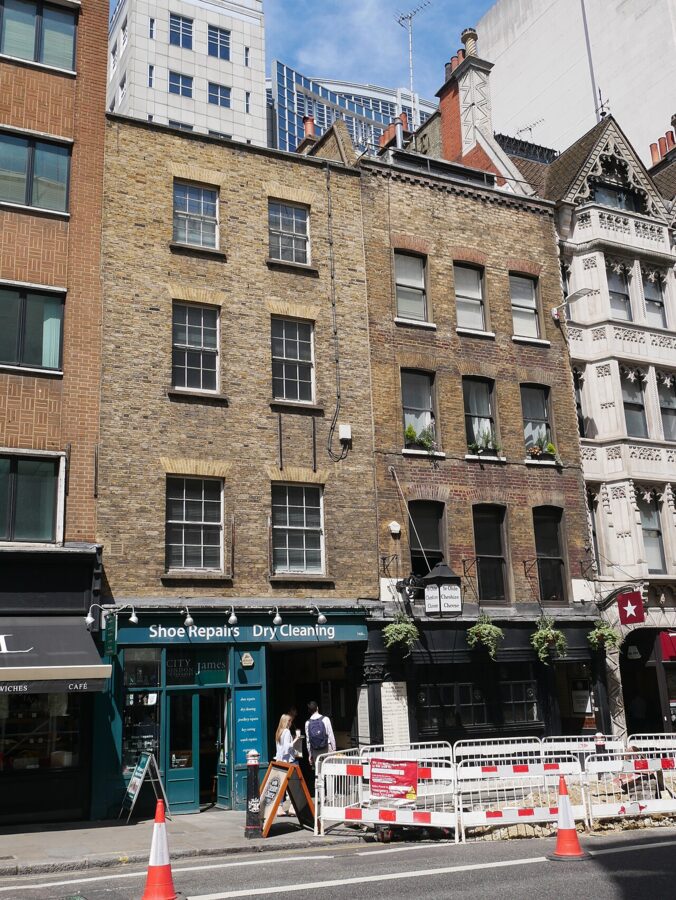
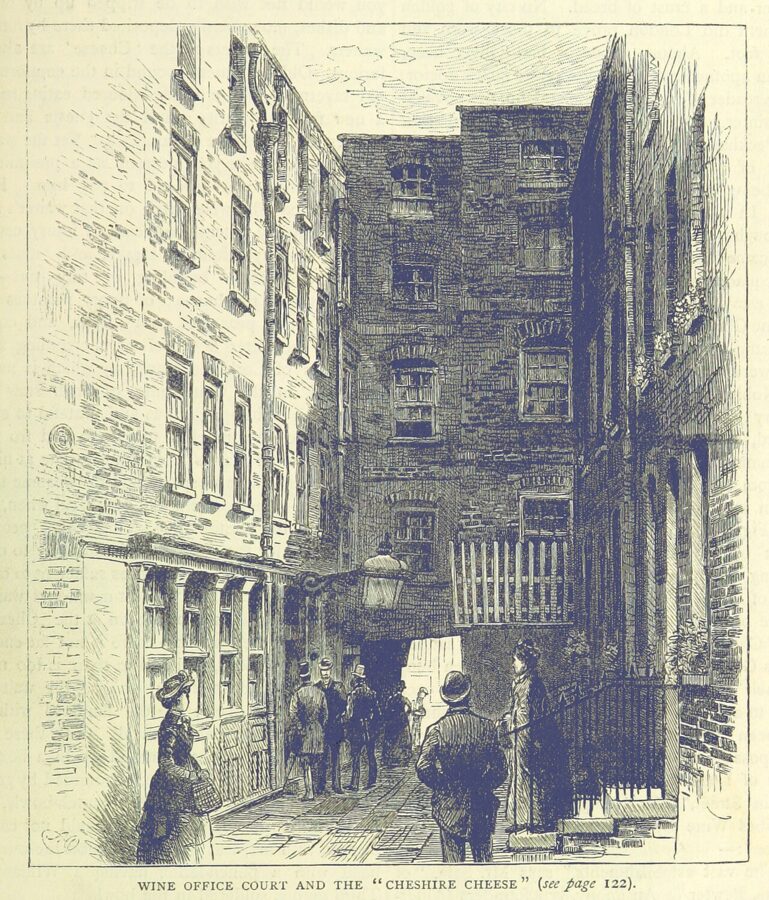
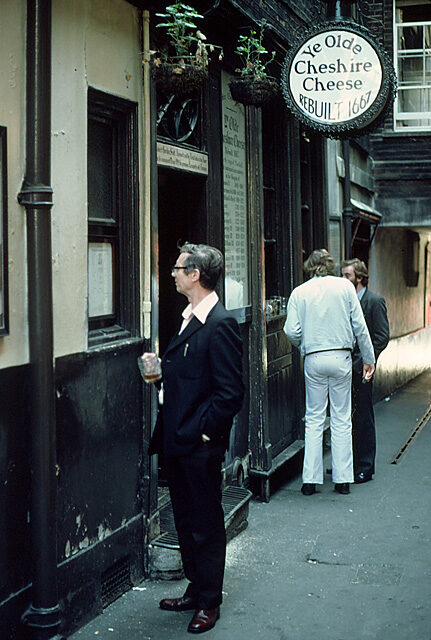
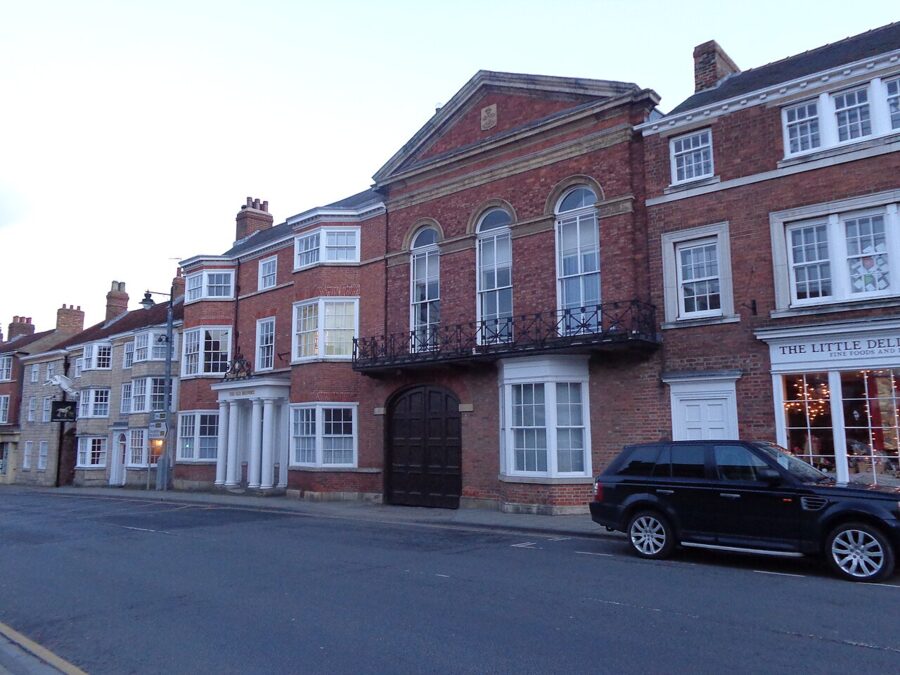
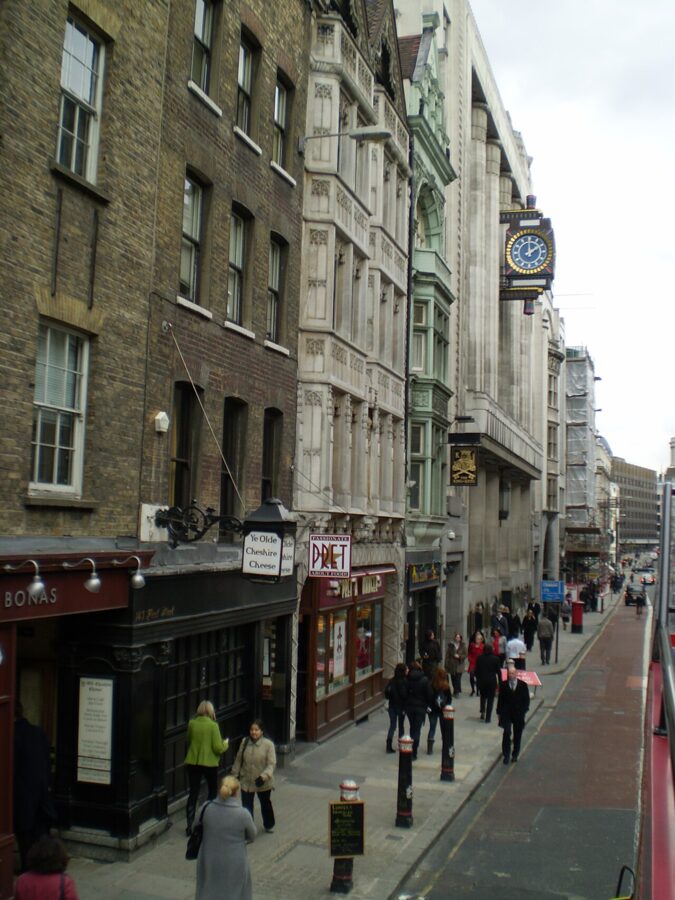
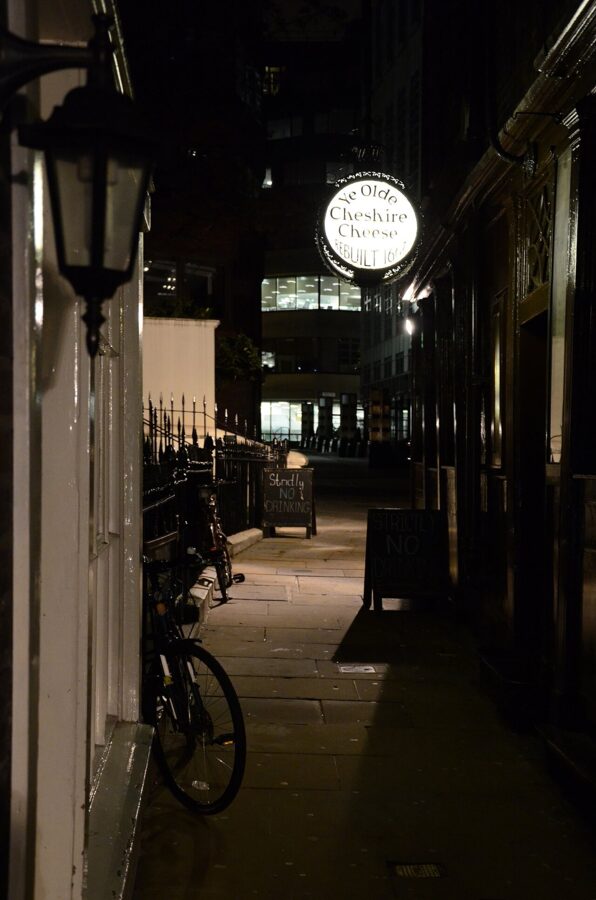
The address is 145 Fleet Street, but the front on Fleet Street is a black-painted shop window that tells you almost nothing. The entrance that matters is in Wine Office Court, the alley immediately to its left as you face it, where a round hanging sign says “Ye Olde Cheshire Cheese, Rebuilt 1667”. The door is a few steps in, under it.

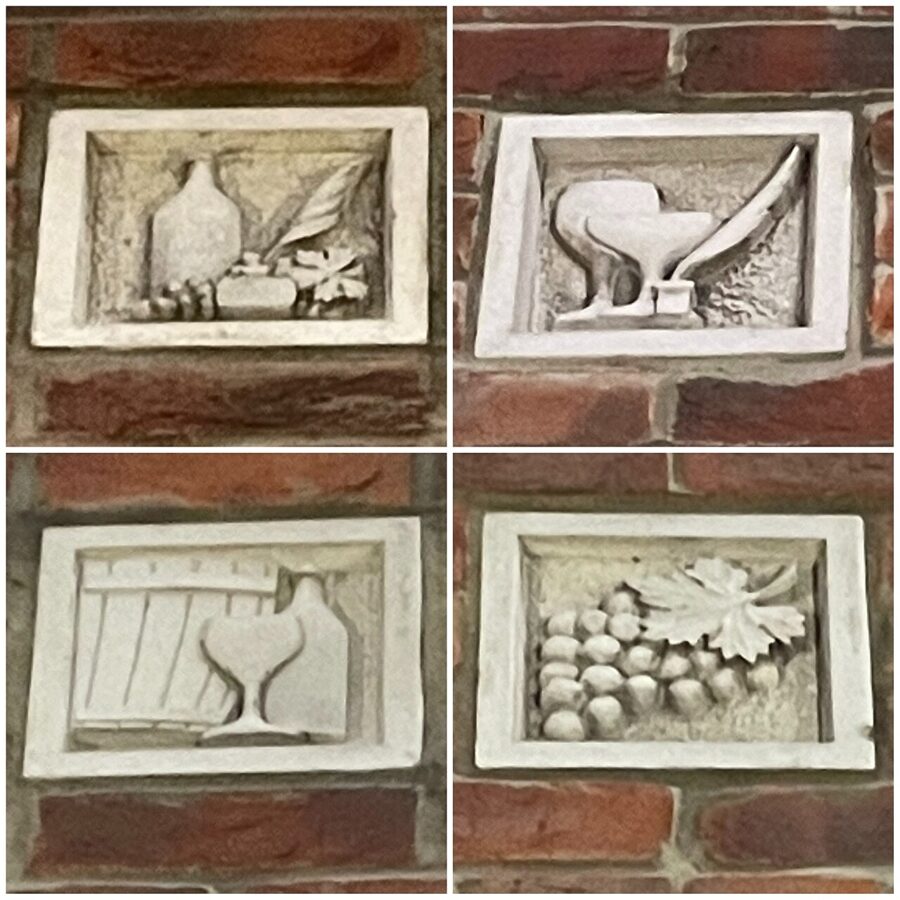
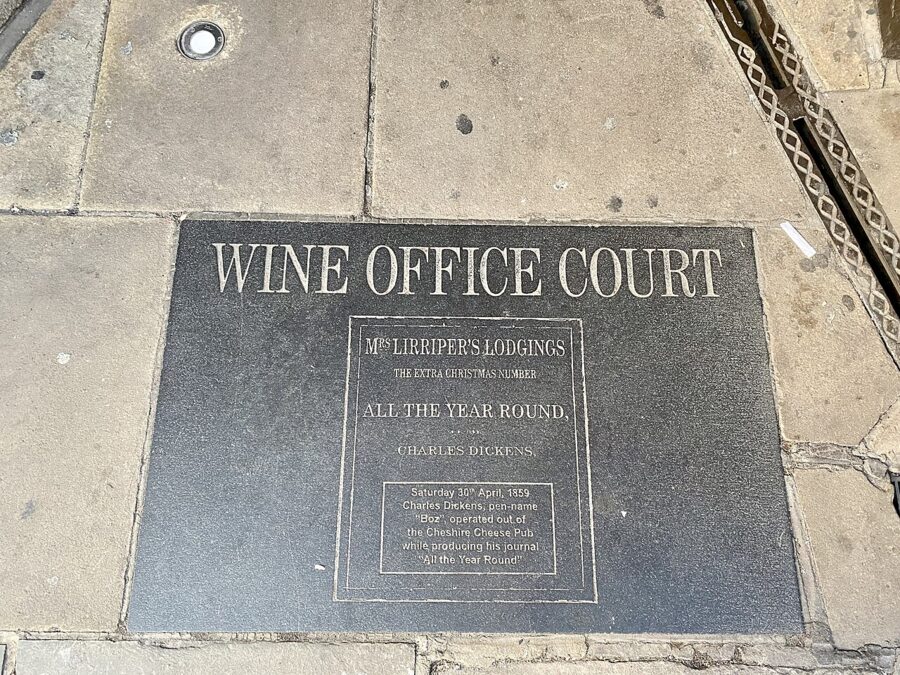
The court takes its name from the excise office that granted wine licences here until 1665, the year before the Great Fire. Look out for four small stone panels set into the brickwork of the court: a bottle, a glass, a cask and a bunch of grapes, a nod to the trade that gave it its name.

Victorian visitors found the place by smell, if the house history is to be believed: the smell of the great pudding was said to reach the Stock Exchange on a windy day. These days the clue is the crowd at the mouth of the court, phones raised to the lantern. Ignore them, walk past, and take the first door.
Rebuilt 1667: what is really old
The pub tells you that a tavern has stood here since 1538, that the medieval building burned in the Great Fire of 1666 and that the present one went up in 1667. The first claim has no document behind it that I can find, which puts it in large company among the oldest pubs in England. The 1908 edition of The Book of the Cheese, a house history the proprietors published for their customers, admits there is “a decided want of complete, or even semi-complete, details” about its early life.
The building itself is better evidence. Historic England listed it at Grade II in 1977 and describes it as late seventeenth century and “very much altered”. The yellow-brick front to Fleet Street is probably late eighteenth century, remodelled and made taller in the nineteenth. Under a small courtyard there is a late seventeenth-century vaulted cellar.
So the 1667 date is plausible for the core, and almost nothing you can see from the street is that old.
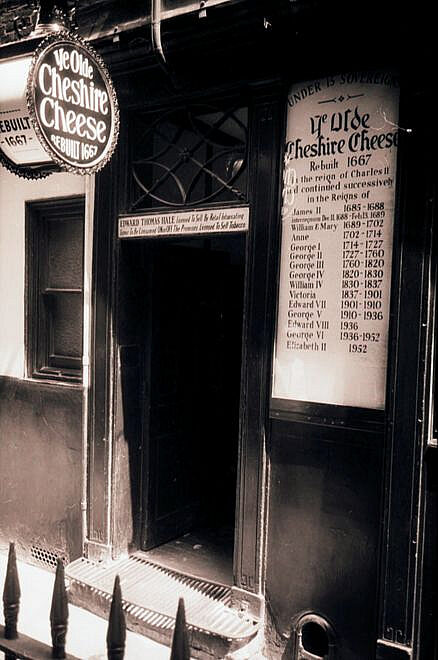

The biggest change came in 1992. Until then the pub was four rooms over three floors plus a small cellar bar, and the Fleet Street side of the building held a newsagent and offices. Samuel Smith’s, which had acquired the pub, extended it east into the neighbouring property, added a new ground-floor bar, doubled the size of the upstairs rooms with replica panelling and turned the old cellars into a proper bar. CAMRA counts at least nine drinking areas now.

One more episode belongs here. A fire upstairs in 1962 exposed a set of eighteenth-century plaster tiles showing couples in positions your grandmother would not discuss, and the pub gave them to the Museum of London. Historians have suggested they decorated a fireplace in a brothel or a gentlemen’s club; the museum showed them in public for one evening in 2014.
The vaults
Ask anyone behind the bar about the cellars and you may hear that they were part of a thirteenth-century Carmelite monastery. The trouble is geography. The Carmelites’ London house, Whitefriars, stood on the other side of Fleet Street, between the road and the river, and the listing dates these vaults to the late 1600s, the same campaign as the building above.
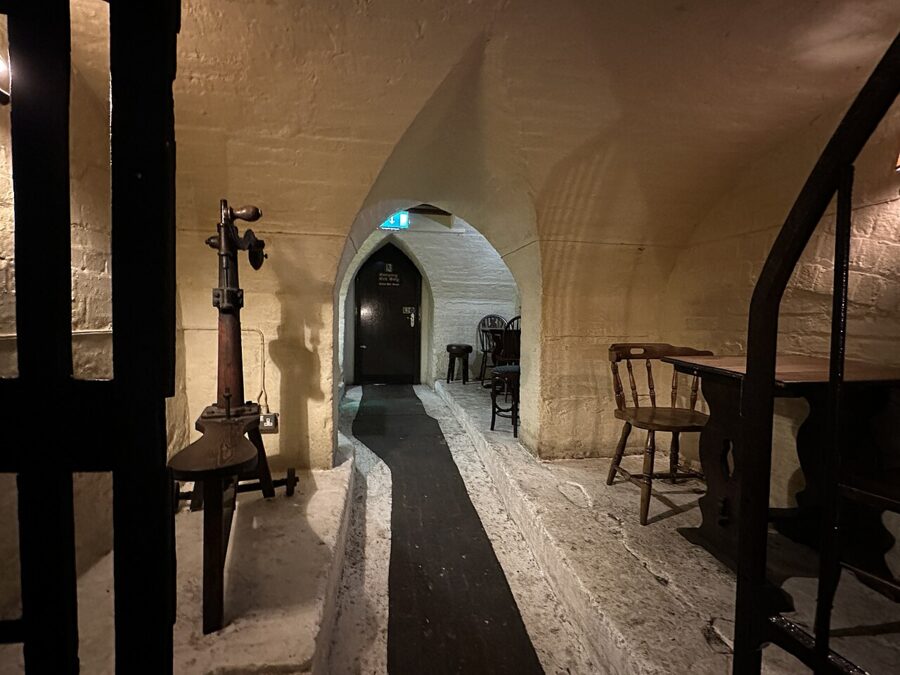

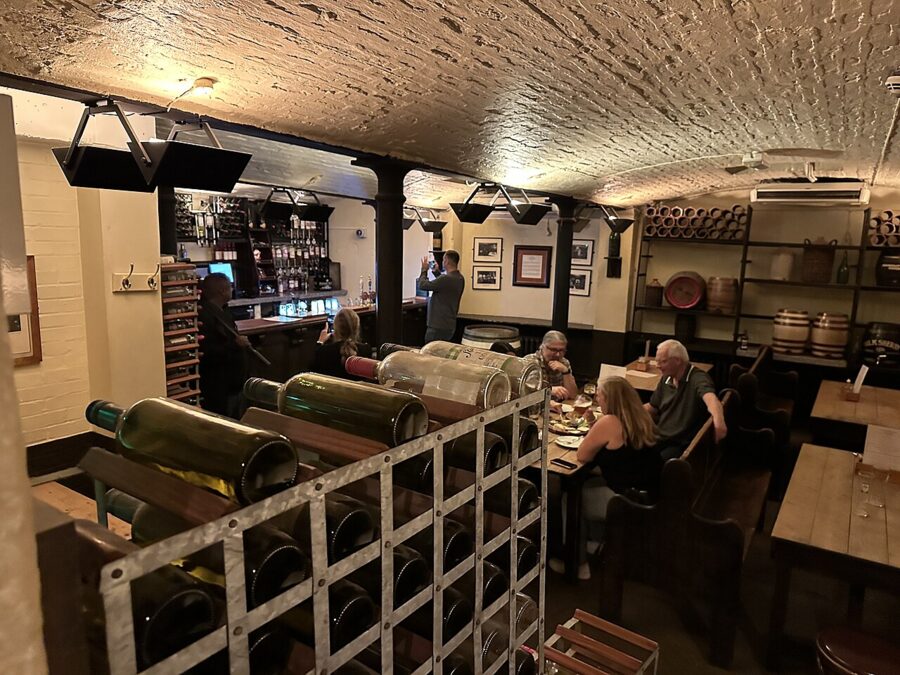
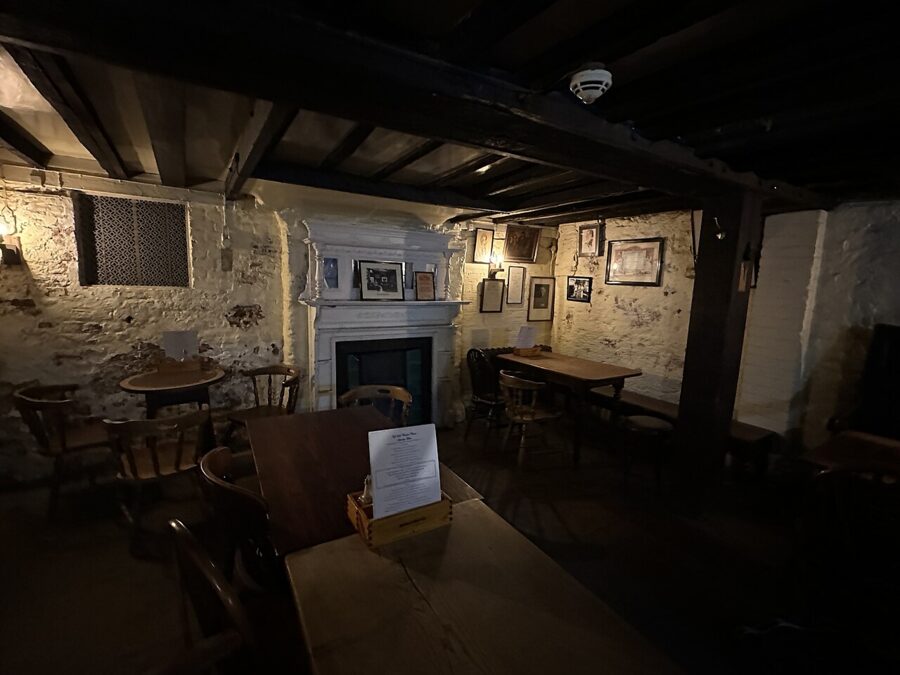
That does not make them less worth seeing. You reach them by a staircase near the old front rooms. The first small room has a replacement flagstone floor and held a tiny servery until 1992; beyond it a narrow barrel-vaulted passage leads to a larger room with a three-bay barrel vault, which is where the Cellar Bar is now. The bar fittings down there date from 1992, the brick and the curve of the ceiling do not.
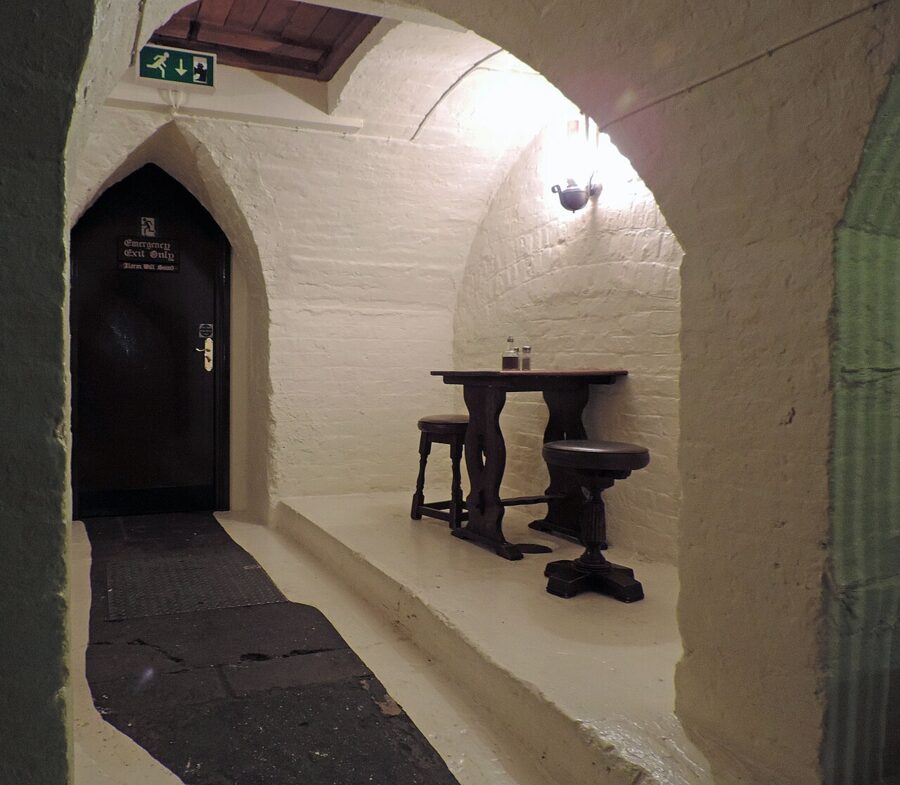

The Cellar Bar is open all day and serves its own short menu, ordered at the bar. If you came to see vaults rather than eat, this is the place to drink: it is the most atmospheric room in the building, and plenty of people who walk in from the court never get past the front rooms to find it.


Room by room
The Cheese works best if you treat it as a building to explore with a pint in hand, rather than a bar to stand at. The two rooms either side of the entrance passage are the best survivors, and CAMRA’s pub heritage group rates the interior three stars, its top grade, for exceptional national importance. Start there.
The front bar
Turn right inside the door. This is the old public bar: a small, dark room with panelling that may date from the rebuild, fixed bench seating, a big fireplace that is lit in winter and a Victorian bar counter. Above the counter, in a glass case, is Polly the parrot, of whom more below. An old sign still reads “Gentlemen only served in this bar”.
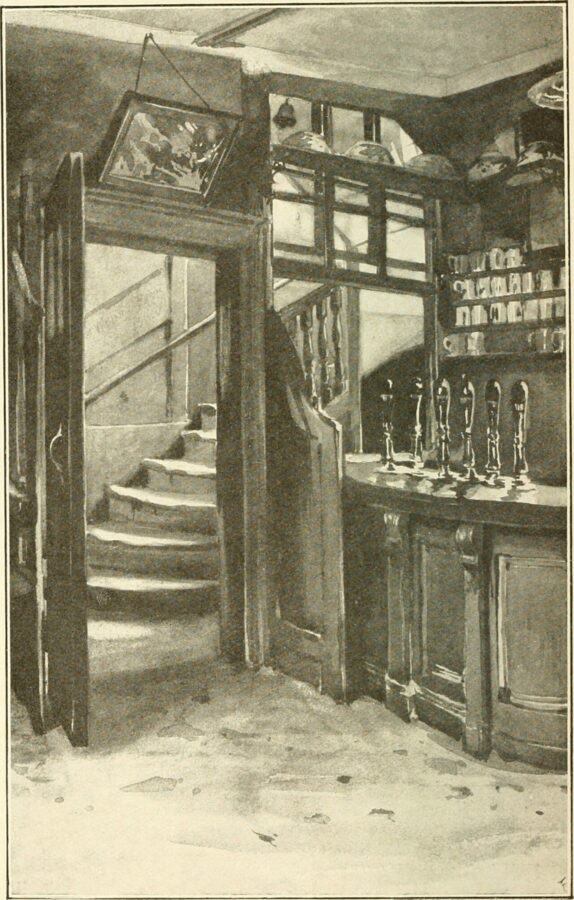
This is where I would drink. It has the fire, it has the handpumps, and it has the best view of who is coming in from the court. It is also the room the sawdust is meant for: the pub says the floor is changed twice a day.
The Chop Room
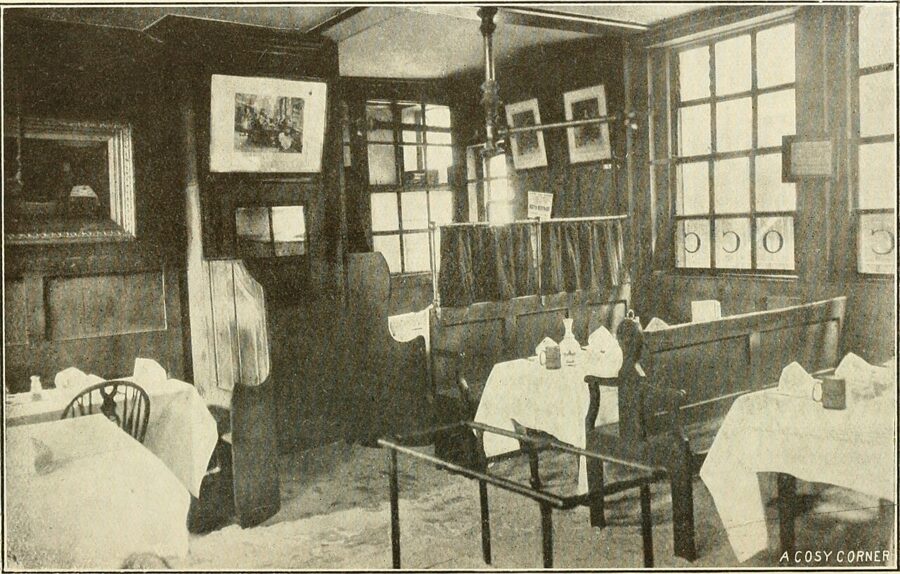
Turn left instead and you are in the Chop Room, the original eating room: panelled, with wall benches, a curtained corner, an old marble fireplace and a bare wooden floor laid with fresh sawdust daily. The pub says Johnson sat in the corner, and staff will show you a seat they call Dickens’s. The pub serves its main menu here, and its booking page is frank that it cannot promise you a table in this room.
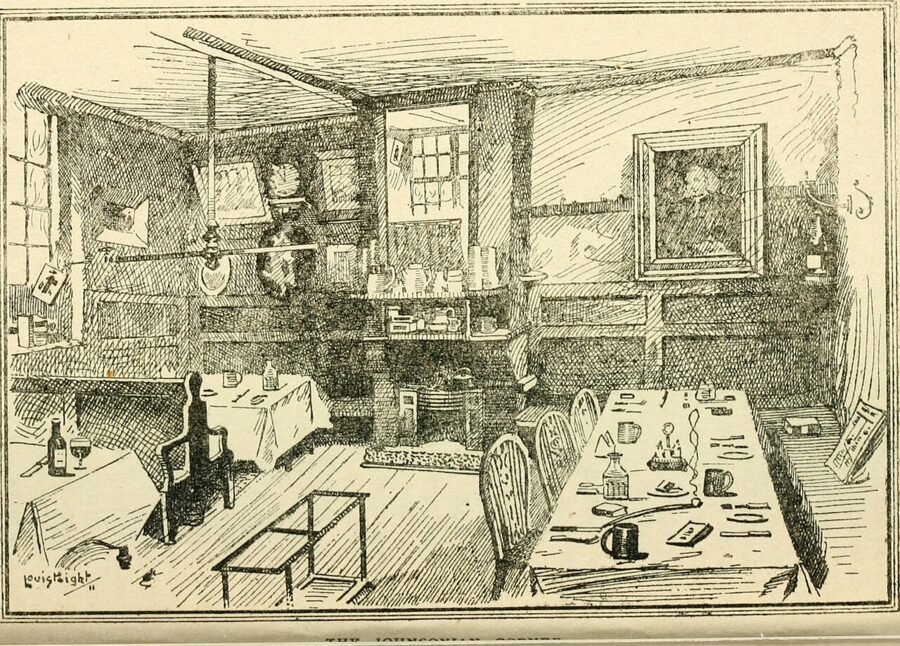
Upstairs: the Williams Room and the Johnson Bar
The stairs are steep and they twist. On the first floor the Williams Room keeps 1930s panelling and a wood-surround fireplace with an old fireback; it is used for private hire now. Also on the first floor, facing Fleet Street, the Johnson Bar was carved out of offices in the early 1990s and has new bar fittings; it takes up to 70 for parties. The second floor has a lunchtime dining room with 1930s panelling and high-backed bays still numbered “1”, “2” and “3” on the ends.
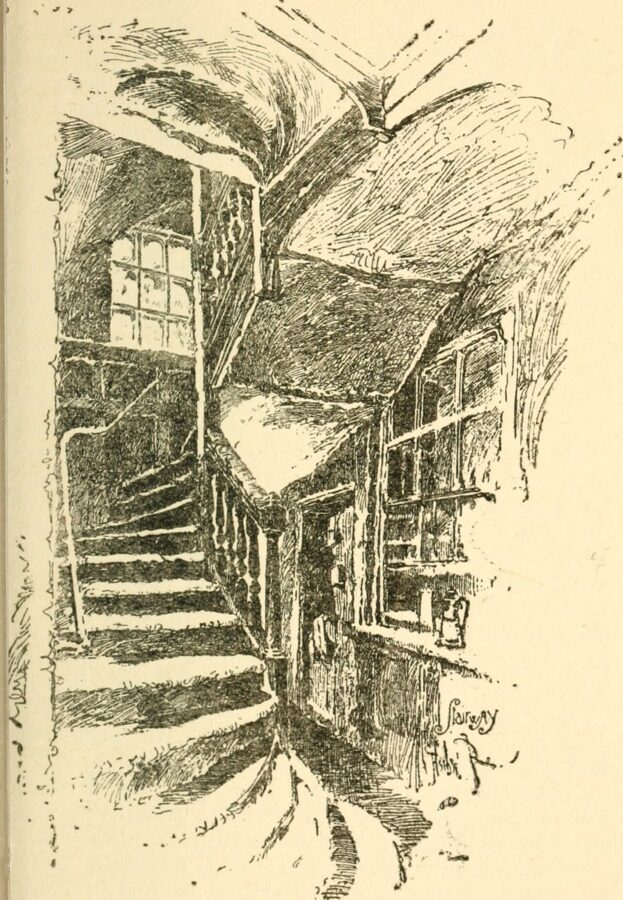
At the top the pub sells its function room as seventeenth century, with a ceiling open to huge oak beams. CAMRA’s survey describes the third-floor dining room as having no old fittings. Both can be true of a roof; the timbers may be old even when everything screwed to them is not. If you are not hiring a room, you will not see it.
The Cheshire Bar
The newer ground-floor bar at the back on the right is the one Samuel Smith’s built in the early 1990s. It opens at 17:00 and soaks up the after-work crowd. It is pleasant enough and nobody’s reason to come.
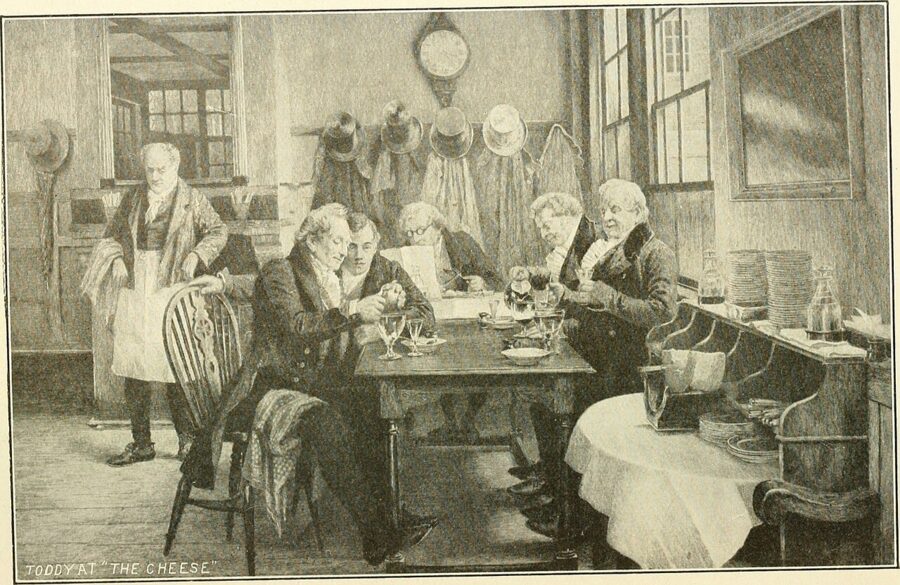
A Sam Smith’s house
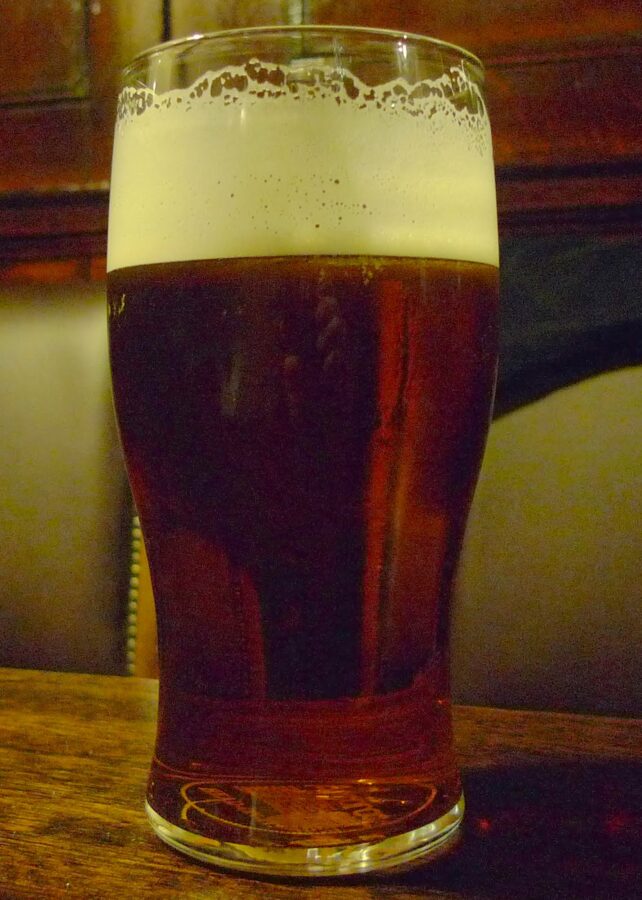
Samuel Smith’s Old Brewery, founded at Tadcaster in North Yorkshire in 1758, owns the freehold and runs the pub itself. That shapes everything at the bar. Every beer is brewed by Sam Smith’s, there are no guest ales, and the single cask beer is Old Brewery Bitter, a 4% brown bitter that the pub says it serves from oak casks in the cellar.
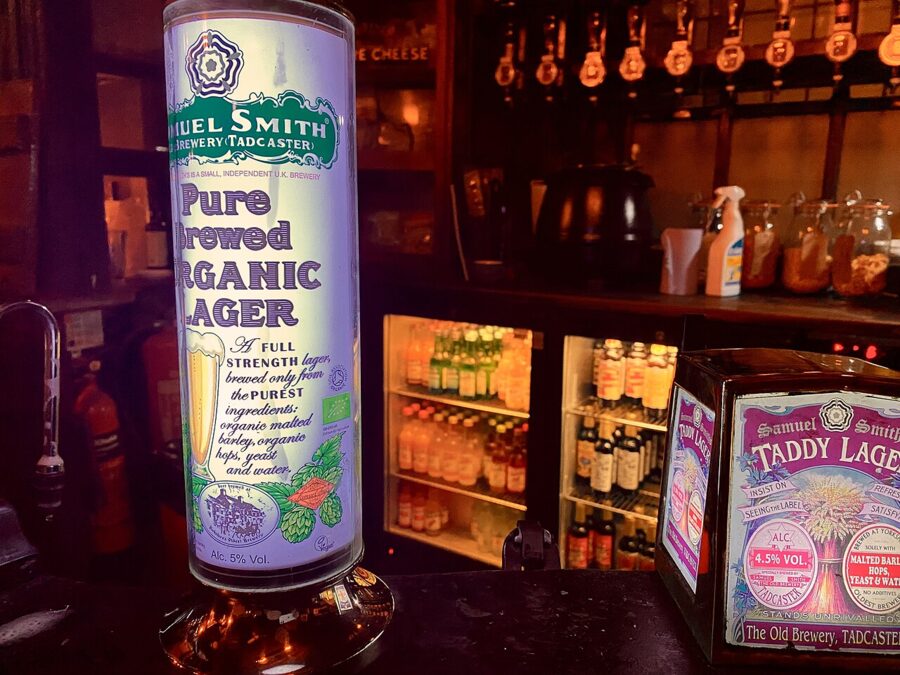

If you are new to real ale, this is a gentle place to start. Old Brewery Bitter is malty, mildly fruity and not at all challenging. It will not change your life; it will go perfectly with a chop.
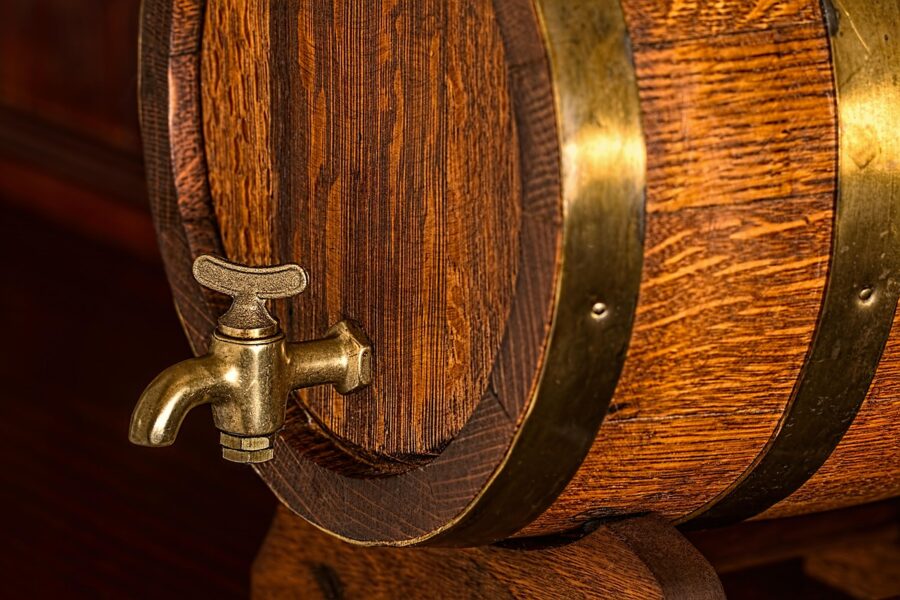
The brewery also has rules, set at the top rather than by the staff. Its pubs play no music and have no television. Swearing has been banned since 2017, and a 2019 memo told managers to stop customers using phones, tablets and laptops inside. How firmly that is enforced varies a good deal, but do not argue with the barman about it; he did not write it.

The upside is that the Cheese is quiet in the right way: the noise is people talking. The brewery does not publish its prices and I will not guess one, but Sam Smith’s pubs have a long reputation for undercutting their neighbours.

Johnson, Dickens and the names on the board
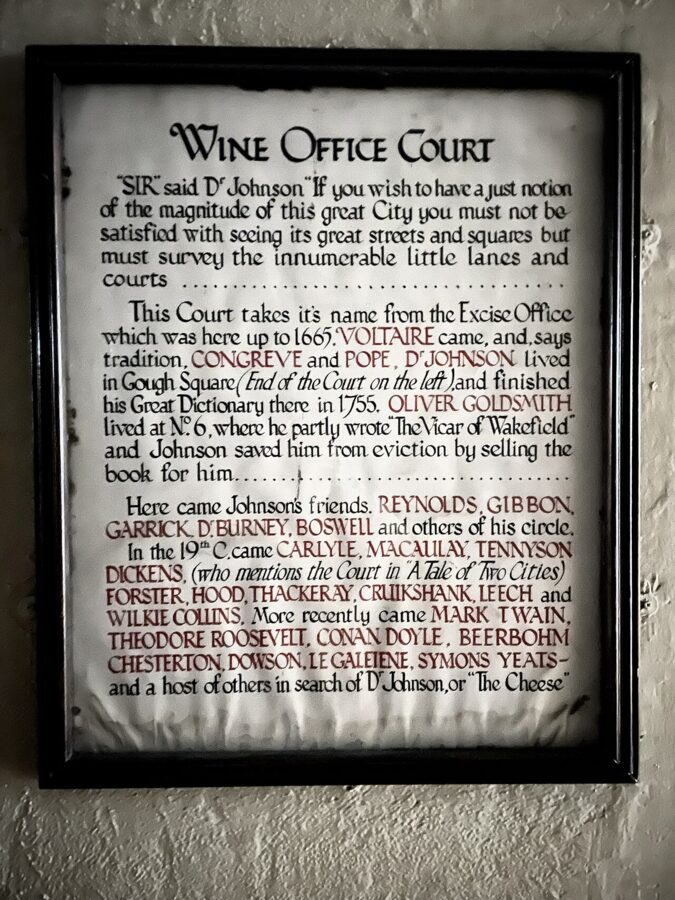
Inside Wine Office Court a hand-lettered board names everyone who is supposed to have come here. It runs from Voltaire, Congreve and Pope through Johnson’s circle to Dickens, Thackeray, Wilkie Collins, Mark Twain, Theodore Roosevelt, Conan Doyle, Chesterton and Yeats. It even says “says tradition”, which is more candour than most pub boards manage. The names fall into three piles: documented, plausible and wishful.

Samuel Johnson: plausible, never proved
Johnson lived a minute’s walk away at 17 Gough Square from 1748 to 1759 and finished his Dictionary there. His biographer James Boswell, who recorded a great many tavern evenings, never mentions the Cheese. Boswell only met Johnson in 1763, after he had left Gough Square, so the silence proves little either way.
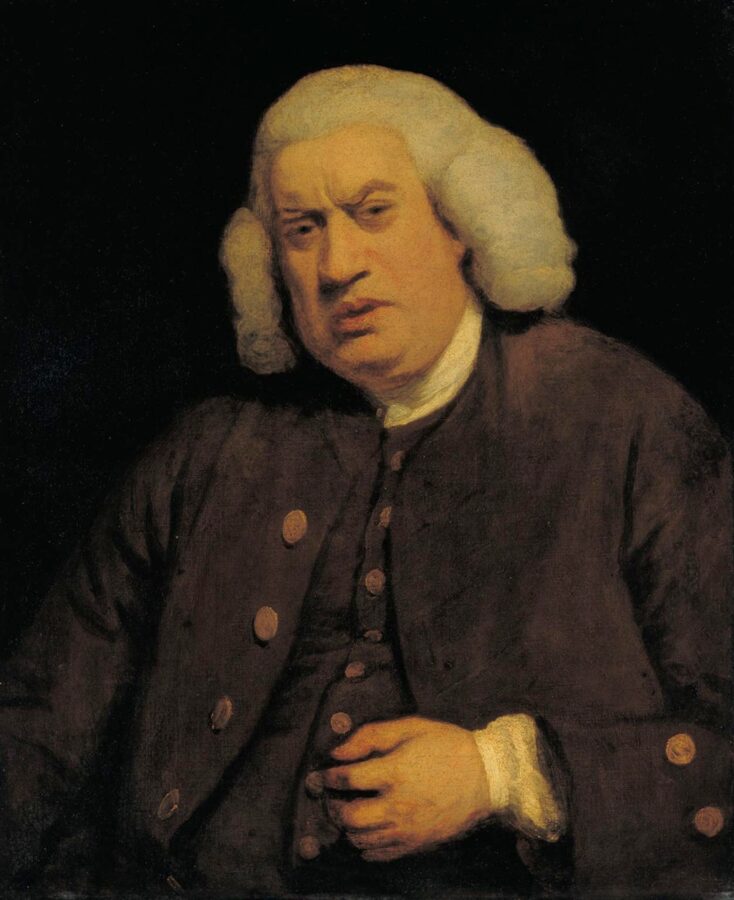
The evidence for Johnson at the Cheese is second-hand but specific. In 1868 a lawyer named Cyrus Jay, who had dined there for more than half a century, wrote that in his early years at the Cheese he met very old gentlemen who remembered Johnson. Their story was that he used the Mitre while he lived in the Temple, but became a constant visitor to the Cheese when he lived north of Fleet Street, “because nothing but a hurricane would have induced him to cross” the road. I find that persuasive, and very Johnson.
The chair is another matter. The pub shows “Johnson’s chair”, and the 1908 house history is clear about where it came from: it was the chair he used at the Mitre, a tavern he favoured that has long since been demolished and no relation of Ye Olde Mitre in Ely Court. The Cheese’s proprietor acquired it after the Mitre came down. A Johnson chair, then, but not a Cheese one.
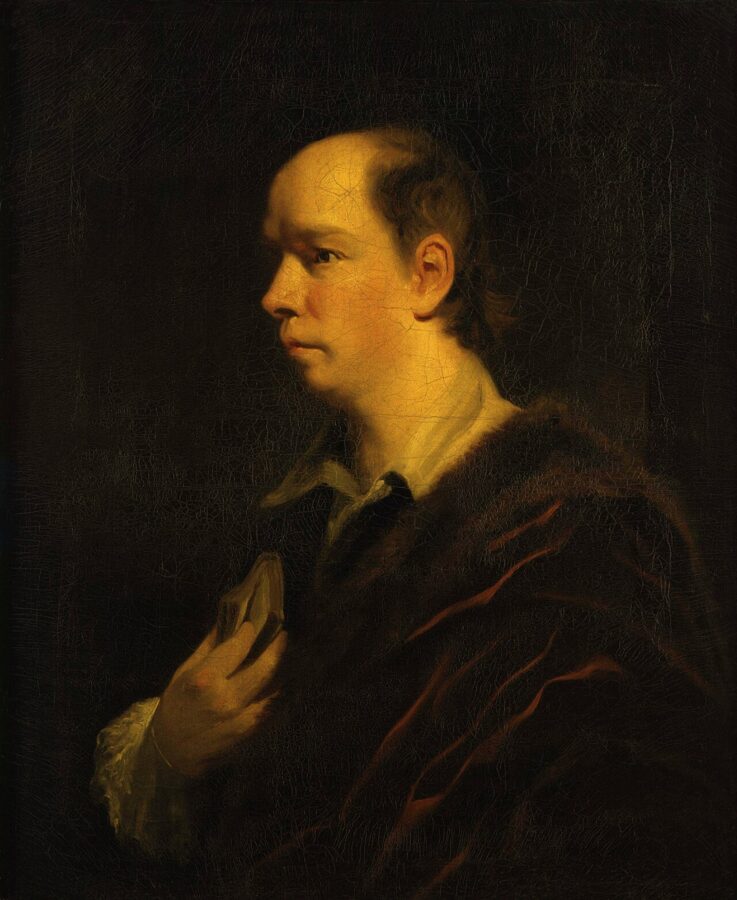
Oliver Goldsmith: next door
Goldsmith lodged at No. 6 Wine Office Court in the early 1760s, a few doors up from the pub, and worked on The Vicar of Wakefield there. The board says Johnson saved him from eviction by selling the manuscript for him. Boswell tells that story in Johnson’s words but gives no address, so the board is doing some tidying.
Charles Dickens: the novel and the plaque
In A Tale of Two Cities, after Charles Darnay’s trial at the Old Bailey, Sydney Carton takes him “down Ludgate-hill to Fleet-street, and so, up a covered way, into a tavern”, where Darnay recovers over “a good plain dinner and good wine”. The book never names the tavern. A covered way off Fleet Street, a short walk from the Old Bailey, is about as close to a description of Wine Office Court as you will get without a street sign.
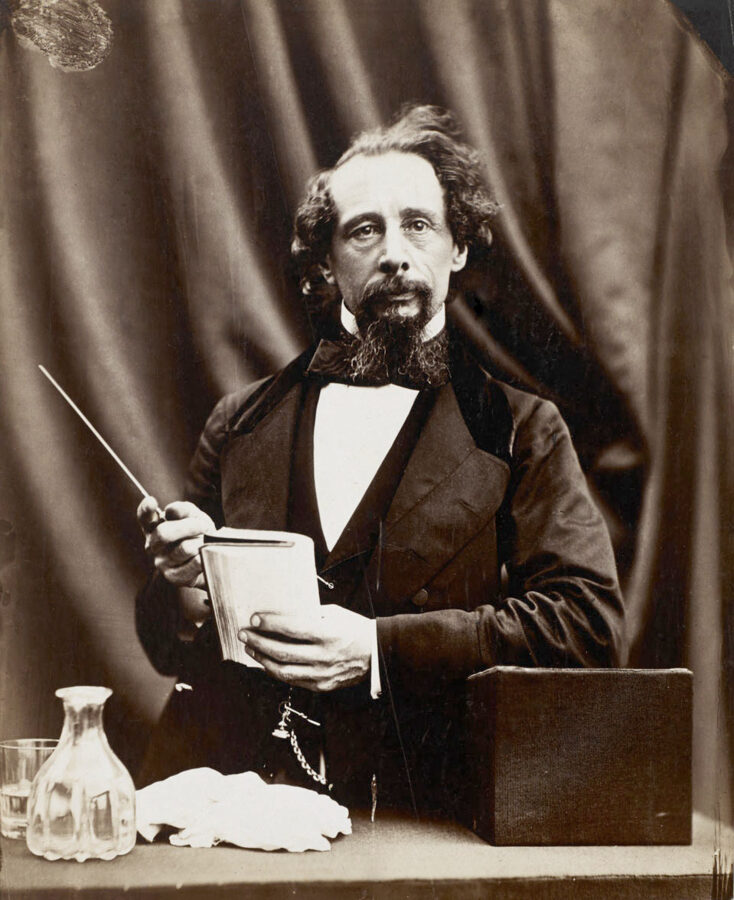
The pavement plaque at the mouth of the court goes much further. It claims that from 30 April 1859 Dickens “operated out of the Cheshire Cheese” while producing All the Year Round. The magazine’s first issue did appear that day, but its office was in Wellington Street, off the Strand. Writers who knew the Cheese in the 1880s and 1890s say Dickens, his friend John Forster and Wilkie Collins drank here, which is believable; that he ran a magazine from it is not.

Yeats and the Rhymers
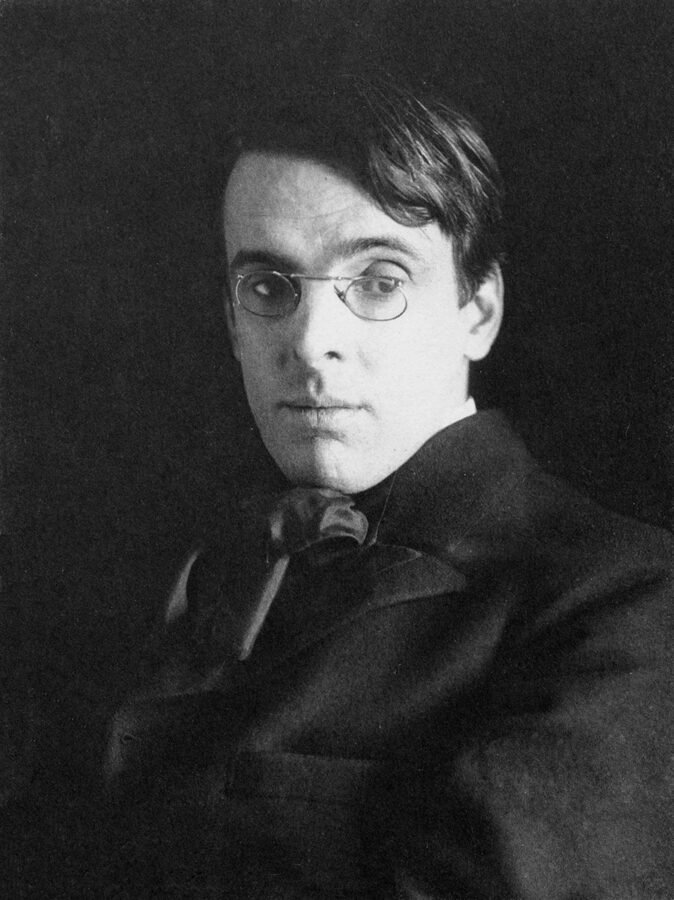
Here the paper trail is solid. In the early 1890s a group of young poets calling themselves the Rhymers’ Club met at the Cheese to read their verse to each other, and their first anthology, The Book of the Rhymers’ Club, came out in 1892.
The members it lists include W. B. Yeats, Ernest Dowson, Lionel Johnson, Richard Le Gallienne and Arthur Symons. Yeats wrote about those evenings in his memoirs decades later.
The Cheese was a club house in a broader sense, too. The 1908 house history lists the clubs then meeting in its rooms: the Johnson Club, the Sawdust Club, founded in 1906, the Mitre Club, the Rump Steak Club and a Dickens Club among them.
Twain, Conan Doyle and the rest
Mark Twain, Arthur Conan Doyle, G. K. Chesterton and Theodore Roosevelt all appear on the board and on most lists of regulars. I could not find a dated letter, diary entry or newspaper report that puts any of them at a table here.
They may well have come; most literary visitors to London in their day did. But “regular” is doing a lot of work, and I would not repeat it to a pub quiz.
The pub also quotes P. G. Wodehouse in 1906, taking “one glance of loathing at the mob” in the Garrick and going off to lunch alone at the Cheese. I could not trace the source, but it sounds exactly like him.
Polly the parrot
The most famous regular in the Cheese’s history was an African grey parrot called Polly, who lived in the bar for around forty years. Accounts disagree on when she arrived, sometime between the mid-1880s and the mid-1890s, and newspapers of the day could not decide whether Polly was a he or a she. Everyone agreed on the language: Polly swore, imitated corks being drawn, called for “pudding and two veg” and shouted fictitious orders to the waiters.
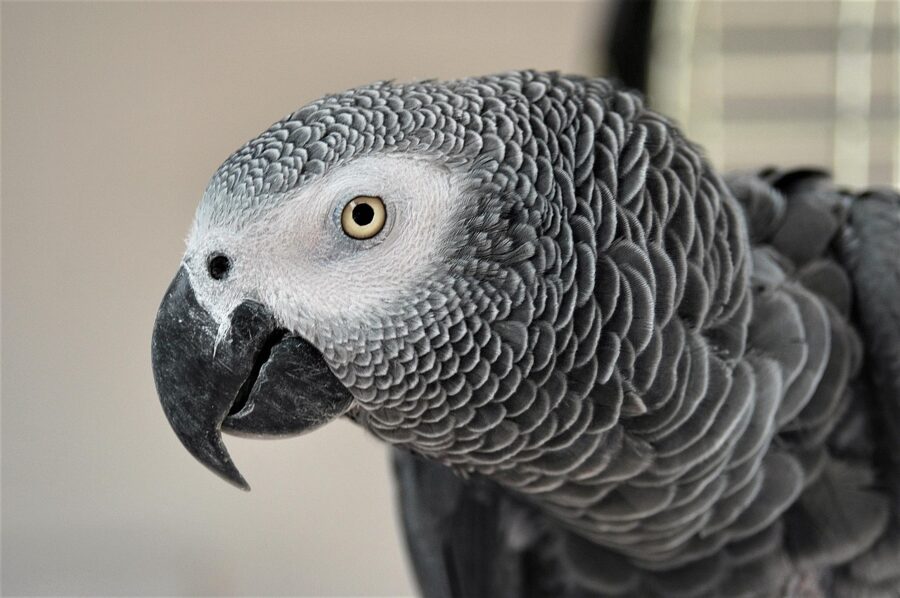
Newspapers loved her. In August 1905 she escaped through an open cage door, and the papers reported the landlord, a Mr Moore, sending waiters over the rooftops to look for her and admitting he had refused £200 for the bird. She was recaptured near Farringdon, demanding pudding. In the same year an elephant called Jumbo Junior was brought into the dining room, ate a bunch of bananas and was introduced to her.
Later stories become harder to check. Princess Mary is said to have stroked Polly’s head in 1919 while opening a women’s club in the court, and Charlie Chaplin talked to her on a visit in 1921. The best-known tale, that on Armistice Night in 1918 she imitated so many champagne corks that she fainted, has no contemporary source I could find and is almost certainly too good to be true.
Polly died in October 1926, of pneumonia according to the reports. The pub says the BBC announced her death and that around 200 newspapers around the world ran obituaries; headlines from China, India and the United States survive in later accounts. She was stuffed, and after a spell elsewhere she is back in the front bar where she made her name.
The pudding, then and now
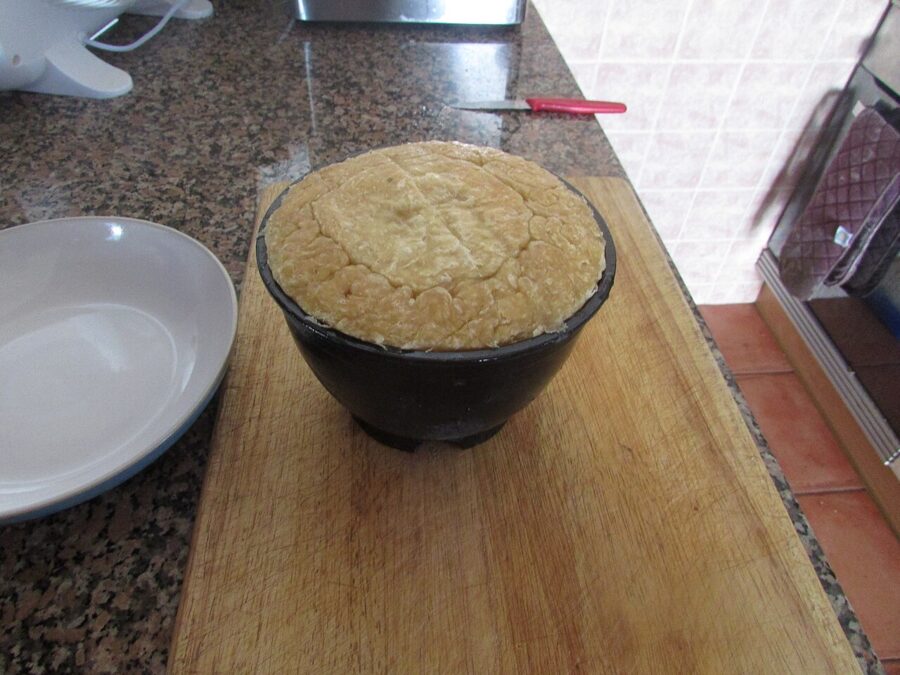
In the late nineteenth century the Cheese was as famous for one dish as for any writer. “The pudding” was a steak and kidney pudding of absurd size: the house history, quoting an 1887 newspaper, puts it at 50 to 80 pounds, with gossip of one reaching a hundredweight. Inside went beefsteak, kidneys, oysters, mushrooms, larks and spices, and it was boiled for sixteen to twenty hours before being carved at the table on Wednesdays and Saturdays in the colder months.

The stories around it are wonderful. The head waiter, William, went round the room asking “Any gentleman say pudden?” until a customer growled that no gentleman did.
In 1891 a pudding sent to a customer in New York was held at the customs house while officials argued over what duty applied to larks. And once, the house history admits, a waiter slipped and the whole pudding rolled across the sawdust in front of fifty diners, who put on their hats and left in silence.
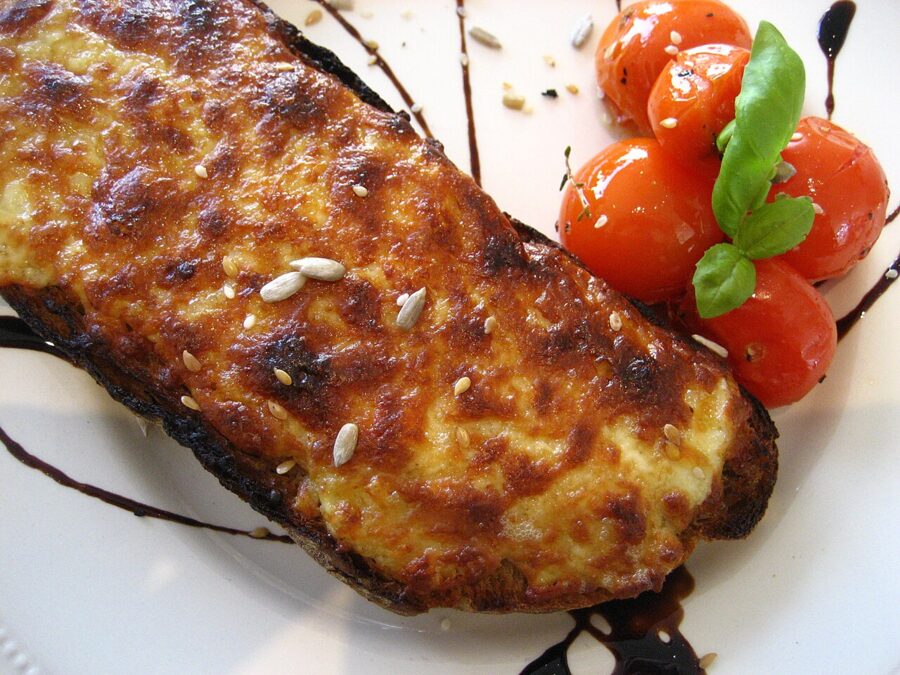
Today the Cheese calls itself a chop house, and the menu that went up in spring 2026 is shorter and saner. The house steak and kidney suet pudding costs £19.95, with no larks. From the grill there is a Barnsley lamb chop at £21.50, with a devilled kidney for £3 more, and an 8oz rib eye at £32.50. The starters include devilled kidneys on toast at £10.25 and a Cheshire cheese rarebit with chilli jam at £9.50.

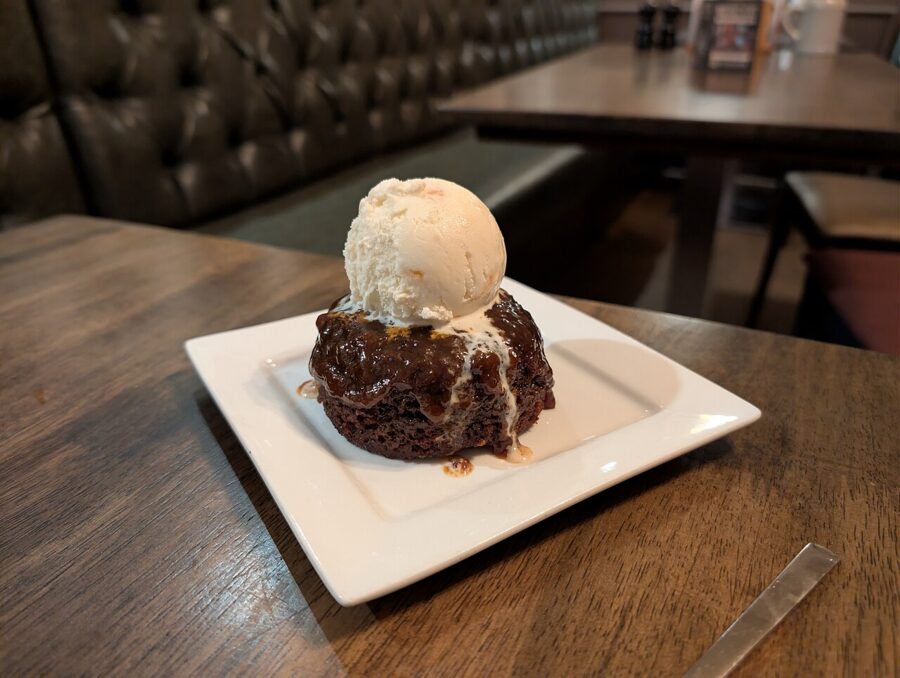
Puddings are all £8.50, and the sticky toffee pudding with honeycomb ice cream is the one to order. The cheese board leads with Mrs Appleby’s Cheshire, an unpasteurised cheese from a Shropshire farm, at £6.95 for a single cheese.
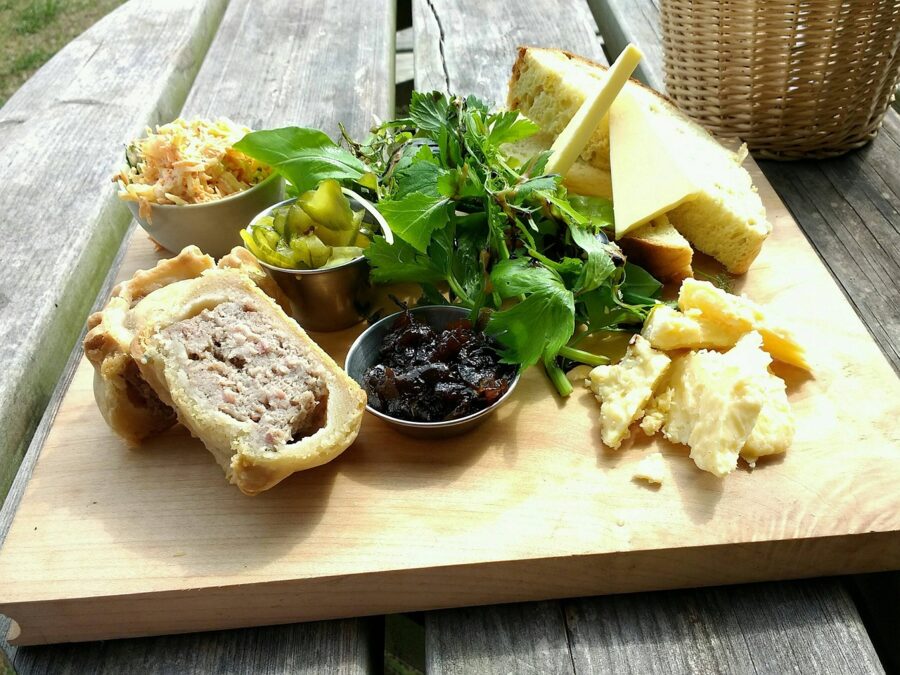
The Cellar Bar has a separate all-day menu, ordered at the bar: Scotch eggs at £8.50, hand-raised pork pie at £7.95, and a Chop House ploughman’s board with pork pie, Scotch egg, Cheshire and Stilton at £24.95 to share. On Sundays the menu switches to roasts, with 28-day aged sirloin at £26.50 and half portions for children at £9.95.
Is the food the point? Not quite. The menu is solid chop-house cooking at City prices, and you are paying something for the room. But a chop and a pint of bitter in the Chop Room, sawdust underfoot, is about as close as you can get to what the place was for, and that is worth paying for once.
Fleet Street around it
The Cheese is the best reason to come to Fleet Street, but it is not the only one, and most of what follows is within five minutes of the door. If you want a whole afternoon, do the house, the church and the crypt, then come back to the Cheese for a late lunch when the tour groups have gone.

Dr Johnson’s House
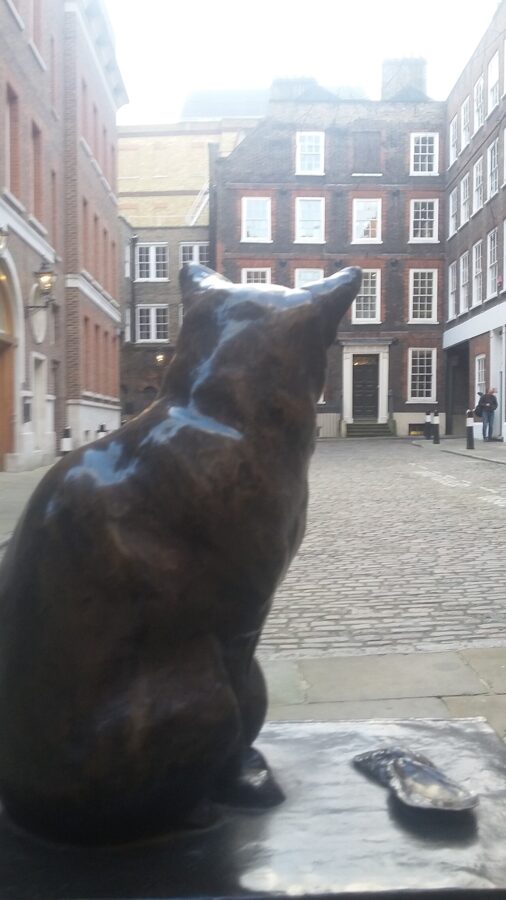
Walk up Wine Office Court and turn left at the top, and you are in Gough Square, two minutes from the bar. No. 17 is the only house Johnson lived in that survives, a brick townhouse built at the end of the seventeenth century, and the garret where he and his assistants compiled the Dictionary is at the top of it. He rented it from 1748 to 1759.
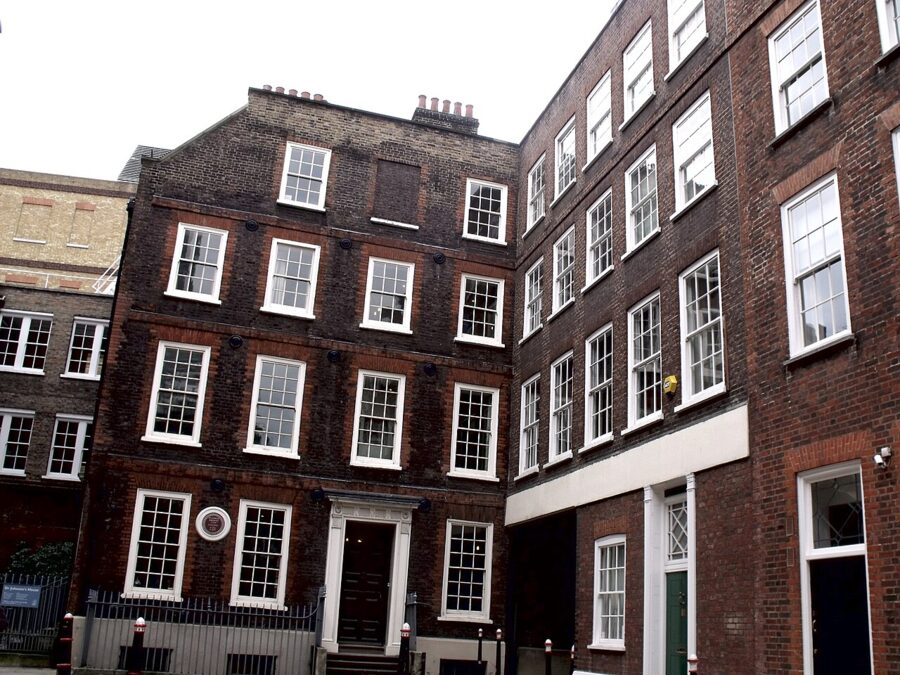

The house is open Tuesday to Saturday 10:00–17:00, with last entry at 16:30, and on Sundays 12:00–16:00, with last entry at 15:30. It is closed on Mondays and occasionally for functions. Entry is £10 for adults and £5 for children aged five to sixteen, and on Friday afternoons from 14:00 adults pay £5.

St Bride’s
Cross Fleet Street and walk down St Bride’s Avenue to the church with the wedding-cake spire. Christopher Wren rebuilt St Bride’s after the Fire; it reopened in 1675, and the steeple went up between 1701 and 1703. At 234 feet it was his tallest until lightning in 1764 forced a rebuild that took it down to 226. The church’s own history says an apprentice baker near Ludgate Circus, William Rich, modelled a tiered wedding cake on it.
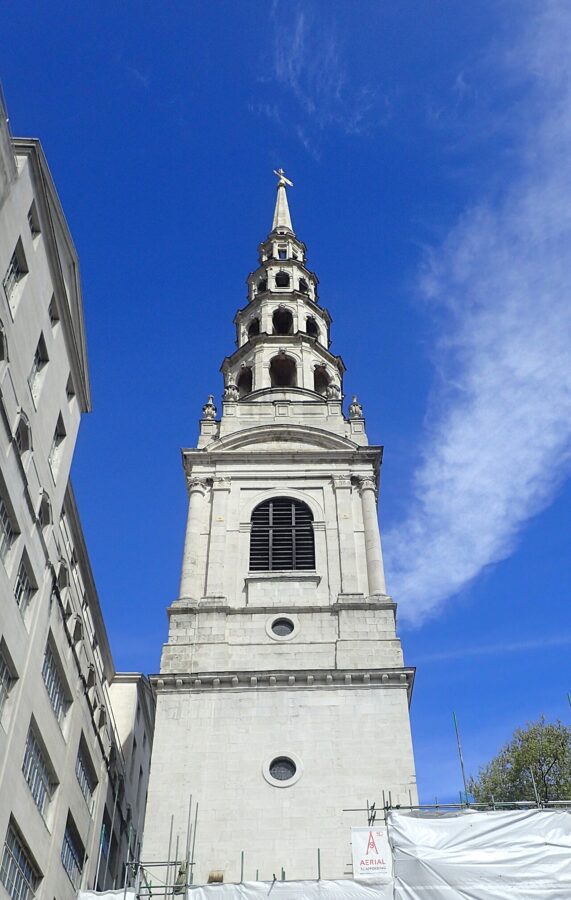

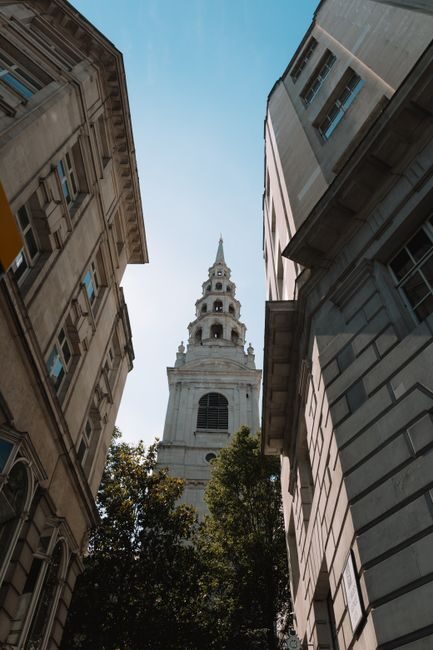
Incendiary bombs gutted it on the night of 29 December 1940, leaving only the spire and outer walls, and it was rededicated in 1957. St Bride’s is still the journalists’ church, with an altar remembering journalists killed while reporting from conflicts. It is free and open Monday to Friday 08:00–17:00, Saturday 10:00–15:30 and Sunday 10:00–18:30.
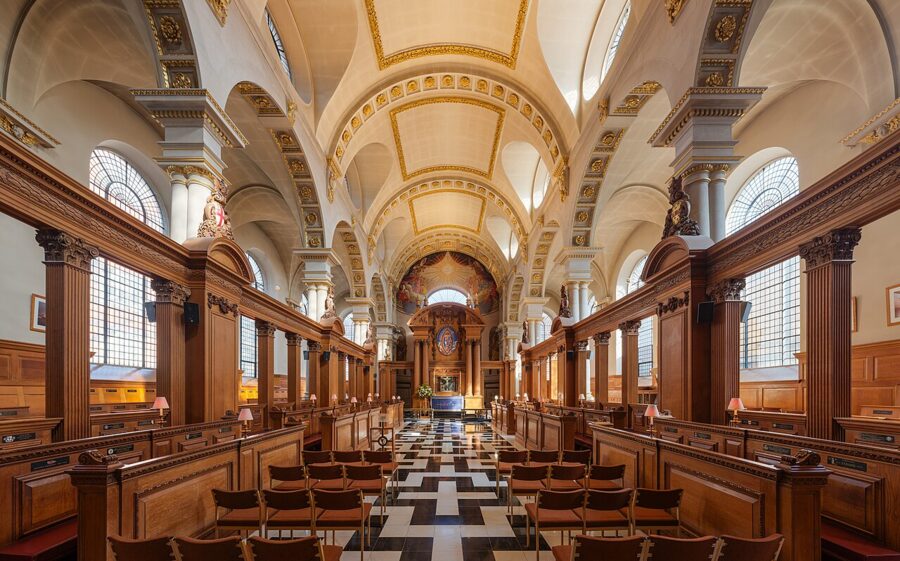

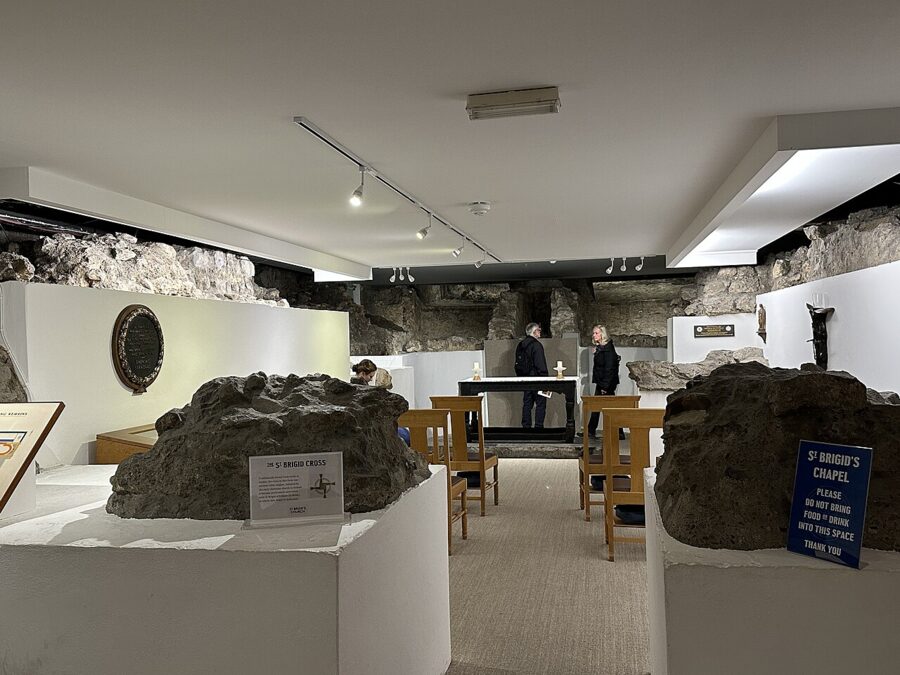
Go down to the crypt. The rebuilding after the war uncovered Roman remains on the site in 1953, a Roman pavement among them, and the vaults below now hold a small museum on the church’s long history. It is the perfect warm-up for the Cheese’s own cellars.

Three more pubs nearby
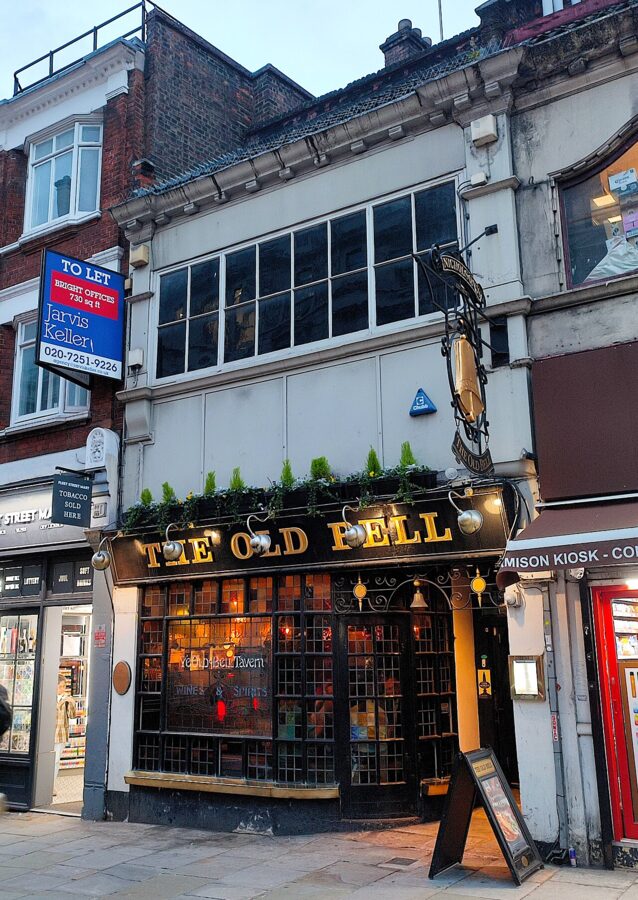
The Old Bell Tavern at 95 Fleet Street, a Nicholson’s pub, backs onto St Bride’s churchyard; the story that Wren built it to house his masons is not one I can stand behind, but it keeps a changing line of cask beers. It opens at 12:00, or 11:30 on Thursdays and Fridays, and closes early on Saturdays, at 21:00.

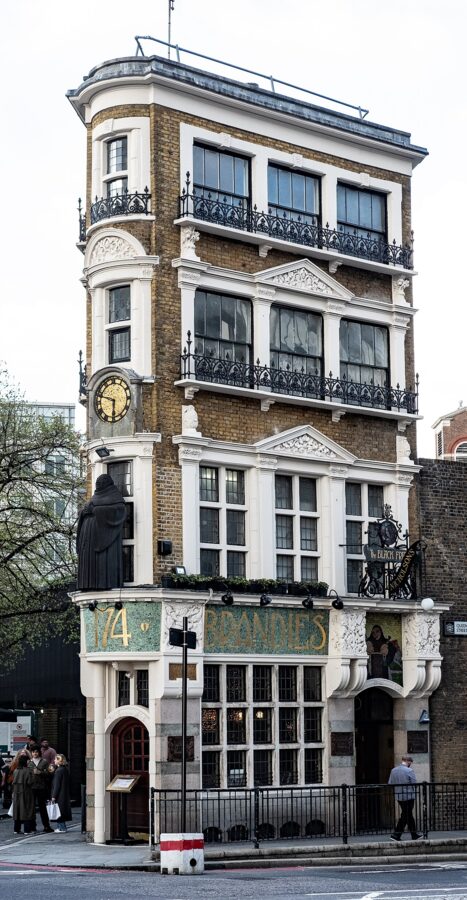
The Black Friar, opposite Blackfriars station, is about six minutes’ walk east and down New Bridge Street. Its 1905 interior, all marble and bronze friars on the theme of the Dominican house that once stood here, is Grade II* listed and the most striking pub room in the City. It is the obvious last pint before the train.

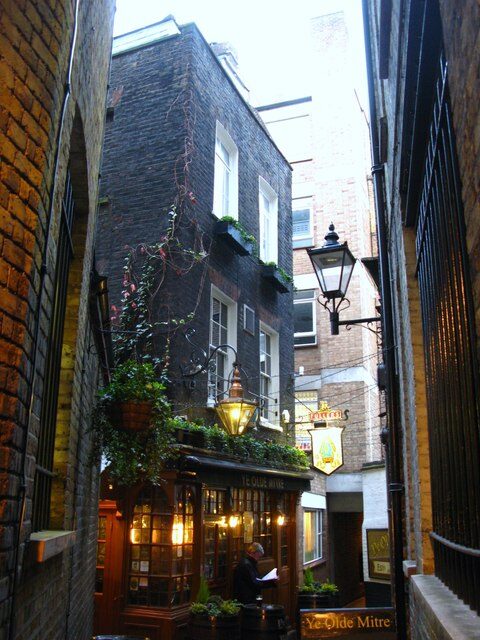
Ye Olde Mitre, up an alley off Hatton Garden about ten minutes north, is the Cheese’s natural partner for anyone doing old pubs: tiny, panelled and run by Fuller’s. Note that it opens Monday to Friday 11:00–23:00 and Saturday until 19:00, and is shut on Sundays.

How to visit
The pub is open Monday to Saturday 12:00–23:00 and Sunday 12:00–22:30. Food in the Chop Room has last orders at 14:45 for lunch and 20:45 for dinner; on Sundays food runs 12:00–18:30. The Cellar Bar menu runs all day, and the Cheshire Bar does not open until 17:00.
Book a table by phone or send a request through the form on the pub’s website; it does not take instant online bookings. Groups larger than ten should email, and food bookings for more than eight need a pre-order. For Christmas 2026, from 17 November to 23 December, there is a set menu for booked parties of ten or more at £42 for two courses or £48 for three.

The nearest station is City Thameslink, about five minutes’ walk east. Blackfriars, on the District and Circle lines, is about seven minutes, and Chancery Lane on the Central line, which the pub itself recommends, is about nine minutes north-west. Temple is a little further. Buses along Fleet Street include the 11, 15, 23, 26 and 76.
Accessibility is poor, and the pub says so plainly: it describes itself as “totally inaccessible for wheelchairs”. There is a small step at the entrance, no accessible toilet and stairs to everything except the ground-floor bars. Dogs are welcome. I could not find a stated policy on children in the bars; the Sunday menu offers children’s portions of the roasts, which tells you families do eat here.
As for crowds, I would avoid weekday lunchtimes, when City workers and tour groups arrive together, and the after-work rush from 17:00. The City empties at weekends, so Saturdays belong to visitors. My pick is a weekday from about 14:30, after the lunch rush, when in winter the fire is lit and the front bar has a free bench.
So go then. Walk in under the lantern, turn right into the front bar, ask for a pint of Old Brewery Bitter and drink it under Polly. Then walk up the court to Gough Square, which is the way Johnson would have walked home, if Cyrus Jay’s old gentlemen were right.