
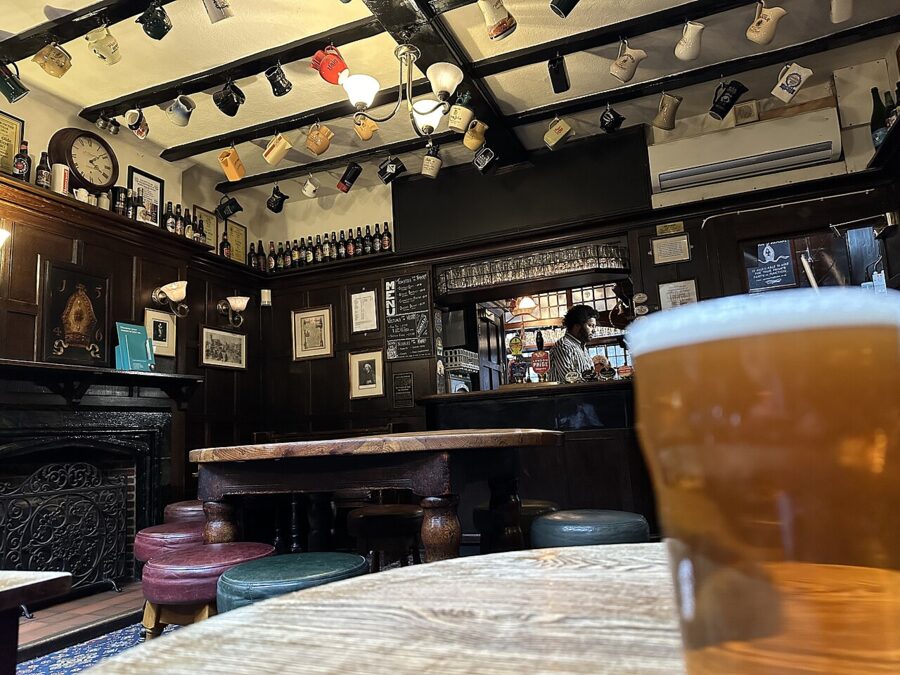
A good deal of the dark oak you will lean on in London‘s oldest-looking pubs was fitted after the First World War. The panelling in Ye Olde Mitre, a pub that dates itself to 1546, most likely comes from a refit in the 1920s or around 1930. The Tudor look of the Mayflower in Rotherhithe dates from a refit after the Second World War. The Lamb and Flag in Covent Garden had its handsome Georgian-looking front rebuilt in 1958.
None of that makes them fakes. It makes them London pubs, which have been burnt, bombed, bought by breweries and dressed up in older clothes for as long as there have been pubs to dress. The trick is knowing which bits of a building are genuinely old, which are a later “olde” job, and which are old in a way nobody planned: a Victorian gin palace that has now outlived everyone who sneered at it.

Below, district by district, are the pubs with a real claim to age, what is original in each, and two walks that string the best of them together. Every pub named was trading in 2026, but London pubs change hands fast, so check the hours before you cross town for one.



On this page
Why so few London pubs are actually old
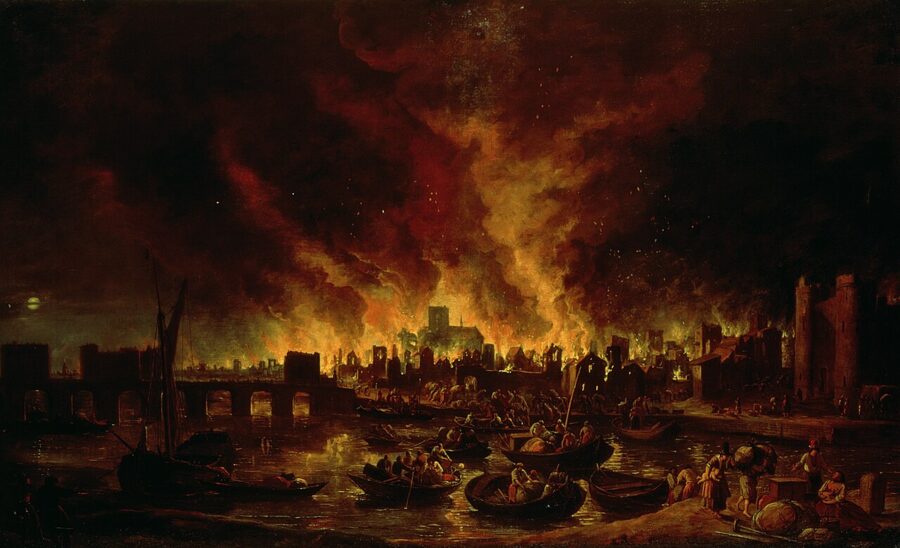
Start with the fire. Between 2 and 6 September 1666 the Great Fire burnt out most of the walled City: around 13,200 houses and 87 parish churches. It reached as far west as the Temple and Fetter Lane, and stopped short of the Tower in the east. Every tavern inside that line went with it, which is why the City’s “oldest” pubs nearly all have a rebuilding date of 1667 or later painted somewhere near the door.
Then came the Victorians, who did more damage to old pubs than the fire did. The railways cut through Southwark and the City, taking coaching inns with them, and the pub-building booms of the 1860s to 1890s replaced timber taverns with brick, plate glass and mahogany. A large share of the pubs you would call “traditional” in London today were built between about 1870 and 1900.
The third layer is the one that fools people. From the late nineteenth century, and especially after the Licensing Act of 1904 set up compensation for closing surplus pubs, brewers rebuilt fewer, bigger houses and wanted them to look respectable and ancient. Between the wars that meant mock-Tudor: leaded lights, dark panelling, heavy beams. It is often called brewers’ Tudor, and a good deal of what visitors photograph as Elizabethan London is in fact interwar London doing an impression of it.
The “Ye Olde” on the signboard belongs to the same fashion. The “Y” stands in for an old letter, the thorn, which was pronounced “th”, so “ye” was always read “the”. Sign painters revived it because it looked quaint, and quaint sold beer.
How to read an old pub before you order
Three questions get you most of the way. First, is the building listed, and at what grade? Historic England’s list entries are plain about dates, and they will tell you when a front was “refaced” or an interior “much altered”.
Second, is the interior on CAMRA’s National Inventory of Historic Pub Interiors? Its star ratings judge the fittings, not the legend, and they rate a 1950s refit as happily as a Georgian one if it survives intact.
Third, read the wording on the sign. “Established 1546” and “site of a tavern since 1520” are claims about a plot of land. “Rebuilt 1667” is a claim about the bricks. The two are not the same, and the pubs know it.
Fleet Street and the City
The City is where the “oldest pub” arguments are loudest and the buildings youngest. That is not a criticism. A post-Fire pub on a medieval alley, rebuilt in 1667 and still pouring, is as old as a London pub gets inside the walls, and two of the best in the country are within a ten-minute walk of each other here.
Ye Olde Cheshire Cheese
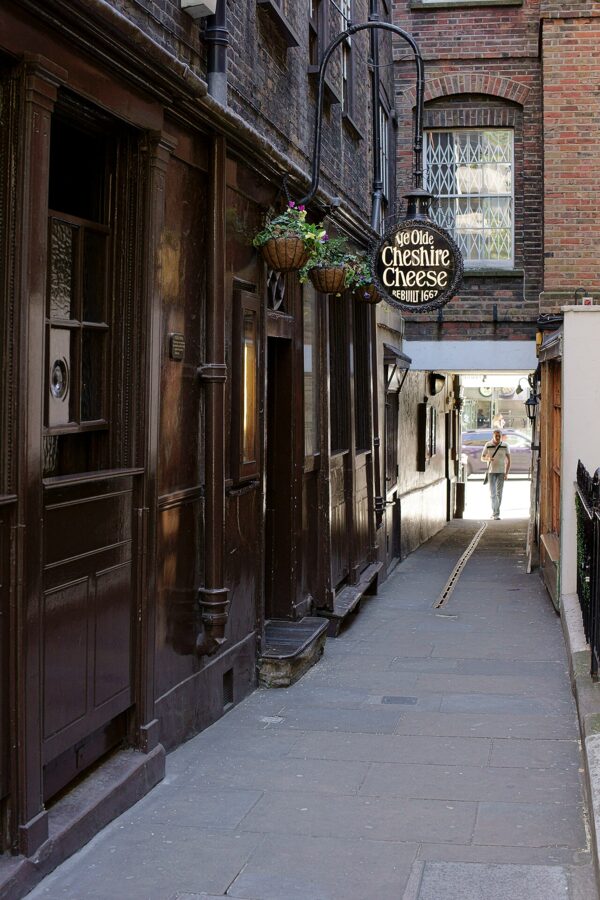
You find the Cheese up Wine Office Court, a passage off the north side of Fleet Street, under a lantern that has been photographed more than most cabinet ministers. The sign says rebuilt 1667, the year after the fire, and Historic England agrees with it in substance: a late seventeenth-century building, “very much altered”, with a yellow-brick front added in the late eighteenth century and heightened in the nineteenth. Under a small courtyard there is a late seventeenth-century vaulted cellar.

The legends need a pinch of salt. The vaulted cellars are often said to be from a thirteenth-century monastery; the listing dates them to the late 1600s. Dr Johnson lived around the corner in Gough Square and his portrait hangs inside, but there is no record of him drinking here. Dickens, on the other hand, sent Sydney Carton and Charles Darnay to a tavern up a covered way off Fleet Street in A Tale of Two Cities, and it is hard to read it as anywhere else.
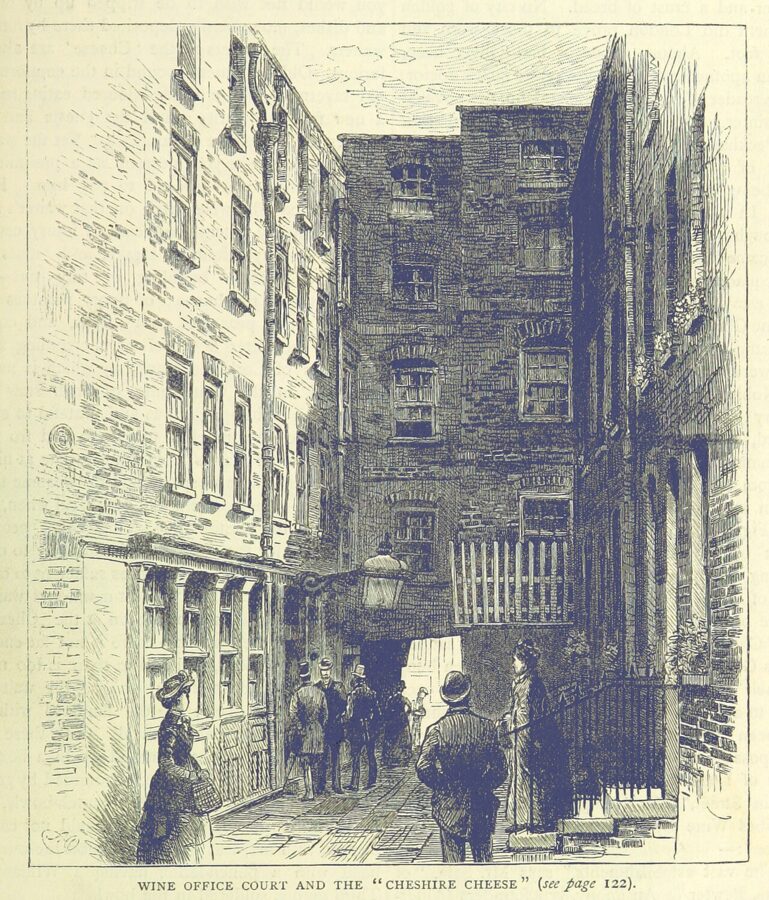
What is genuinely old is the pair of rooms by the entrance: old panelling, a Victorian bar counter, a big fireplace that is lit in winter. In 1992 the pub was extended east into the buildings next door, which is why it now rambles across three levels and at least nine drinking areas. Polly, the parrot who swore at customers for around forty years, died in 1926 to obituaries in newspapers around the world.
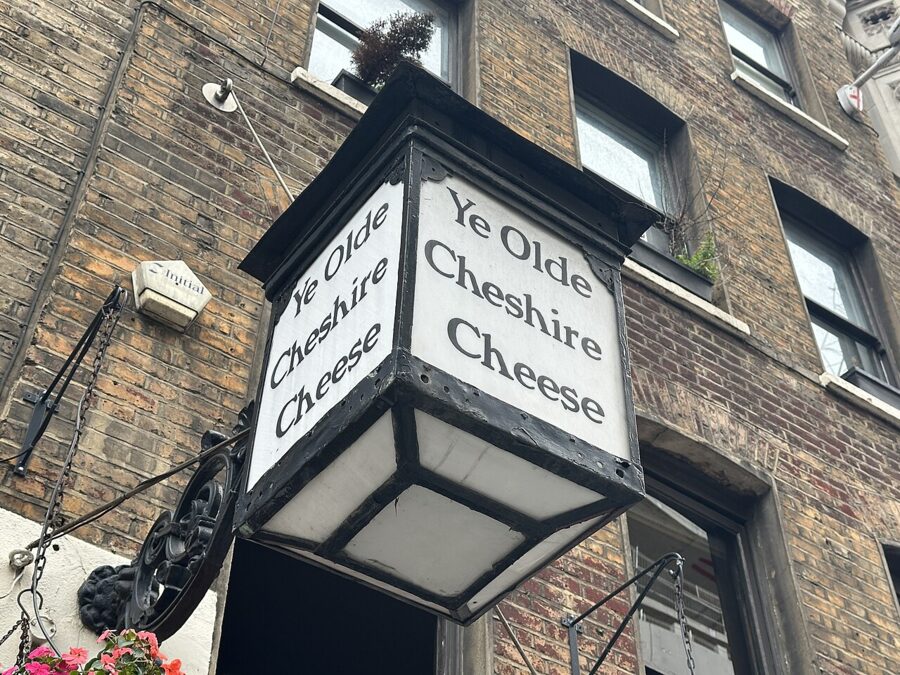

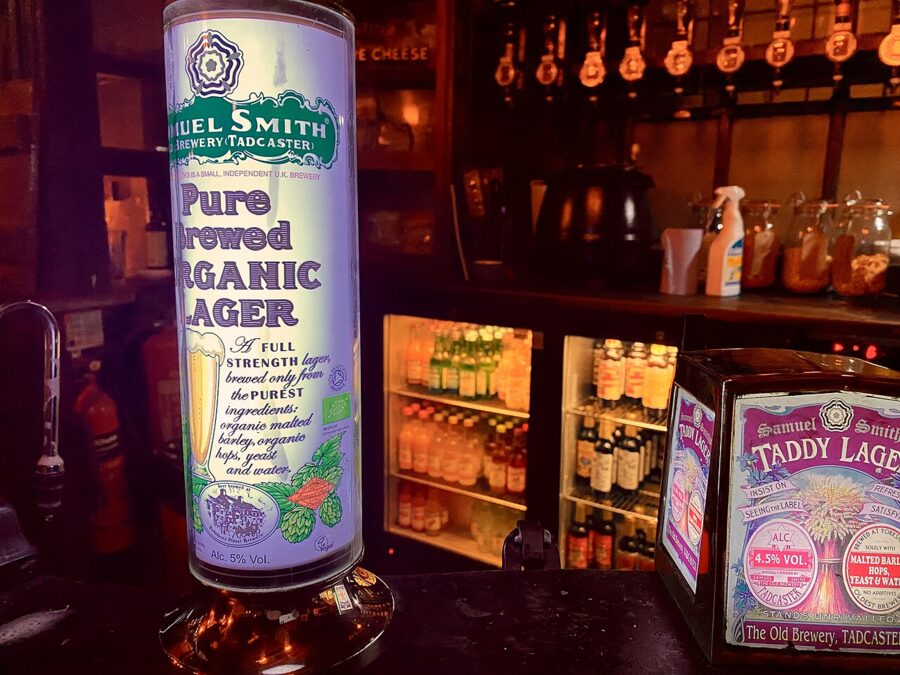
It is a Samuel Smith’s house, which tells you how it runs: the brewery’s own beers only, Old Brewery Bitter as the single cask ale, no music and no television. Food is served at lunch and in the evening, with last orders at 14:45 and 20:45 (12:00–18:30 on Sunday), and dogs are welcome. I would sit in the front room on the left and leave the cellar bars to the tour groups.

The Cheese deserves a whole article to itself, and it will get one. For this walk, it is the anchor of Fleet Street.
Ye Olde Mitre
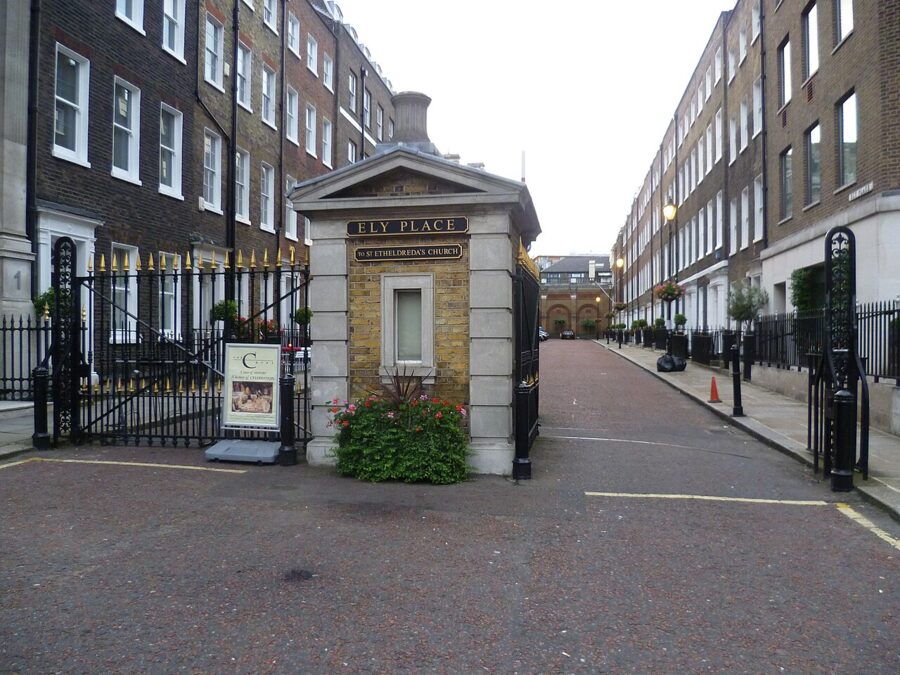
The Mitre is the pub you walk past twice. It sits at the end of Ely Court, a passage about as wide as a wardrobe that runs between Hatton Garden and Ely Place, and the only clue from the street is a lamp and a small sign. The tavern is said to have been founded in 1546 for the servants of the Bishops of Ely, whose London palace stood here.
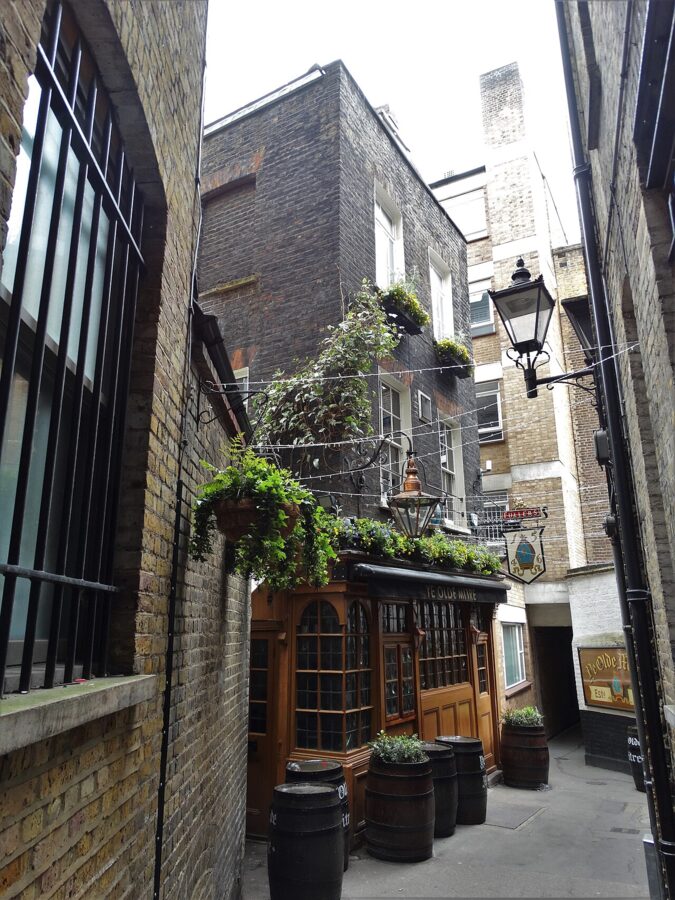

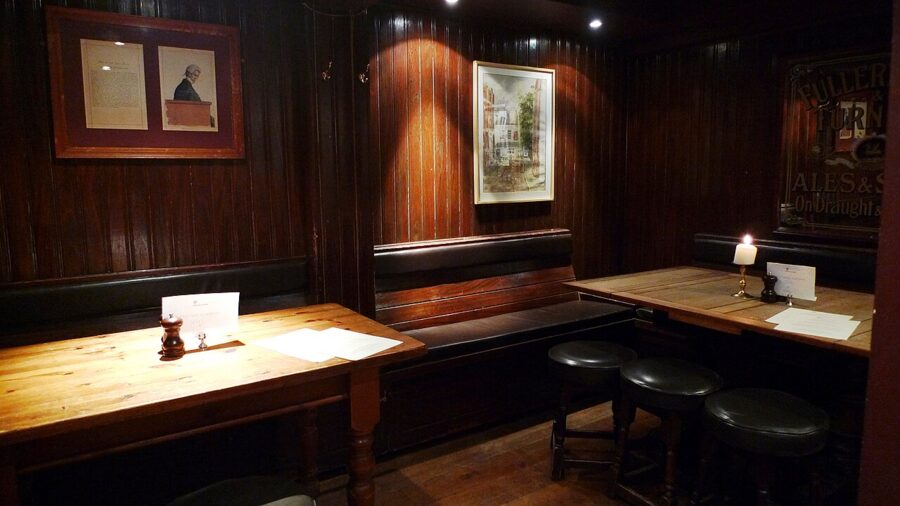
What stands now is younger. The Crown took over the area in 1772, the site was cleared, and the present building dates from about 1773. The panelled interior, the bar counters and the Tudor-style fireplaces come from an early twentieth-century remodelling, and the upstairs room was fitted out around 1990. CAMRA still gives the interior three stars, and rightly, because it has barely been touched since.
In the corner of the front bar, behind glass, is a tree trunk said to be a cherry tree that marked the boundary between the bishop’s garden and land leased to Sir Christopher Hatton. The story that Elizabeth I danced round it is the kind of thing I enjoy and do not believe. The tiny snug is called Ye Closet, and if it is empty, take it.


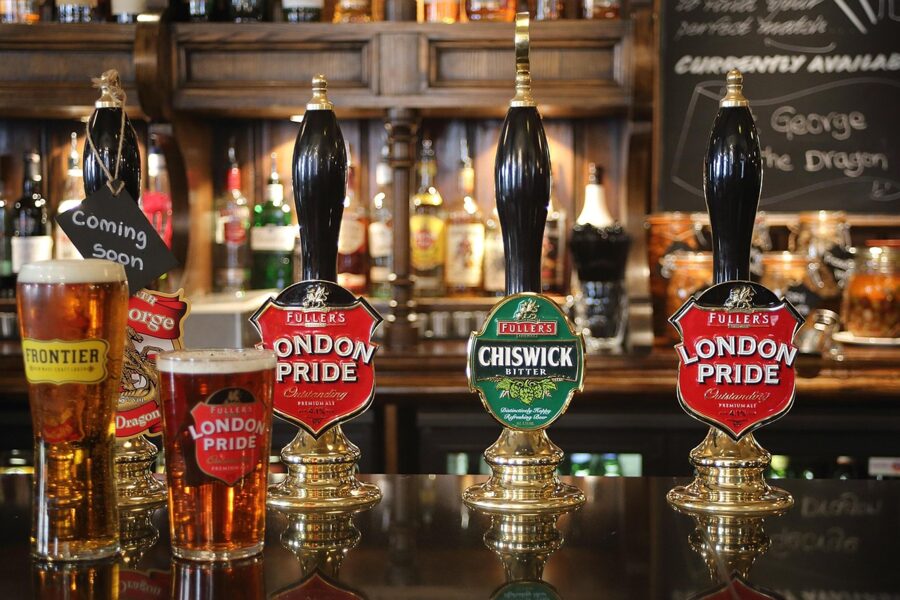
Fuller’s has run it since 2009, with London Pride as the regular and up to five changing cask beers, and it was the local CAMRA branch’s Pub of the Year in 2025. The hours are the catch: 11:00–23:00 Monday to Friday, 11:00–19:00 on Saturday, and shut on Sunday. Farringdon station is about 500 metres away.
The Seven Stars
Carey Street runs along the back of the Royal Courts of Justice, just outside the line the fire reached, and the Seven Stars has been there long enough to be a contender. The frontage is dated 1602. Historic England says “perhaps C17 in origins”, with a painted brick skin over a partial timber frame; CAMRA thinks the building probably dates from the 1680s, with an extension in 1878.
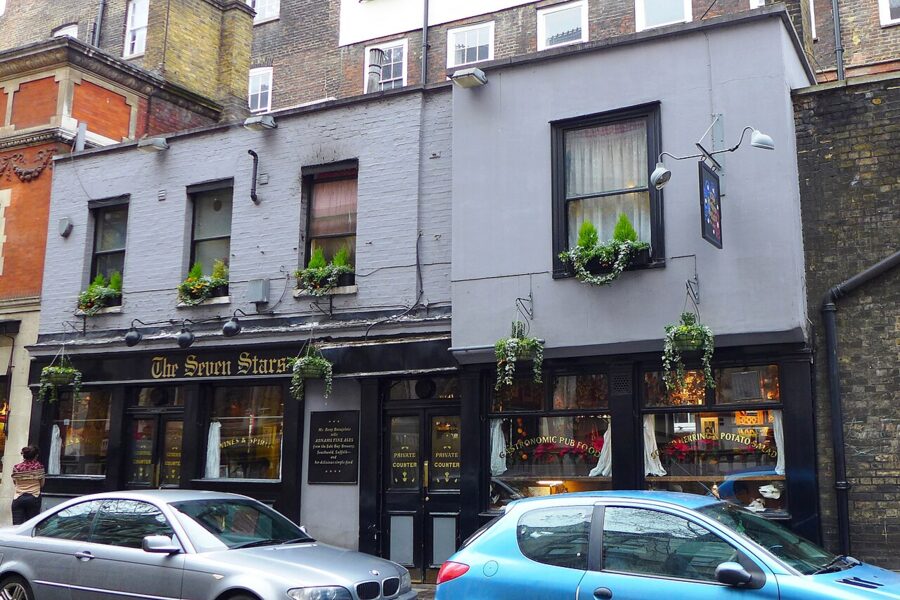

Inside are two small rooms with nineteenth-century bar-backs and mirrors, a corner fireplace of about 1900, and thin ceiling beams of the same date laid over the older framing. It is the best example in this guide of a genuinely old building wearing its later fittings openly. The toilets are up a steep, narrow stair behind the bar, and you will be sober by the top.
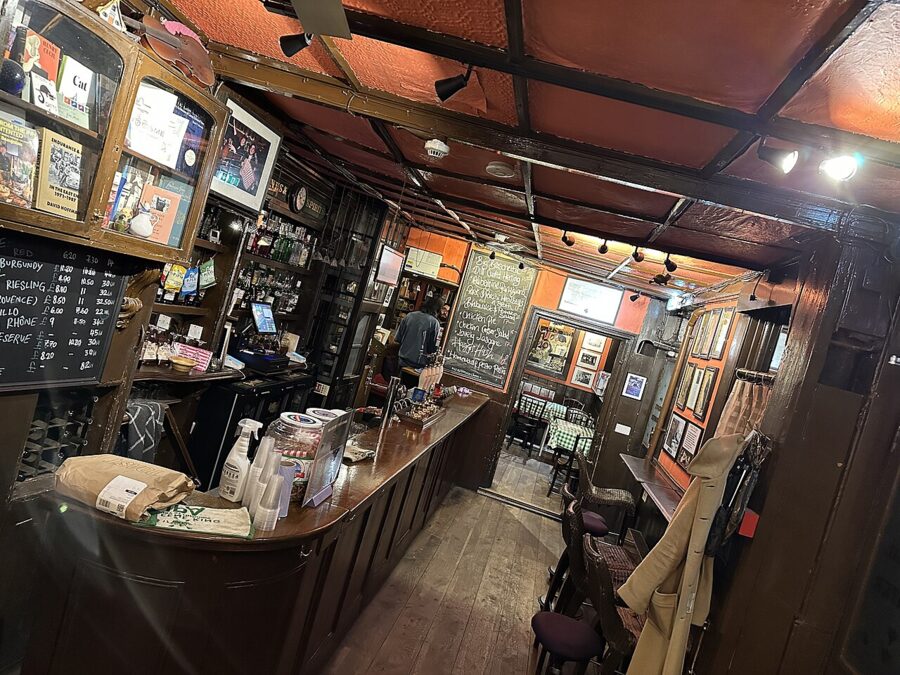

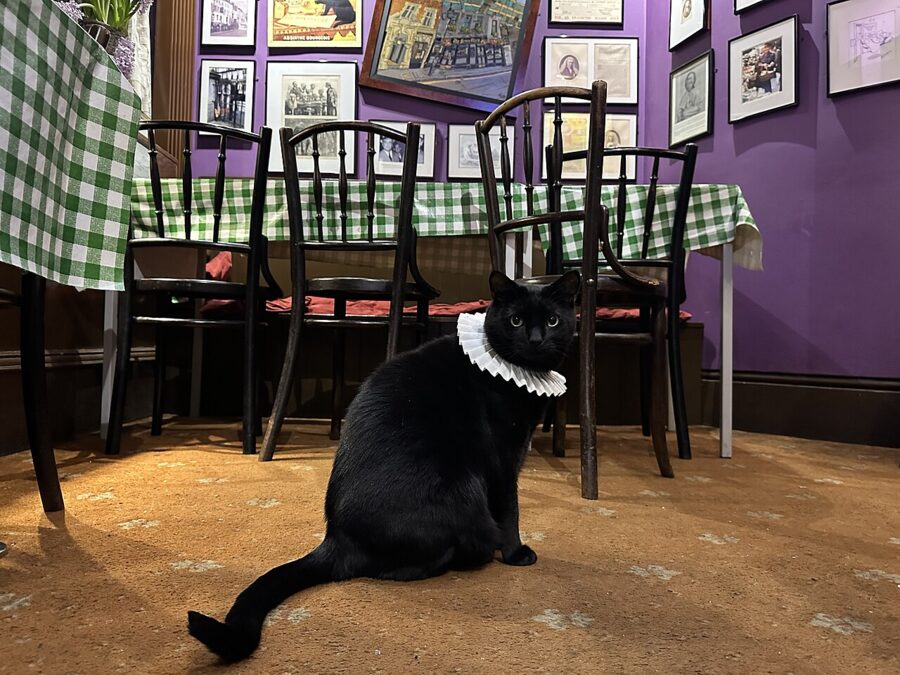
It is a free house that takes its real ale seriously: Adnams Broadside and Ghost Ship are regulars, with a changing guest, and the kitchen cooks proper food from noon until 21:30 on weekdays and from 13:00 at weekends. The pub has a resident cat. Chancery Lane station is about 550 metres away and Temple about 700.

The Black Friar
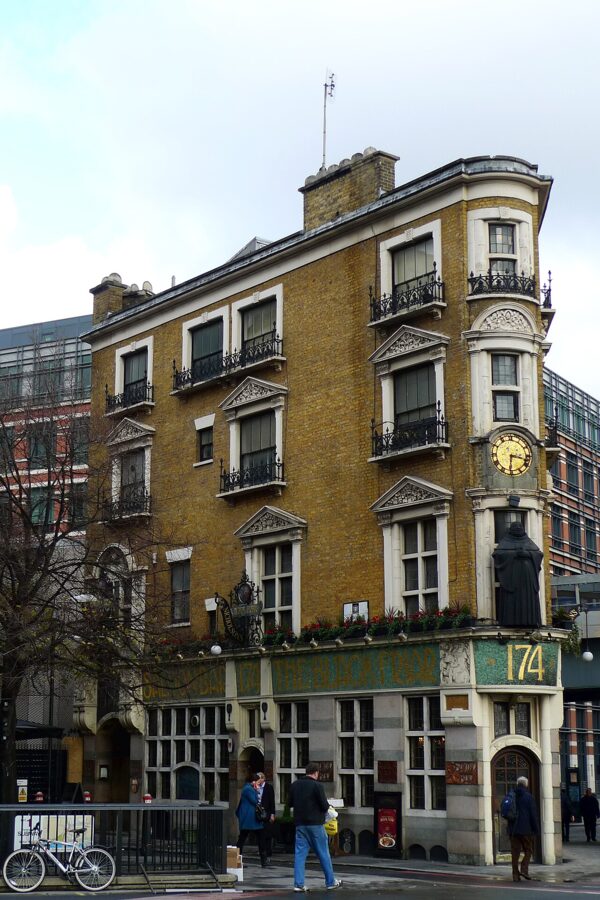
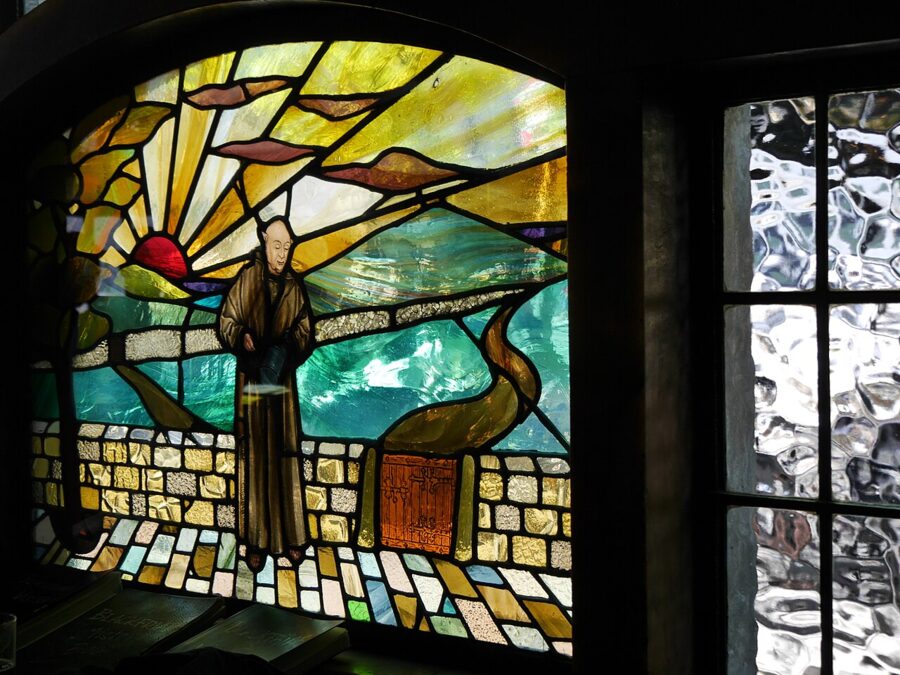
Now a different kind of old. The Black Friar is a wedge of a building on the corner of Queen Victoria Street and New Bridge Street, put up in about 1875 on the site of a Dominican friary. Between about 1905 and 1917 the architect H. Fuller Clark and the sculptors Frederick Callcott and Henry Poole turned its insides into the finest Arts and Crafts pub interior in the country.

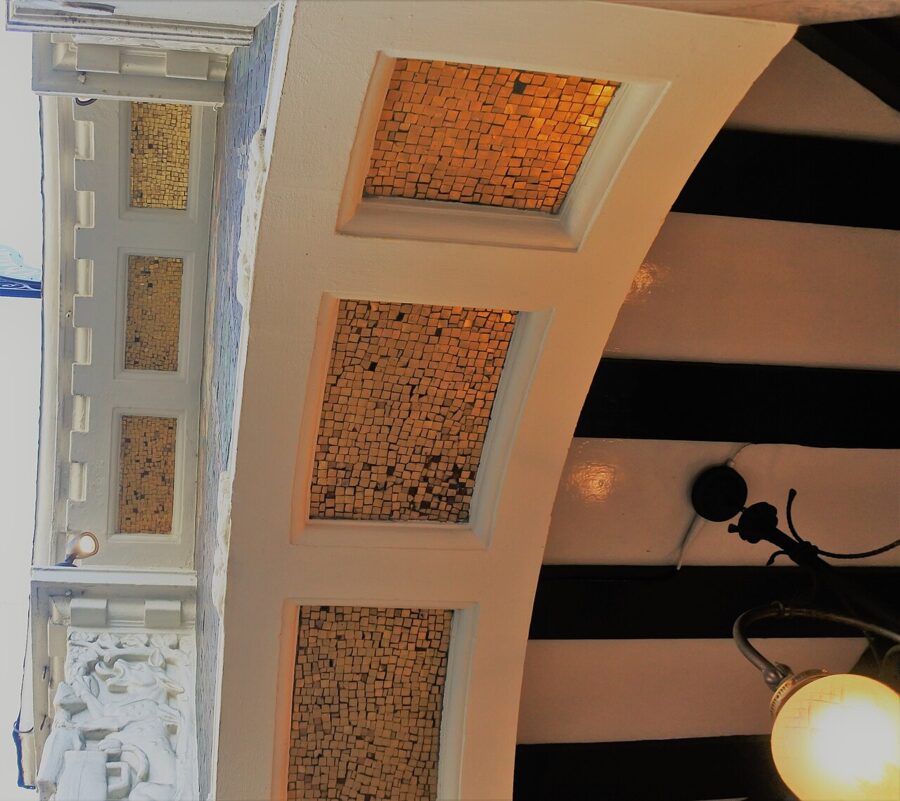
Every surface is about monks. Bronze reliefs above the bar show friars catching fish under the title “Tomorrow will be Friday”; others garden, do the laundry or push a trussed pig in a wheelbarrow. At the back is the Grotto, a small barrel-vaulted room dug out of a railway vault and finished in 1917–21, with mosaic ceilings, marble ribs and gilded mottoes such as “Haste is slow”.
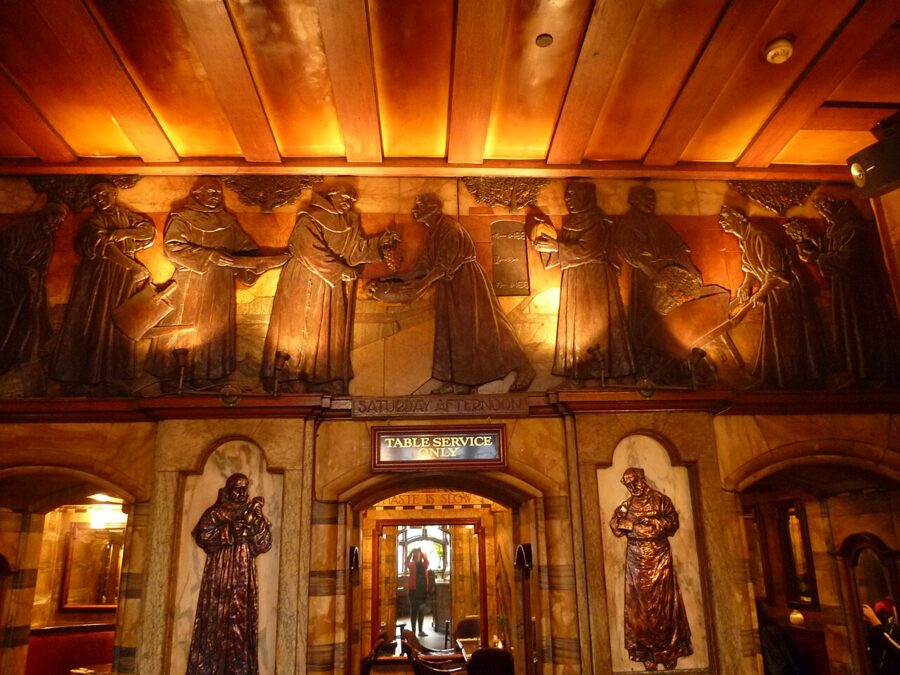

In the 1960s the building was threatened with demolition, and John Betjeman was among those who campaigned to save it. It is now listed at Grade II* and rated three stars by CAMRA, which puts it level with buildings two centuries older. That is the point I would make about it: in 1905 it was a theme pub, and a century on it is one of the most important historic interiors in London.

It is a Nicholson’s pub with London Pride, Nicholson’s Pale Ale and Tribute as regulars and pies on the menu. Food runs 11:30–21:00 Monday to Saturday and 12:00–20:00 on Sunday, and children are welcome, as are dogs outside the restaurant area. The after-work crush between 17:00 and 19:30 is real; at three in the afternoon you can study the reliefs in peace.
The Hoop and Grapes, Aldgate
At the other end of the City, on Aldgate High Street, the Hoop and Grapes is the strongest case for a building that predates the fire’s aftermath rather than following it. Historic England lists it at Grade II* as a timber-framed house of “probably late C17”, one of a type once common in London and now very rare, with carved posts at the entrance that may be seventeenth century. The pub’s own claim is 1593.
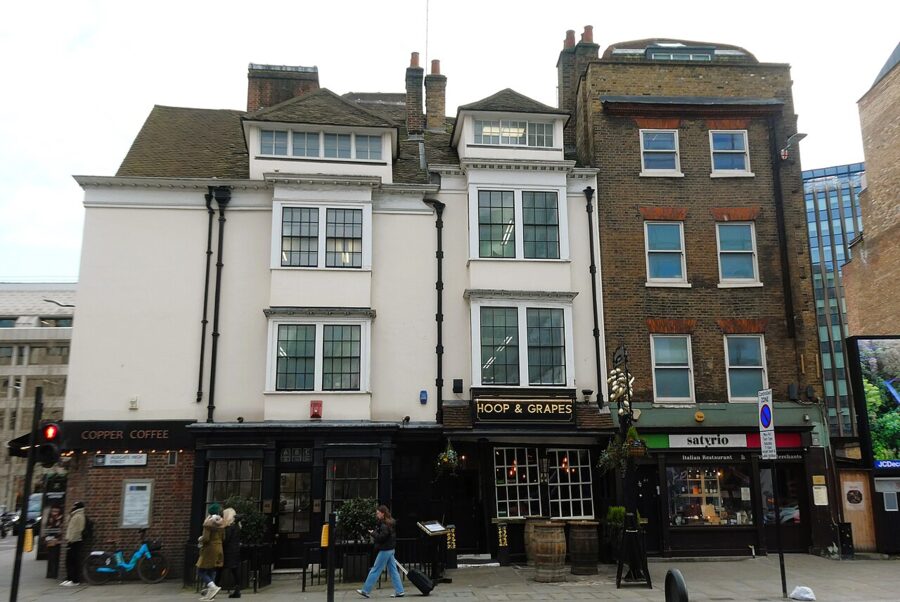

You will hear that the fire stopped fifty yards from the door. The fire stopped some way short of Aldgate, so I would not lean on that story. The building is the thing: a leaning, low-ceilinged house that has watched Aldgate be rebuilt around it several times over. It is a Nicholson’s pub, open seven days, with Timothy Taylor’s Landlord among the regulars and food until 22:00 on weekdays.
Southwark and the river
South of London Bridge, Southwark was the City’s back door: inns for travellers coming up from Kent and Sussex, theatres, bear pits and everything else the Corporation would not have within its walls. The fire of 1666 did not cross the river, but Southwark had its own in 1676, and the railways took most of what survived.
The George Inn
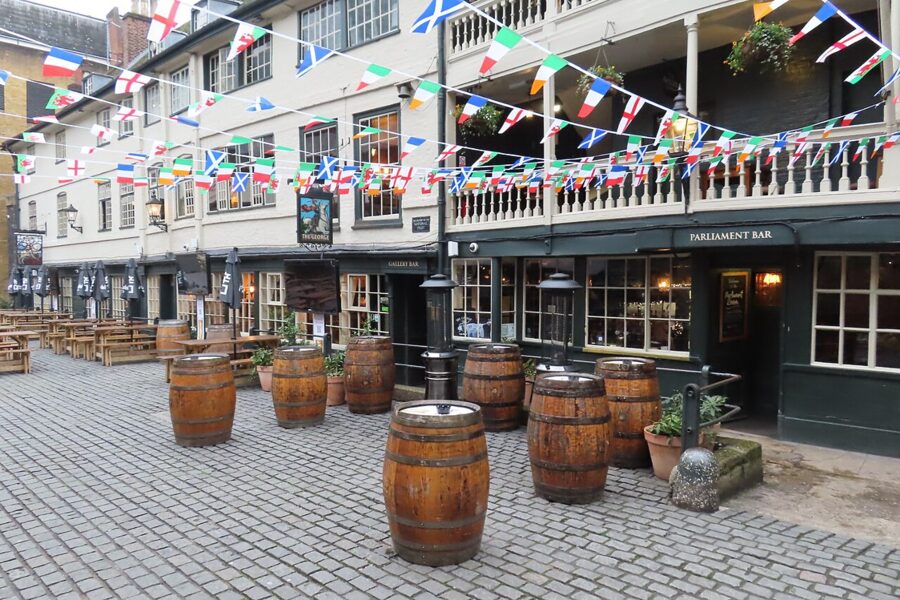
The George is the last galleried coaching inn in London, and the only pub in this guide listed at Grade I. An inn stood here by the sixteenth century; it burnt in the Southwark fire of 1676 and was rebuilt straight away round the same yard. Coaches left from here for the south, and passengers slept in rooms off the open galleries.
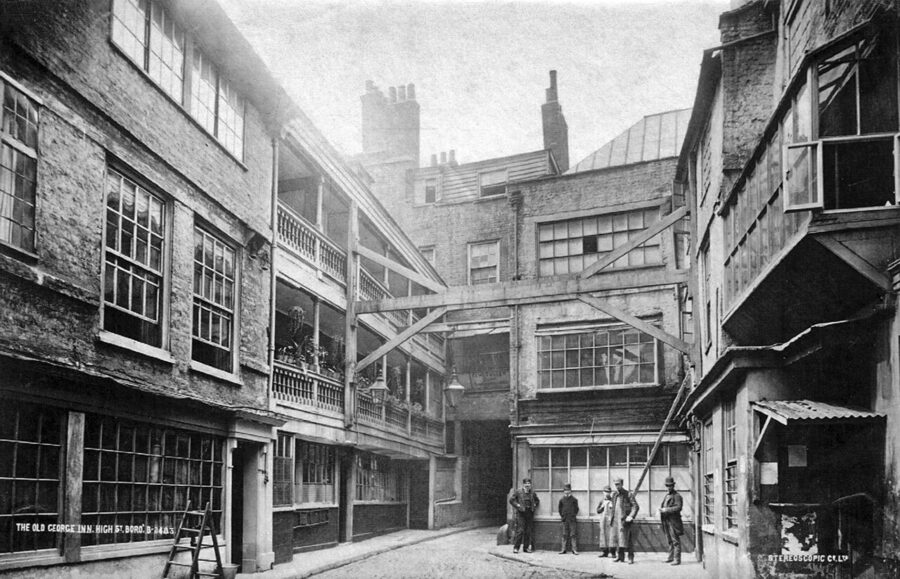
The railway age nearly finished it. The Great Northern Railway bought it as a goods depot and in 1889 pulled down most of the galleried ranges, leaving the south range alone. The National Trust took it on in 1937 and leases it to Greene King, which runs it as a pub.
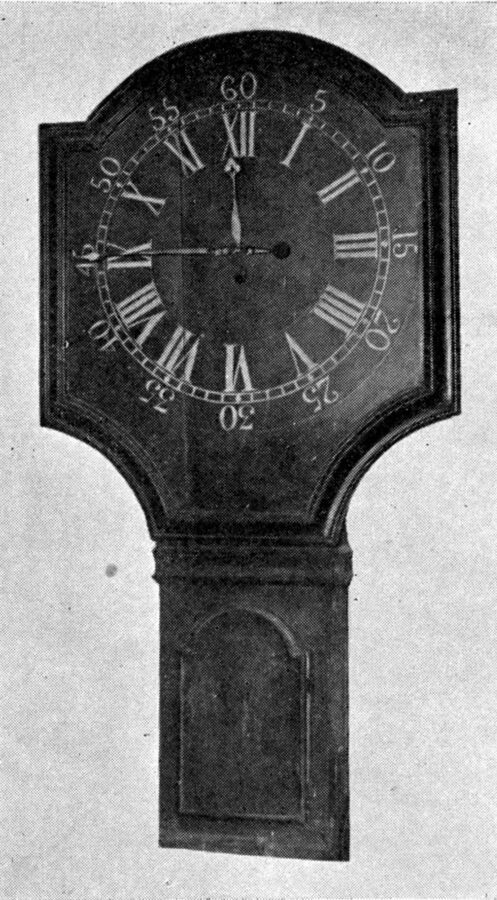
Start in the Parliament Bar. It has old woodwork and a rare set of disused Victorian handpumps of the “cash register” type, and the building keeps an early eighteenth-century staircase and panelled rooms upstairs. The Middle Bar was once the coffee room, and Dickens, who knew the inn, mentions it in Little Dorrit. Ignore anyone who tells you Shakespeare drank here: the building is sixty years too late, though an earlier inn on the site would have been open in his day.
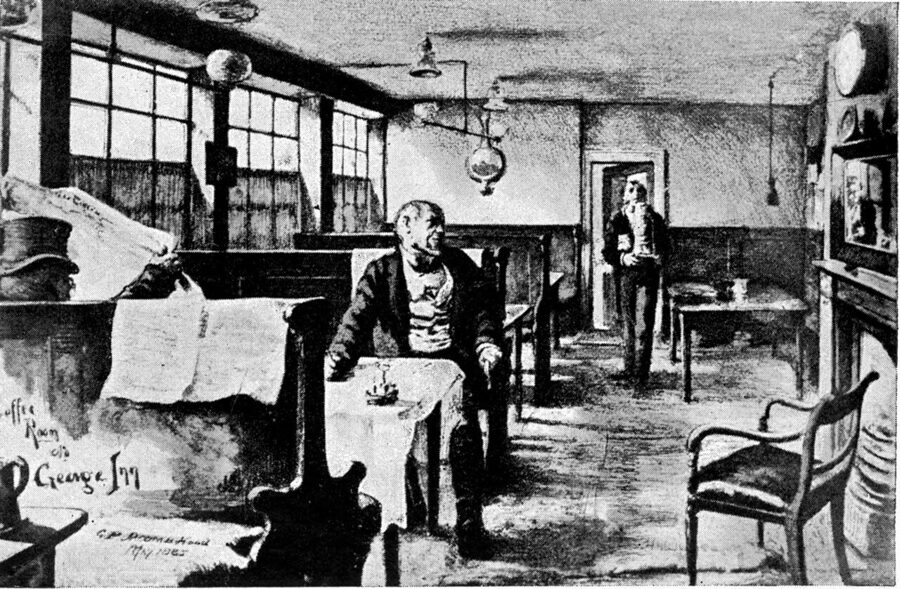
The beer is Greene King with house ales called George Inn Ale and Golden George, plus guests; I come for the building. It opens 11:00–23:00, until midnight Thursday to Saturday, with food until 22:00, and the upstairs gallery bar is not always open. London Bridge station is about 300 metres away, and on a summer evening the yard is solid with office drinkers from 17:30.
The Anchor, Bankside
Five minutes west along the river is the Anchor, on the corner of Bankside and Park Street. Its claims are large; the listing is short and blunt. It describes a mid to late eighteenth-century pub with an early eighteenth-century kitchen fireplace, an early eighteenth-century staircase and a complete pine-panelled room upstairs called the Shakespeare Room. Then it adds that much of the timberwork in the rest of the building “is imitation”.
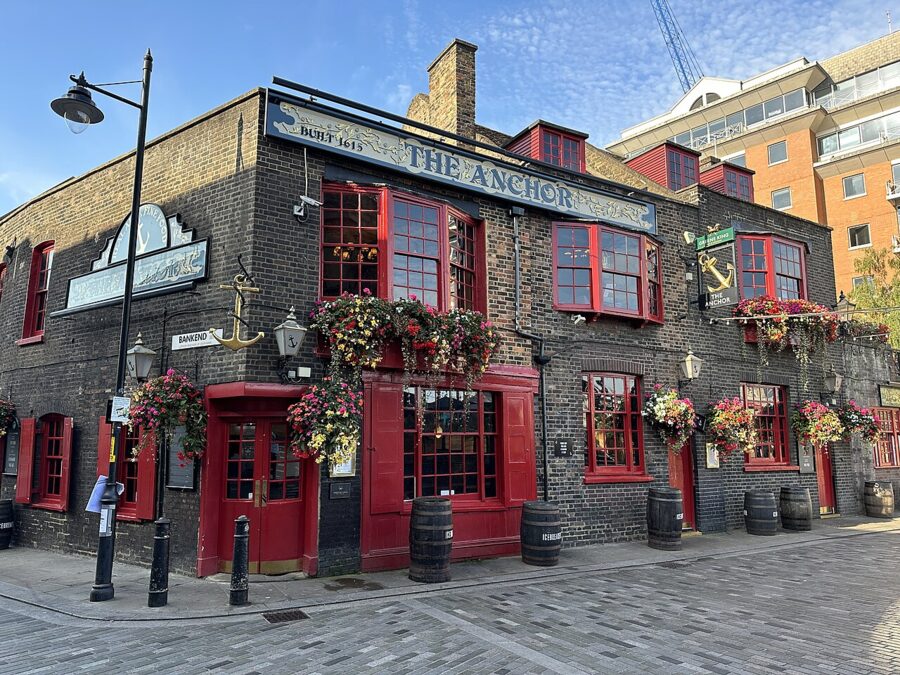

The most famous story attached to it belongs to Samuel Pepys. On 2 September 1666, driven off the water by the heat, he went into “a little alehouse on the Bankside” and watched the City burn until it was almost dark. The Anchor would like that alehouse to be its predecessor; nobody can prove it either way. It is a Greene King pub with food all day, and London Bridge station is about 700 metres away.
Wapping and Rotherhithe
Downstream, beyond Tower Bridge, the river pubs are the old waterside taverns of the docks, now standing among warehouse flats. Wapping High Street is one of the quietest streets in central London on a weekday afternoon, which makes these pubs far more pleasant than their reputations for pirates and hangings would suggest.
The Prospect of Whitby
The Prospect claims to be London’s oldest riverside pub, with a tavern here from around 1520. It has been called the Pelican and, unofficially, the Devil’s Tavern; the current name comes from a Tyne collier, the Prospect, that used to berth alongside. Execution Dock, where pirates were hanged at low water, was a short way upstream.
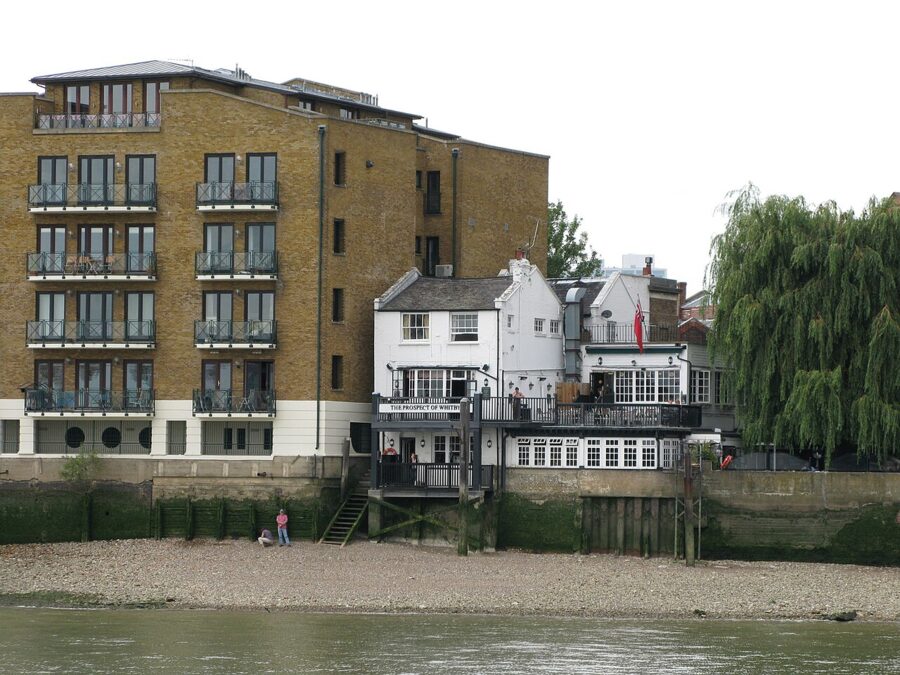

Historic England’s verdict is the most useful thing ever written about the place. The front was refaced in the early nineteenth century, the interior is “much altered”, and a little eighteenth-century panelling survives upstairs; the building is listed mainly for its associations and as a surviving riverside inn. The flagstone floor and the pewter-topped bar are what people come for, and the pewter, at least, is very good to lean on.
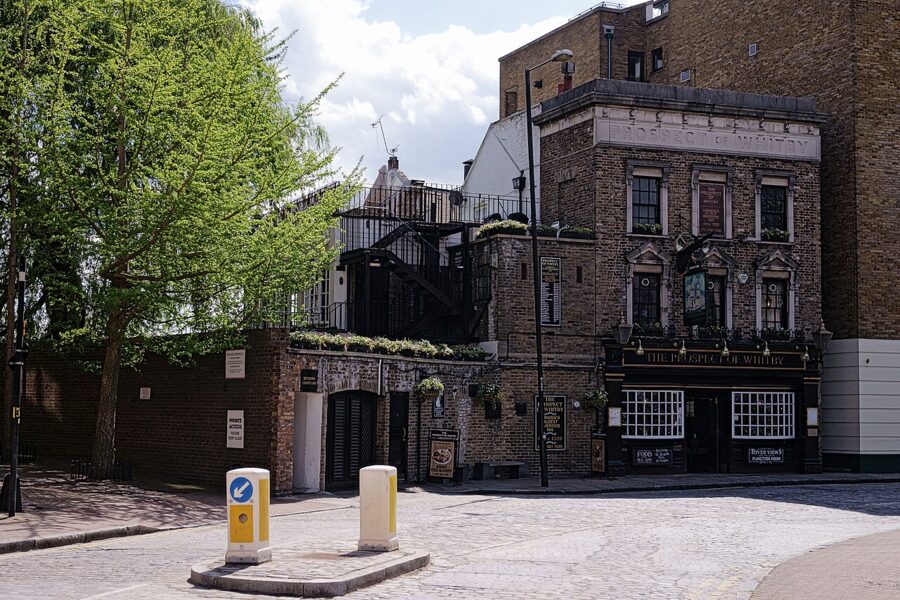

It is a Greene King house with Abbot as the regular and up to five guests, food 12:00–21:00, children welcome until 19:00 and dogs welcome. It opens 11:00–23:00 Monday to Saturday and 12:00–22:00 on Sunday. Wapping station is about 600 metres away, and on a sunny weekend afternoon the terrace is gone by two o’clock.
The Town of Ramsgate
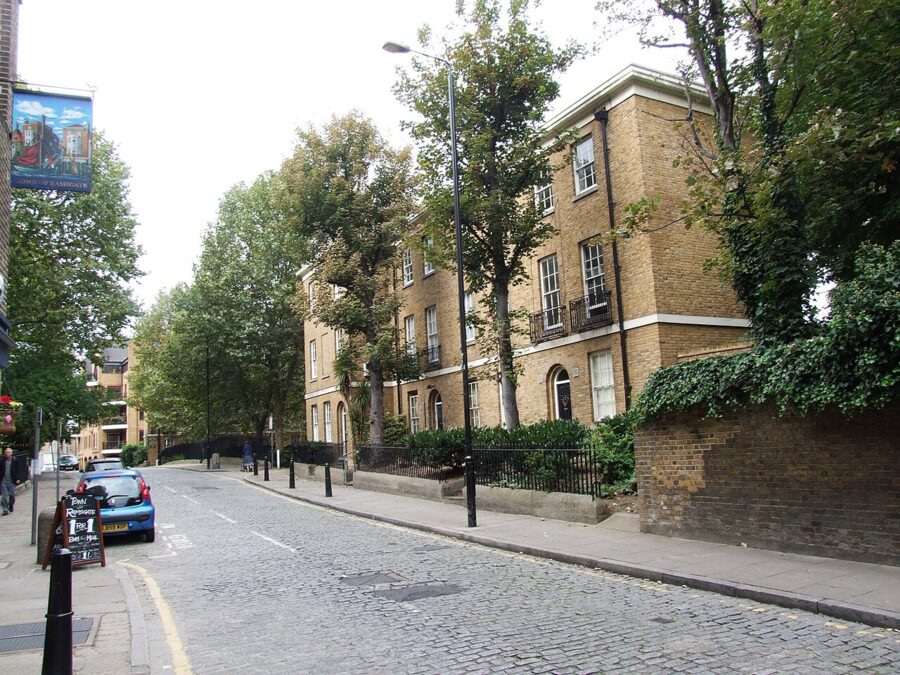
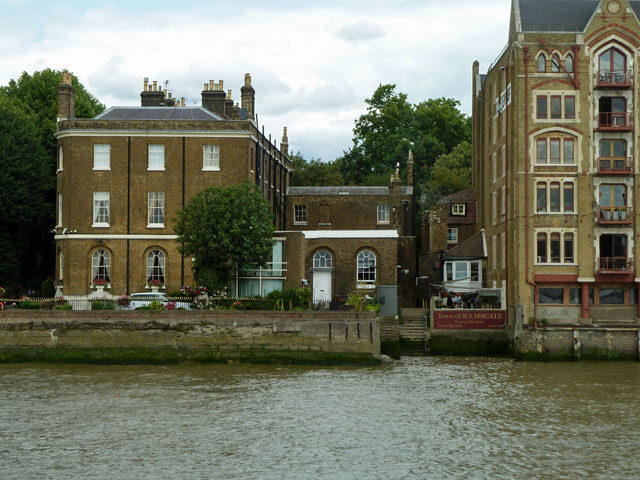
A kilometre upstream along Wapping High Street, the Town of Ramsgate is the one I would choose of the two. Historic England dates it to the eighteenth century “on earlier foundation”, with beamed ceilings, plank panelling, benches and an engraved glass screen inside a long, narrow bar. The name is said to come from Ramsgate fishermen who landed their catch at Wapping Old Stairs, next door, to avoid the dues at Billingsgate.
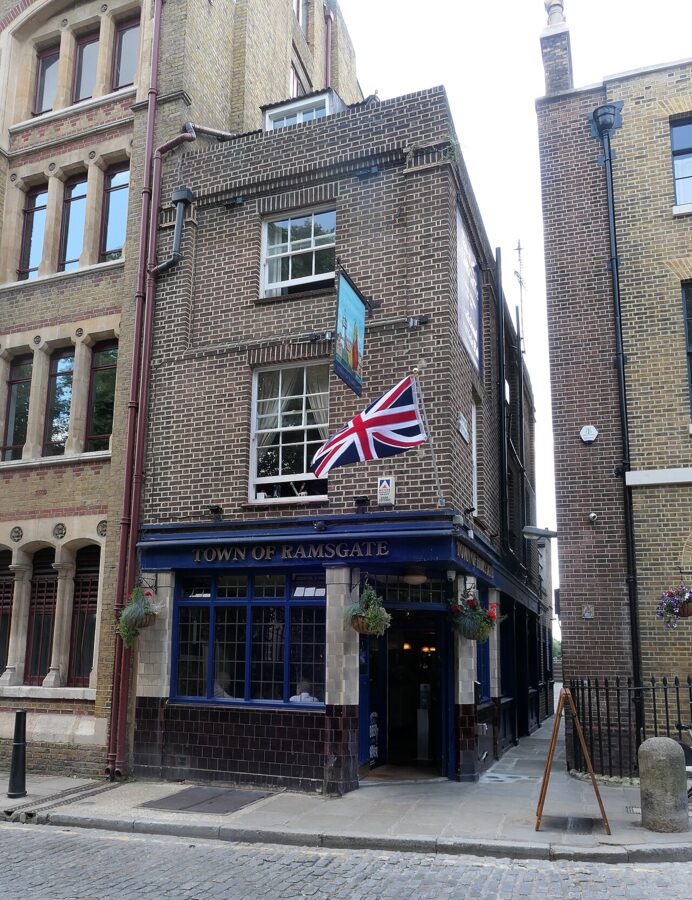

The listing also records the story that Judge Jeffreys, the hanging judge of the Bloody Assizes, was caught here in 1688 trying to slip out of the country disguised as a sailor. “Reputedly” is the word it uses, and I would use it too. Harvey’s Sussex Best, Young’s and Doom Bar are the regulars; food is served 12:00–16:00 and 17:00–21:00, and children and dogs are welcome.


The Mayflower
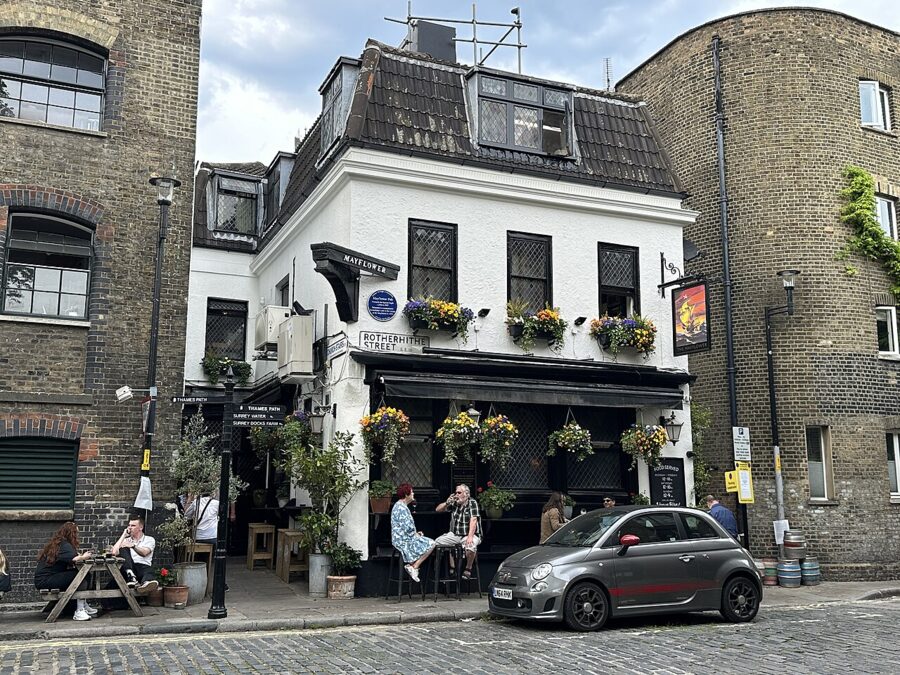
Across the river in Rotherhithe, the Mayflower trades on a date it cannot quite own. The Mayflower sailed from here in 1620 with the Pilgrim Fathers, and an inn called the Shippe is said to have stood on the site. The building was rebuilt in the eighteenth century and traded for years as the Spread Eagle and Crown.
After war damage to the roof and top floor, the brewery refurbished it in 1957 in a sixteenth-century style and renamed it after the ship; sources give 1956, 1957 and 1958 for the renaming. So the old-looking interior is a post-war idea of Tudor. The interesting twist is that CAMRA rates that 1957 interior at two stars, as “of very special national historic interest”, while the building itself is not listed.
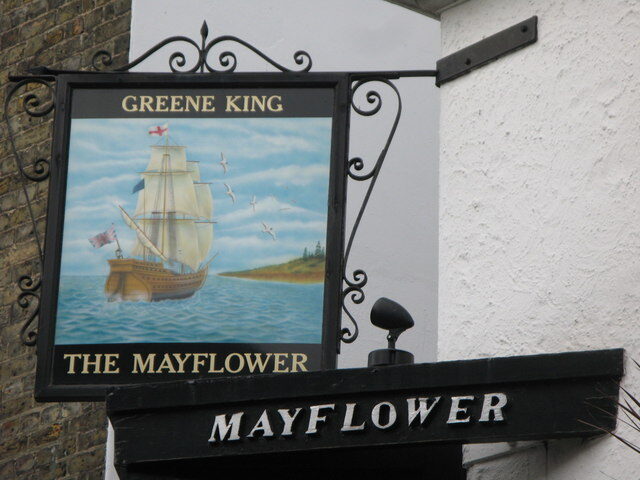

I like it a great deal anyway. The jetty at the back stands over the water, the fireside nooks are good on a cold night, and there are six handpumps with Kent and Southwark beers among the guests. It opens 12:00–23:00 Monday to Saturday and 12:00–22:00 on Sunday, with food until 22:00 (21:00 on Sunday); dogs are welcome downstairs and on the jetty but not in the upstairs restaurant. Rotherhithe station is about 270 metres away.
Covent Garden and Holborn
West of the City, outside the fire, the old pubs are squeezed into alleys between theatres, law courts and offices. Two of them could not be more different: one a seventeenth-century carcase in a Georgian costume, the other a high Victorian showpiece that never pretended to be anything else.
The Lamb and Flag
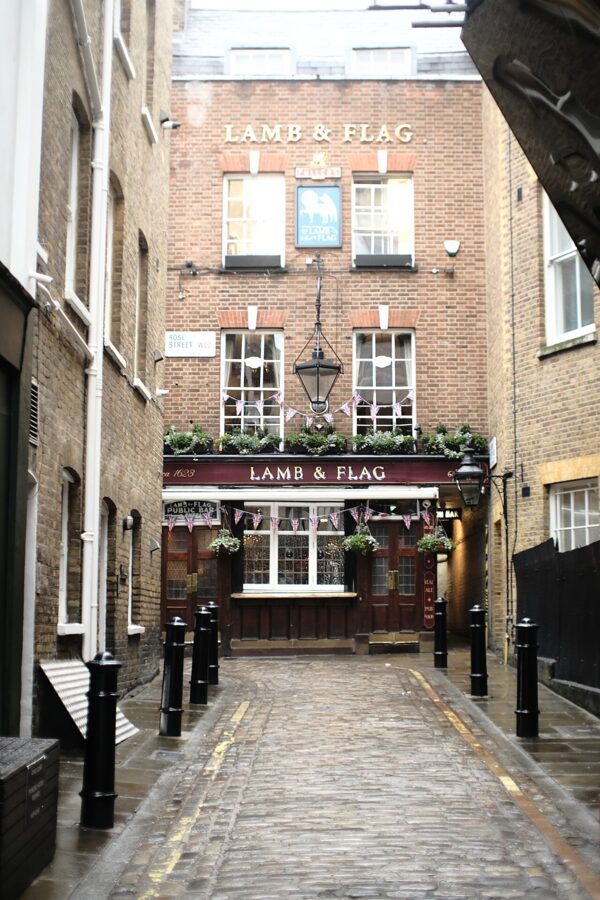
The Lamb and Flag sits where Rose Street turns into a covered passage off Floral Street, and it is usually called the oldest pub in Covent Garden. The listing puts its carcase at about 1688 or the early eighteenth century, with part of an original closet wing in the rear wall. The front, though, was rebuilt in 1958, in what Historic England calls a “convincing early C.19 style elevation”. Convincing is right; almost nobody notices.
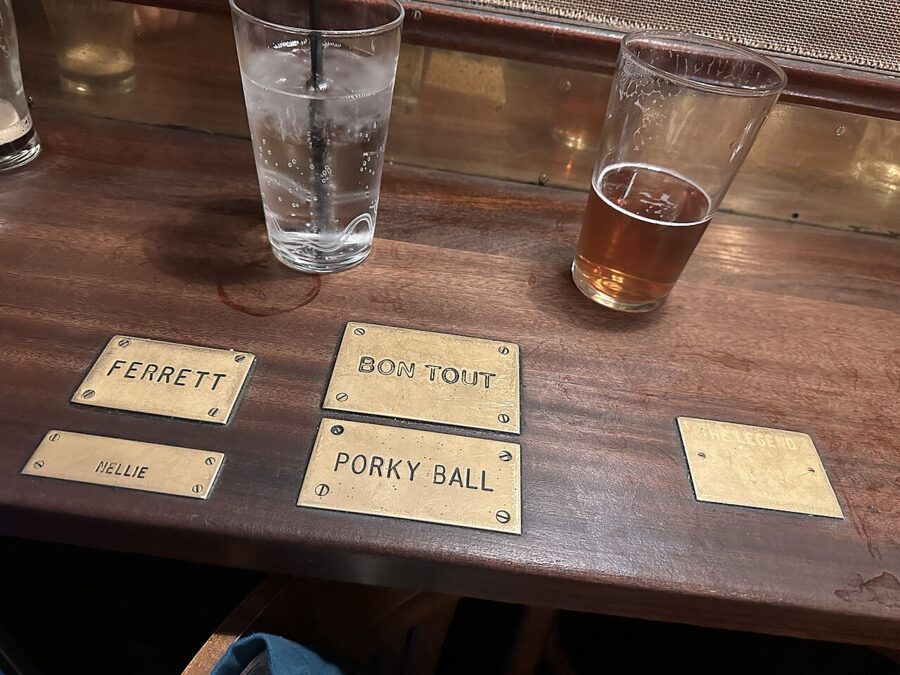

It is reputed to have been licensed in 1623, and the street outside has a better-documented story: in December 1679 the poet John Dryden was set upon and beaten in Rose Alley, probably at the instigation of someone he had offended in print. The pub’s nickname, the Bucket of Blood, is said to come from bare-knuckle fights upstairs. Inside are two small, dark ground-floor rooms and the Dryden Room upstairs, with no music and no machines.
Fuller’s runs it, with ESB, London Pride, Oliver’s Island, Seafarers and Hophead on the bar, and CAMRA rates the interior at three stars. Food runs 12:00–21:30 (20:30 on Sunday); children are welcome only when dining upstairs, and dogs only downstairs. Covent Garden station is about 230 metres away. After work it fills the alley outside, so come at noon or after 21:00.
The Princess Louise
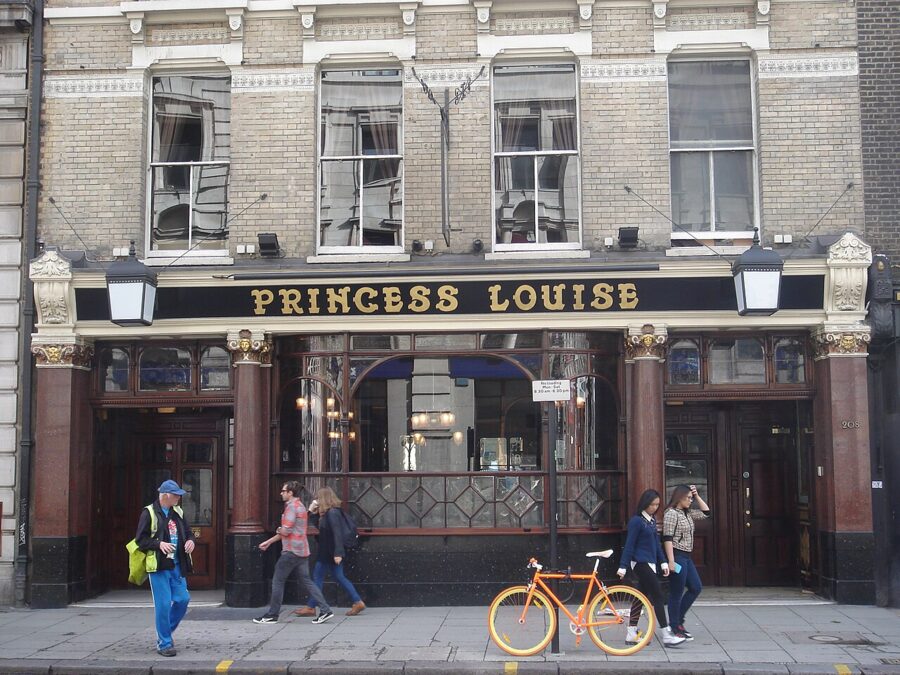
Ten minutes north-east on High Holborn is the answer to anyone who thinks a pub has to be old to be historic. The Princess Louise was built as a pub in 1872.
In 1891 it was fitted out by William B Simpson and Sons, who contracted out the work to the best trades in London: gilded and embossed glass by R Morris and Son, mahogany bar fittings by W H Lascelles, tiles everywhere else. It is listed at Grade II* as “a rich example of a Victorian public house interior”.

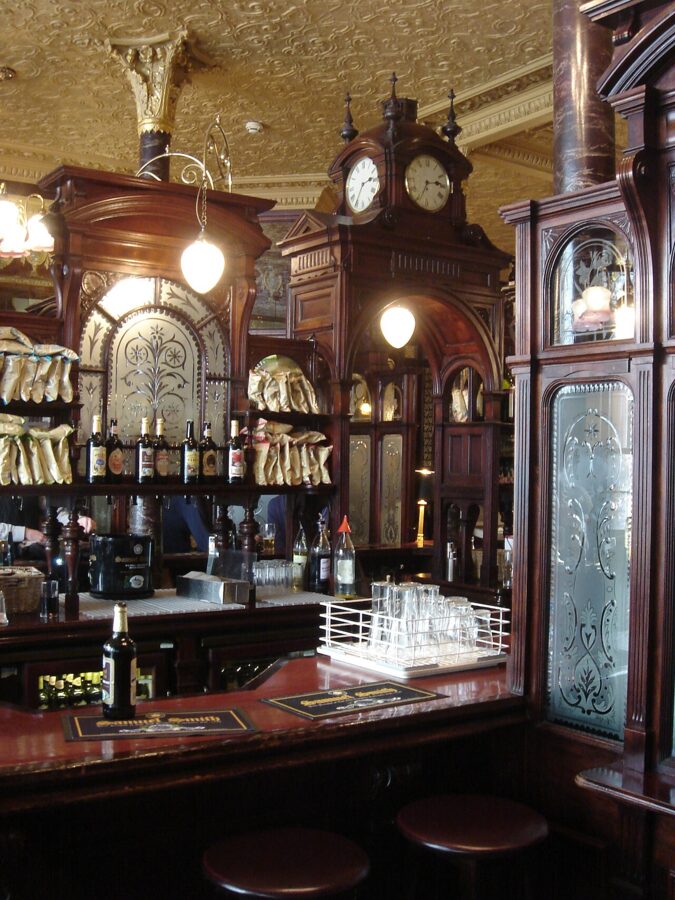

For much of the twentieth century the bar’s partitions had gone, as they did in most London pubs. Samuel Smith’s, which took the lease in 1998, put the screens back in 2008, so the pub is once again a set of small compartments around a central island bar. The gents in the basement, with marble urinals, get a mention in the listing too. CAMRA gives it three stars, the same as the Cheshire Cheese.
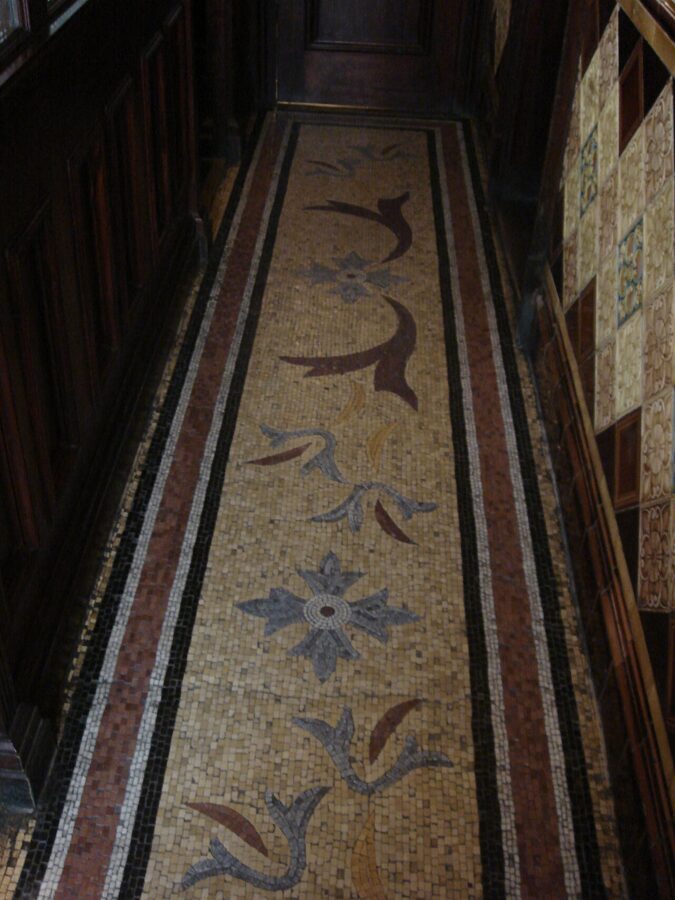

Sam Smith’s rules apply: the brewery’s own beers, Old Brewery Bitter as the cask, no music, no television, and phones out of sight. It opens 12:00–23:00 Monday to Saturday and, at the last count, 12:00–22:00 on Sunday; Sunday hours have varied, so check. Food is served Monday to Thursday at lunch and early evening, Friday at lunchtime only, and not at weekends.
Hampstead and Highgate
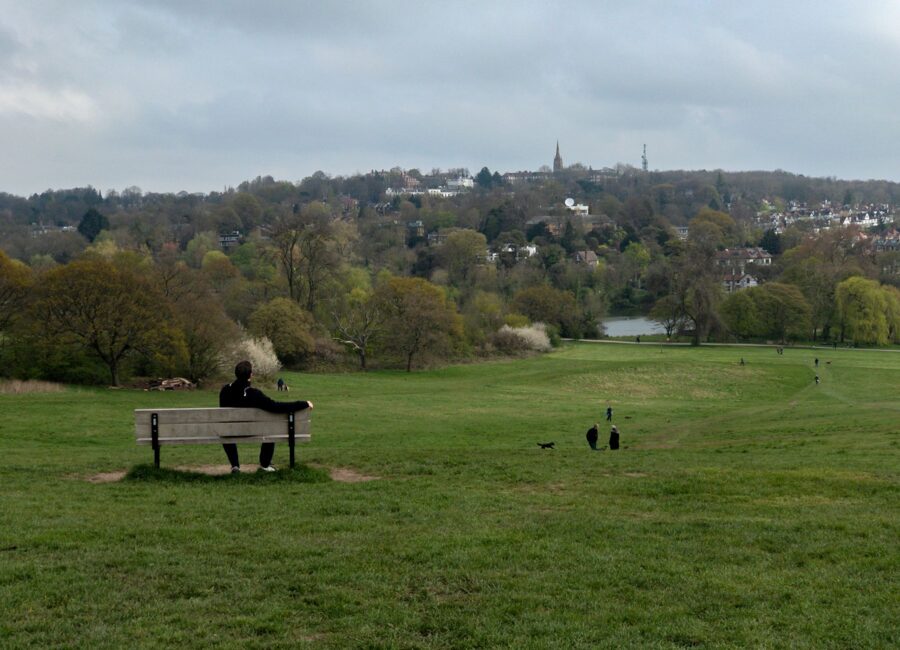
The hill villages north of London were never touched by the fire, and their pubs were country inns on the roads out of town. They are the ones you go to for a garden and a walk rather than a quick pint between meetings, and they make the best Sunday of the lot.
The Spaniards Inn
The Spaniards sits on the road between Hampstead and Highgate at the top of the Heath, its white weatherboarding squeezing the traffic to a single lane against an old toll house opposite. The pub says 1585. Historic England says seventeenth century, altered but with “great character”, and notes old panelling inside under a great deal of paint. The toll house across the road dates from around 1710 and is listed too.
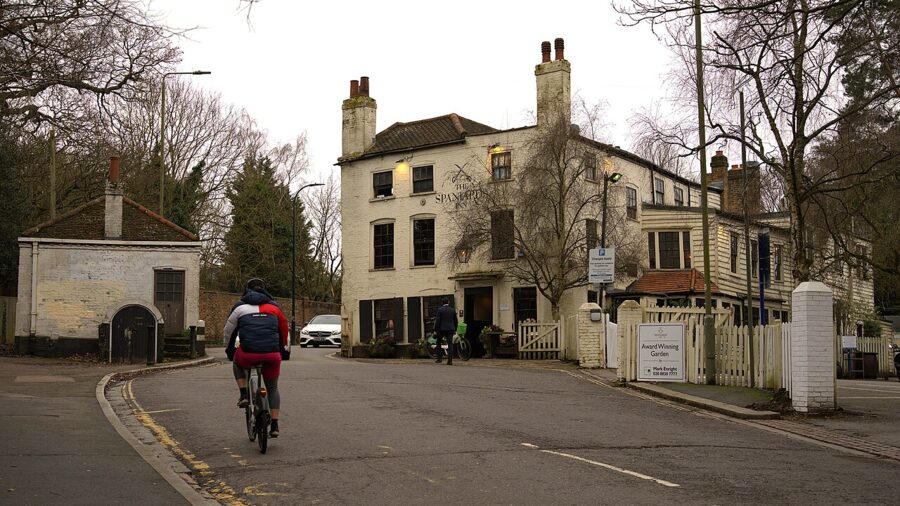

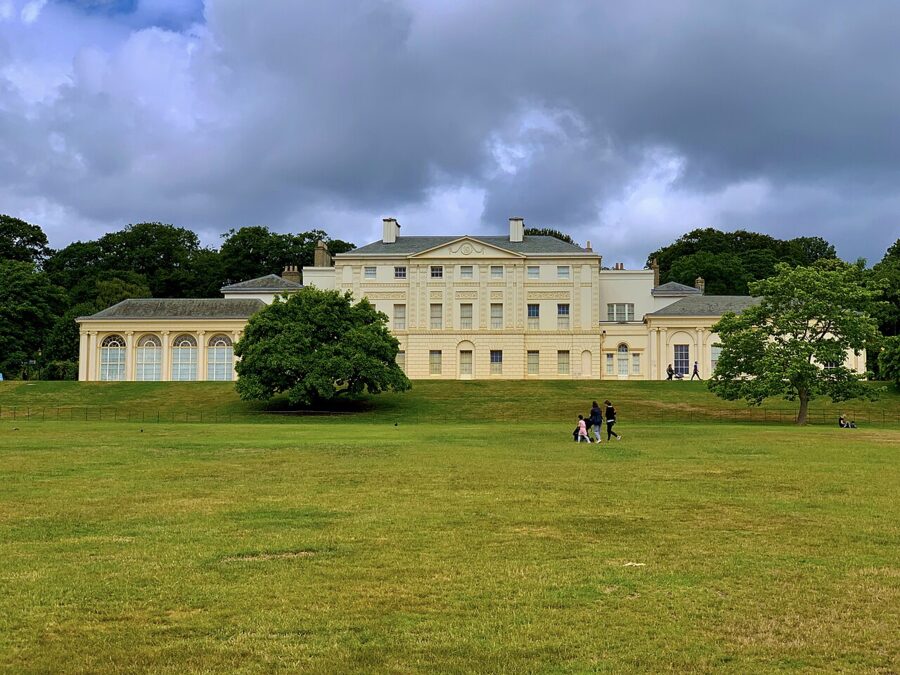
The stories are the best on the list and the least reliable. Dick Turpin is said to have been born here; CAMRA’s own listing points out that he was born in Essex. Dickens put the inn in The Pickwick Papers, Bram Stoker mentions it in Dracula, and the pub tells you Keats wrote his ode to a nightingale in its garden, though he lived and wrote down the hill. In the Gordon Riots of 1780 the landlord is said to have kept a mob drinking until the soldiers arrived to protect Kenwood House.
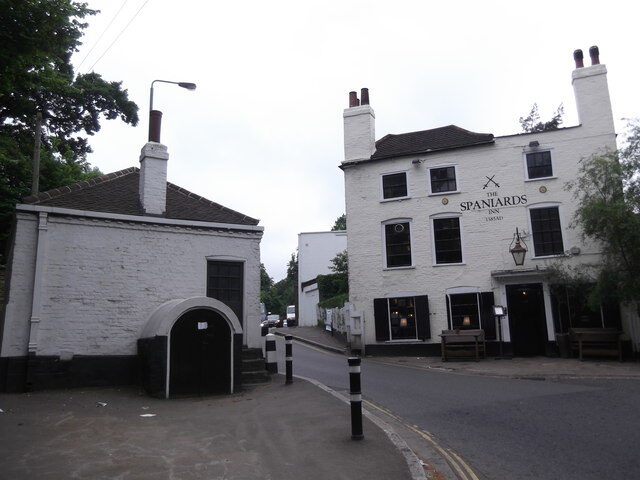

It is a Mitchells and Butlers pub with London Pride and Doom Bar and a changing guest, rated one star by CAMRA. It opens at 10:00 Tuesday to Saturday for brunch, noon on Monday and 11:30 on Sunday, with food until 22:00 (21:00 on Sunday). Children and dogs are welcome, but there is no step-free access. There is no station nearby; the 210 bus stops outside.
The Flask, Highgate
Two kilometres east, the Flask stands on Highgate West Hill with a big front yard of tables. It may be early eighteenth century, and it was partly rebuilt in 1767 by William Carpenter, whose initials and the date are on an oval tablet on the front. The manorial court sat here in the early 1700s.
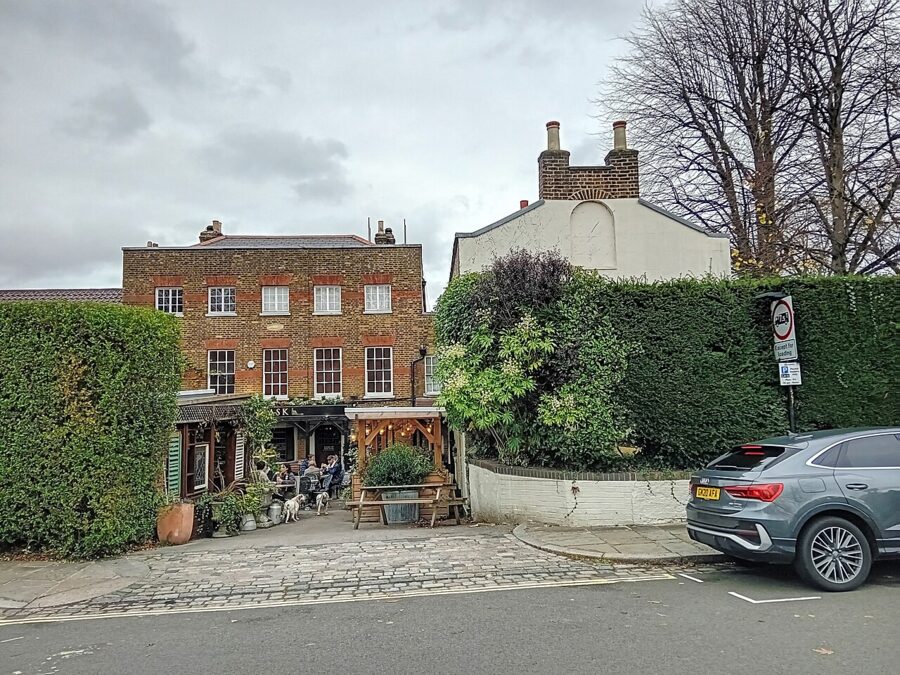

The lower bars, now called the Snug and the Committee Room, are in the original building, with 1930s panelling and fireplaces, and between them is an unusual central servery closed off with sliding sash windows. CAMRA rates it two stars. Hogarth and Marx are both said to have drunk here, which is the sort of claim Highgate pubs collect the way other pubs collect beer mats.
Fuller’s runs it with ESB, London Pride and Hophead plus guests. It opens 11:00–23:00 Monday to Saturday and 12:00–22:30 on Sunday, with food until 22:00 (21:00 on Sunday), and families and dogs are welcome. Highgate station is about 1.2 kilometres away.
The Holly Bush, Hampstead
Back in Hampstead village, up a flight of steps from Heath Street, the Holly Bush is a multi-roomed Victorian pub made out of the stables of the painter George Romney’s house, which still stands just to the north. It has a coffee room with an open fire, an old Benskins brewery sign, and a two-star rating from CAMRA.
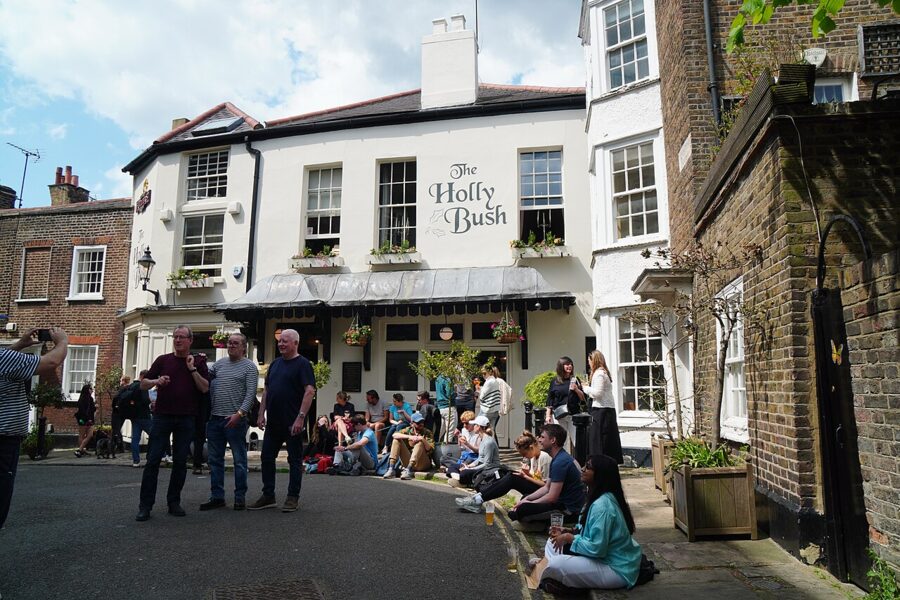

It is Fuller’s again, with Hophead, London Pride and ESB, and it takes cards only. It opens 12:00–23:00 (22:30 on Sunday), and food runs at lunch and in the evening on weekdays and 12:00–20:00 on Sunday. Dogs are allowed in the bar.

The claims, side by side
Here is how the main “oldest” claims stand up against the buildings. My verdict is a judgement, not a ruling, and every one of these is worth a pint either way.
| Pub | The claim | What the building says | My view |
|---|---|---|---|
| Prospect of Whitby, Wapping | Tavern since about 1520 | Front refaced in the early 1800s; interior much altered | Oldest riverside site, not oldest building |
| Ye Olde Mitre, Holborn | Founded 1546 | Built about 1773; interior early twentieth century | Old site, superb interior, younger than it says |
| Spaniards Inn, Hampstead | 1585 | Seventeenth century, altered | A contender for the oldest pub building on the list |
| Hoop and Grapes, Aldgate | 1593 | Probably late seventeenth century, timber-framed | The rarest building type on the list |
| Seven Stars, Holborn | 1602 | Seventeenth century, probably the 1680s | A real survivor of the fire |
| Lamb and Flag, Covent Garden | Licensed 1623 | About 1688 or early 1700s; front rebuilt 1958 | Old carcase, new face |
| Ye Olde Cheshire Cheese, Fleet Street | Rebuilt 1667 | Late seventeenth century, much altered | The best post-Fire pub in the City |
| George Inn, Southwark | Rebuilt 1676 | Seventeenth century, Grade I | The only one that is old in every sense |
| Mayflower, Rotherhithe | Inn here since about 1550 | Rebuilt in the 1700s; interior of 1957 | Historic now, but as a 1950s pub |
Outside London the claims get wilder and the buildings older, and almost every county town has a pub that says it was first. The oldest pubs in England are a separate argument, with better beams.
Two walks through old London pubs
Both walks below are measured on foot from station to station. Neither is meant to be done with a full pint in every pub; a half in each and something to eat in the middle will get you to the end with your judgement intact.
Walk one: Covent Garden to Blackfriars
About 3.9 kilometres and six pubs, from Covent Garden station (Piccadilly line) to Blackfriars (District and Circle lines, and Thameslink).
- Covent Garden station to the Lamb and Flag: 230 metres, down Garrick Street and into Rose Street.
- Lamb and Flag to the Princess Louise: 850 metres, north-east via Long Acre and Drury Lane to High Holborn.
- Princess Louise to the Seven Stars: 800 metres, south through Lincoln’s Inn Fields to Carey Street.
- Seven Stars to Ye Olde Mitre: 750 metres, up Chancery Lane, along High Holborn and into Hatton Garden.
- Ye Olde Mitre to Ye Olde Cheshire Cheese: 550 metres, down to Fleet Street and into Wine Office Court.
- Cheshire Cheese to the Black Friar: 500 metres, east along Fleet Street to Ludgate Circus and down New Bridge Street; the station is across the road.
When to go: Saturday, starting at noon. The City is empty at weekends, the Lamb and Flag is quiet at opening time, and the Mitre is open until 19:00. Do not try it on a Sunday, when the Mitre is shut.
On a weekday, start at 14:00 and you will reach Fleet Street before the 17:00 rush, which in the Black Friar and the Cheese is serious. The Hoop and Grapes is a separate trip; it is 150 metres from Aldgate station.

Walk two: Bankside to Rotherhithe
About 5.4 kilometres on foot plus one stop by train, from London Bridge station to Rotherhithe on the Overground. Most of it follows the Thames Path.
- London Bridge station to the Anchor: 700 metres, west along the river past Southwark Cathedral.
- Anchor to the George: 500 metres, back east to Borough High Street.
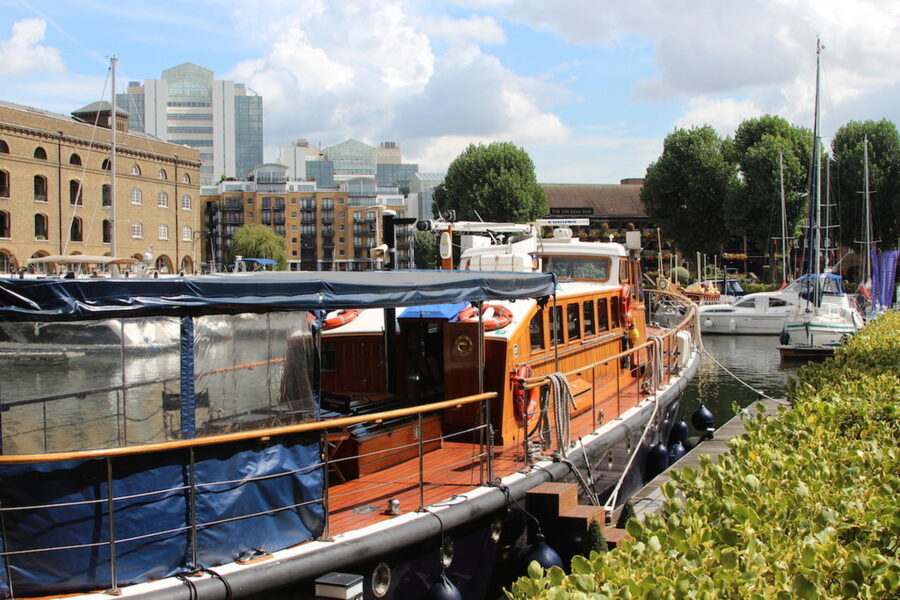
- George to the Town of Ramsgate: 2.6 kilometres, across Tower Bridge, through St Katharine Docks and along Wapping High Street.
- Town of Ramsgate to the Prospect of Whitby: 1 kilometre, east along Wapping High Street to Wapping Wall.
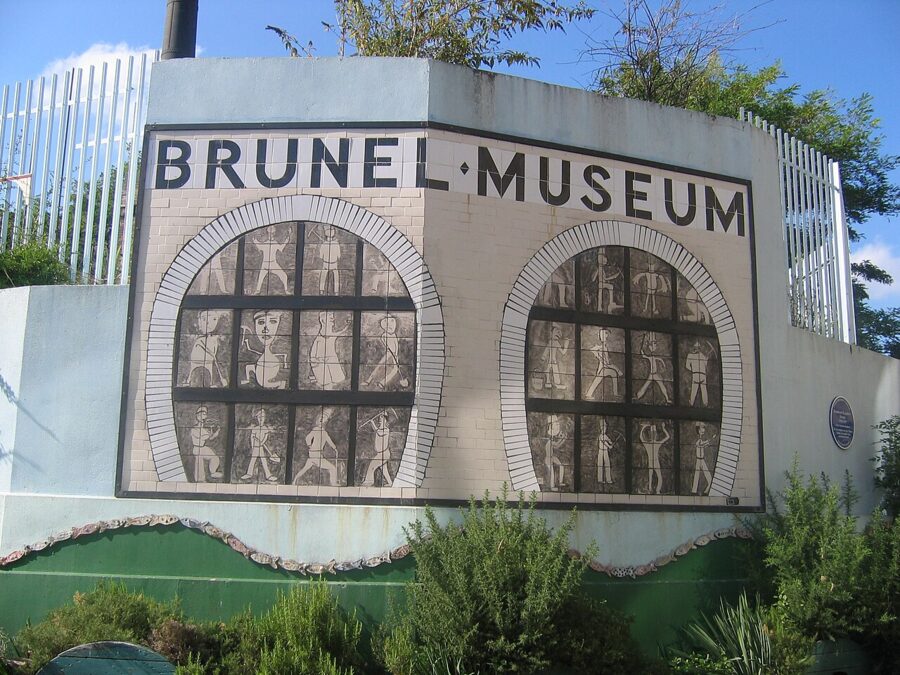
- Prospect of Whitby to Wapping station: 600 metres. Take the Overground one stop south to Rotherhithe; the trains run through Marc Brunel’s Thames Tunnel, opened in 1843.
- Rotherhithe station to the Mayflower: 270 metres along Rotherhithe Street.

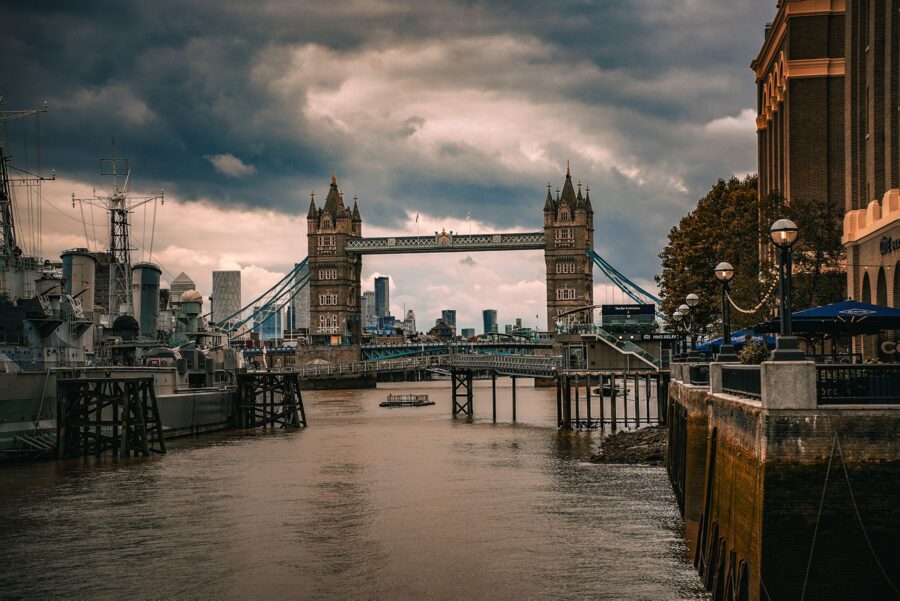
When to go: a weekday, starting at the Anchor when it opens at 11:00, puts you at the George before the lunch crowd and in Wapping in the quiet of the afternoon. Avoid Saturdays, when Borough Market fills Southwark, and avoid sunny weekend afternoons at the Prospect. If the tide is low when you reach the Mayflower, take your drink out onto the jetty and look for the old river stairs.

And if you would rather do Hampstead, there is a third walk with no list needed: from Hampstead station up to the Holly Bush (150 metres), across the top of the Heath to the Spaniards (1.6 kilometres), along Hampstead Lane past Kenwood to the Flask (2 kilometres), and down to Highgate station (1.2 kilometres). It is the one to save for a Sunday, when the Mitre is shut, the City is dead and the Heath pubs serve food all afternoon; if a Sunday roast is the plan, book ahead.
Whichever you choose, finish at a bar with old wood, and ask before you admire it. In the Mitre it will probably be about 1930, in the Mayflower 1957, and in the George it might really be 1676. They are all London’s oldest pubs; they just got old at different times.