
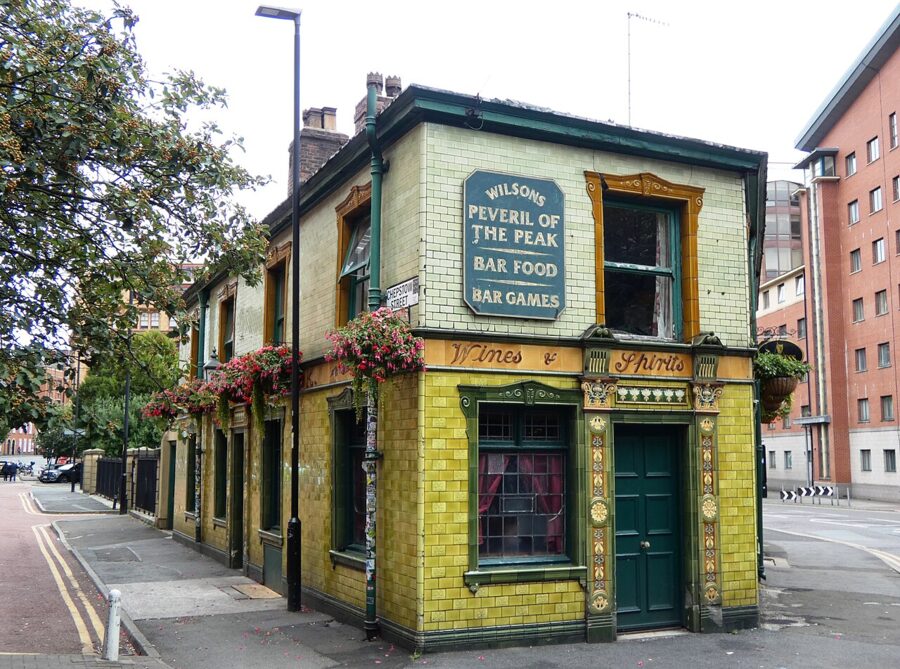
The Peveril of the Peak stands on its own on a corner of Great Bridgewater Street, a two-storey Victorian pub wrapped in green tiles with cream ones above, while the terrace it once belonged to has long gone and offices and flats tower on every side. Nancy Swanick held its licence from 1971 until she died in July 2026. The pub is still pouring, still in her family, and still has the old table football game in the back bar. If you only have time for one pub in Manchester, it is this one.
What makes the city worth a pub weekend is the way two things sit side by side. One is the old stuff: tiled Victorian and Edwardian pubs with their rooms, bell pushes and drinking lobbies still in place, an unusual number of them within a short walk of each other. The other is the beer. Four family brewers from the 19th century still supply pubs here, and since the 1990s a crowd of newer ones have moved into railway arches and warehouses within a mile of Piccadilly station.

The centre is compact enough to walk end to end in half an hour, so the trick is choosing a direction. I would start in the south around Oxford Road, work up through the old town by the cathedral, and finish in the Northern Quarter or at the Marble Arch, close to Victoria station for the train home. Salford is a short walk west over the river, and Ancoats and the brewery taps sit just east.

On this page
- How Manchester drinks
- Great Bridgewater Street and Oxford Road
- Cross Street, St Ann's Square and the Shambles
- Shudehill and the Northern Quarter
- Angel Meadow and the Marble Arch
- Ancoats and the Piccadilly taprooms
- Over the Irwell into Salford
- The historic interiors, and what is genuine
- One evening, Oxford Road to Victoria
- Stations, trams, late licences and match days
How Manchester drinks
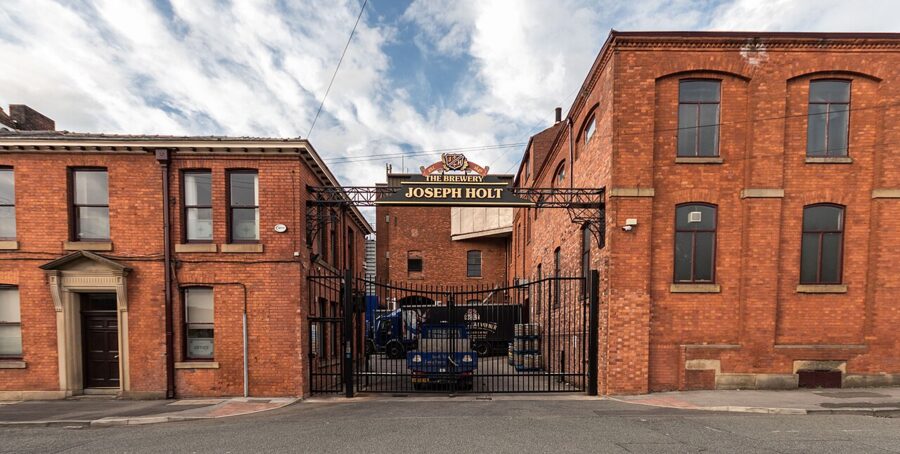
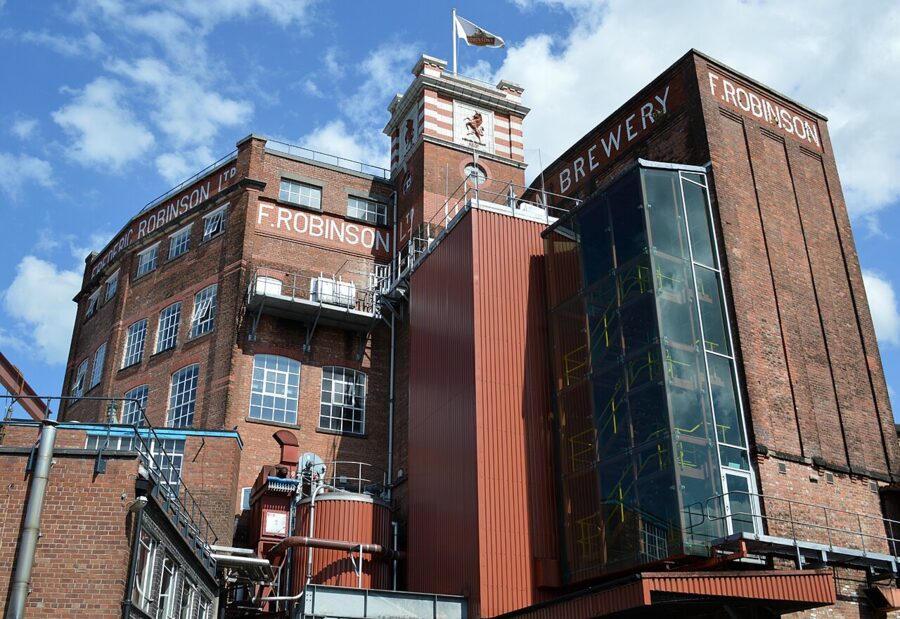
Start with the family brewers, because their names are on half the pub signs in town. Joseph Holt began brewing in 1849 and still brews at the Derby Brewery in Cheetham, a mile north of the centre, run by the same family six generations on.
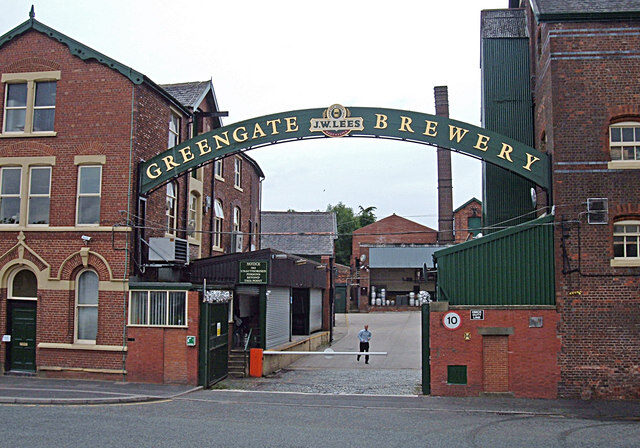
Robinsons of Stockport trace themselves to 1838, when William Robinson bought the Unicorn pub on Lower Hillgate. Hydes started in Moss Side in 1863. JW Lees has brewed at the Greengate Brewery in Middleton Junction since 1828.

Each has a house in the centre worth seeking out. Holt’s Bitter is on at the Hare and Hounds on Shudehill, though Heineken owns that pub, and Holt’s has a run of its own: the Old Monkey, the Ape and Apple, the Lower Turks Head and, since June 2026, the Spinner’s Rest in Ancoats. Robinsons owns the Castle Hotel on Oldham Street. Hydes has the Grey Horse on Portland Street, and Lees beer is on at the Rain Bar, the Millstone and Sam’s Chop House.

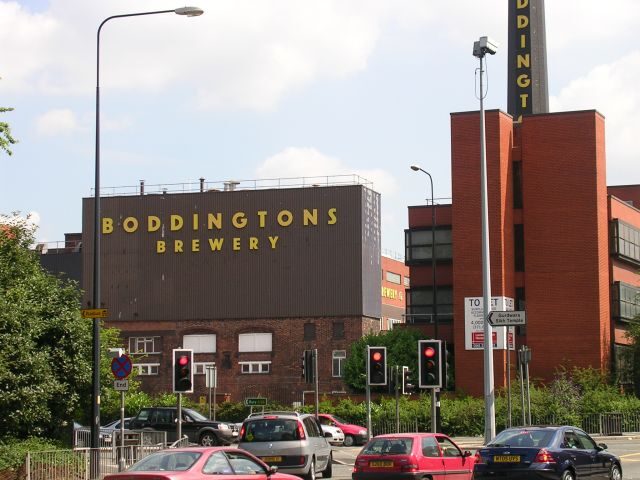
The fifth name is a ghost. Boddingtons, the “Cream of Manchester”, was brewed at Strangeways from the 18th century until the brewery closed in 2005, and the cask version, brewed under licence by Hydes, stopped in 2012. In 2025 Lees took a licence and began brewing Boddingtons Cask at Greengate with its own yeast. You will see it on the bar at Sam’s Chop House and in the Circus Tavern, and it is worth one pint for the history even if you go back to something hoppier afterwards.

Then the new lot. Marble started brewing in 1997 in the back of the Marble Arch on Rochdale Road and moved to Salford in 2019.

Cloudwater, Track, Sureshot and Balance all have taprooms within ten minutes’ walk of Piccadilly, and Blackjack runs the Smithfield Market Tavern. Much of what they make is keg, but most of them keep a handpump or two, and the city’s best pubs move between the two without fuss. If cask is new to you, real ale is the thing to ask for at the bar.
One more house rule. Samuel Smith’s has just one central Manchester pub, Sinclair’s Oyster Bar, and like every Sam Smith’s house it bans phones and laptops in the bar. Keep that in mind before you settle in to check the train times.

Great Bridgewater Street and Oxford Road
The south side of the centre, between Oxford Road station and Deansgate, has the best two old pubs in the city within a couple of minutes of each other, and a handful of good locals around them. Oxford Road and Deansgate stations are both on the doorstep.
The Peveril of the Peak
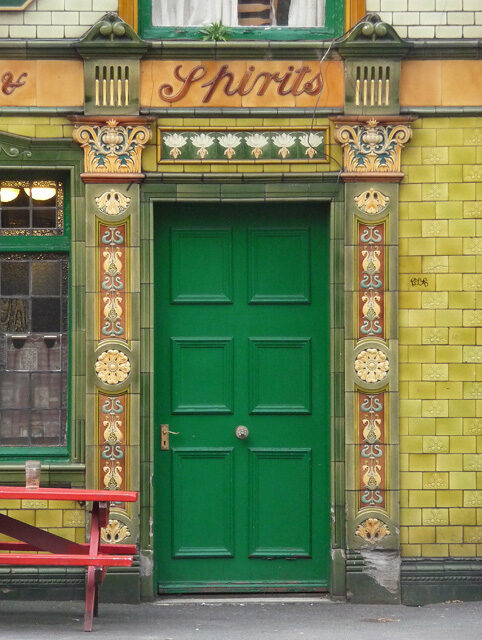
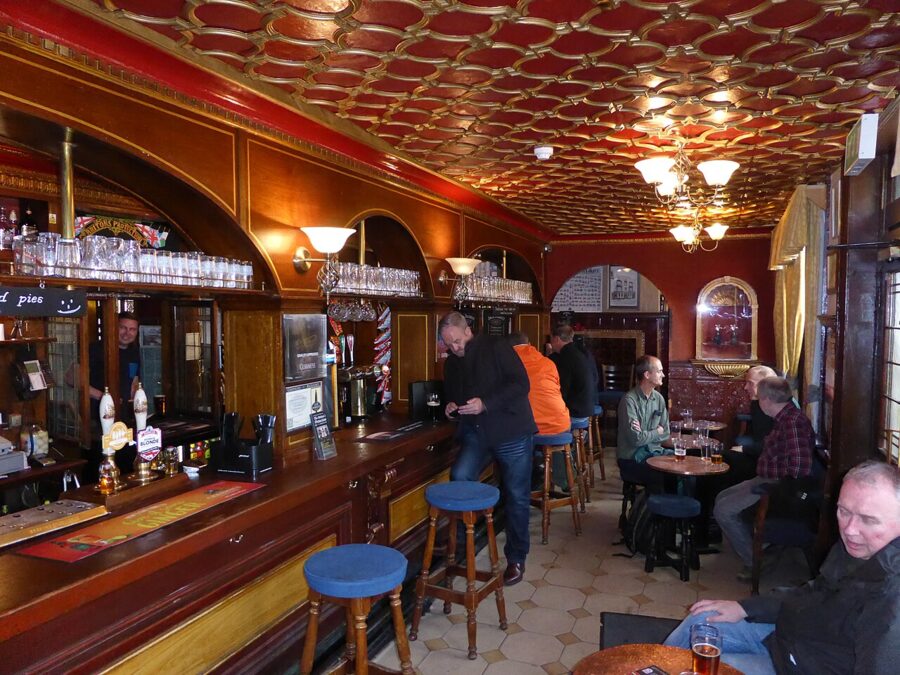
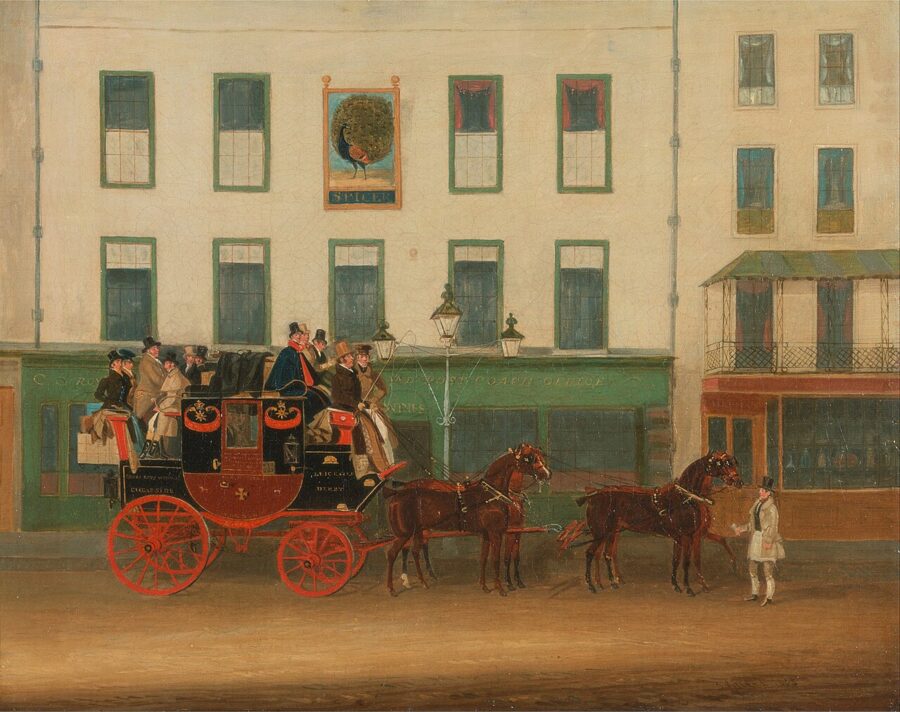
The Pev takes its name from the London to Manchester stagecoach, which was itself named after Walter Scott’s 1823 novel. The building is mid-Victorian, remodelled around 1900 when it got the coloured faience, and it was saved from demolition for a road scheme in the 1980s after a campaign by CAMRA and others. Inside is a dog-leg drinking lobby lined with green and cream tiles, wrapped round an island bar with a stained-glass screen. The glass looks Victorian and was made in 1982 to match the panels in the lobby.
There are four drinking areas. The front room facing Great Bridgewater Street is the one to aim for, with baffles by the door, fixed seating with bell pushes, a Victorian fireplace and a panelled bar counter. The public bar in the point of the wedge has the table football. The snug has an etched mirror over the fire marking Nancy’s first forty years, and on Tuesdays from 19:30 it holds an Irish music session that has run for about forty years.
The beer list is short and steady: Timothy Taylor’s Landlord, Titanic Plum Porter, Millstone’s Tiger Rut and Brightside’s The Mancunian. It opens at 12:00 daily and closes at 23:00 early in the week, 23:30 on Thursday, midnight on Friday and Saturday and 22:30 on Sunday. Dogs are usually welcome except on a busy Friday night or Saturday.
The Britons Protection and the Rain Bar
Two minutes west, opposite the Bridgewater Hall, the Britons Protection opened in 1811 and is said to have been used for recruiting soldiers to fight Napoleon, which is the usual explanation of the name. St Peter’s Field, where the Peterloo Massacre happened in 1819, was just up the road, and a mural in the hall remembers it. What you see inside, though, mostly dates from a refit around 1930: a terrazzo corridor, a tiled passage running up the stairs, the moulded ceiling in the front bar and two back rooms served through a double-doored hatch.
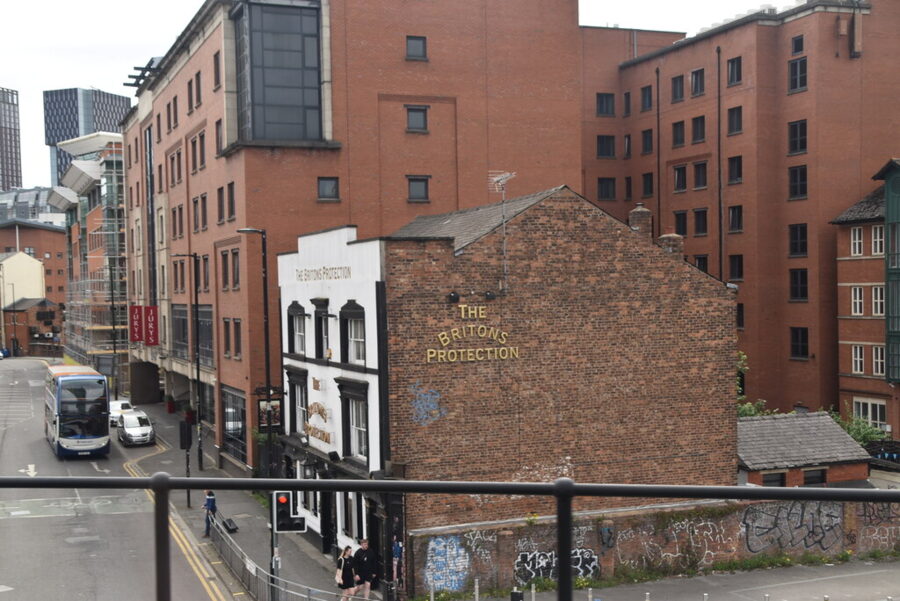

Heineken owns the freehold, and the pub closed for a refit before reopening in January 2025. Regulars argued about the changes, and the old landlord’s famous whisky shelves did not survive in full, but there are still around thirty whiskies, and a cellar refit in spring 2026 brought the cask range up to eight changing beers. Players from the Hallé come in before and after concerts. Go and look at the 1930s urinals in the gents, which CAMRA’s heritage surveyors single out by name.

A few doors along, beside the canal, the Rain Bar is a former umbrella factory turned into JW Lees’ flagship pub in the 1990s and refurbished in 2023. Inside is a big room of dark wood and leather. The reason to come is the patio along the Rochdale Canal, one of the largest outdoor drinking areas in the city centre, and the full Lees range, with food until 20:00.
The Salisbury
Tucked in a hollow between Oxford Road station and Oxford Road itself, in what was once the slum called Little Ireland, the Salisbury is a brown-tiled rock pub with a jukebox, pool table and up to six cask beers, often including Theakston Old Peculier, which is rarer here than you would think. Pizza runs from 15:00. It opens until 01:00 most nights and 02:00 on Thursday, Friday and Saturday, it is card only, and it knocks something off if you show a gig ticket.
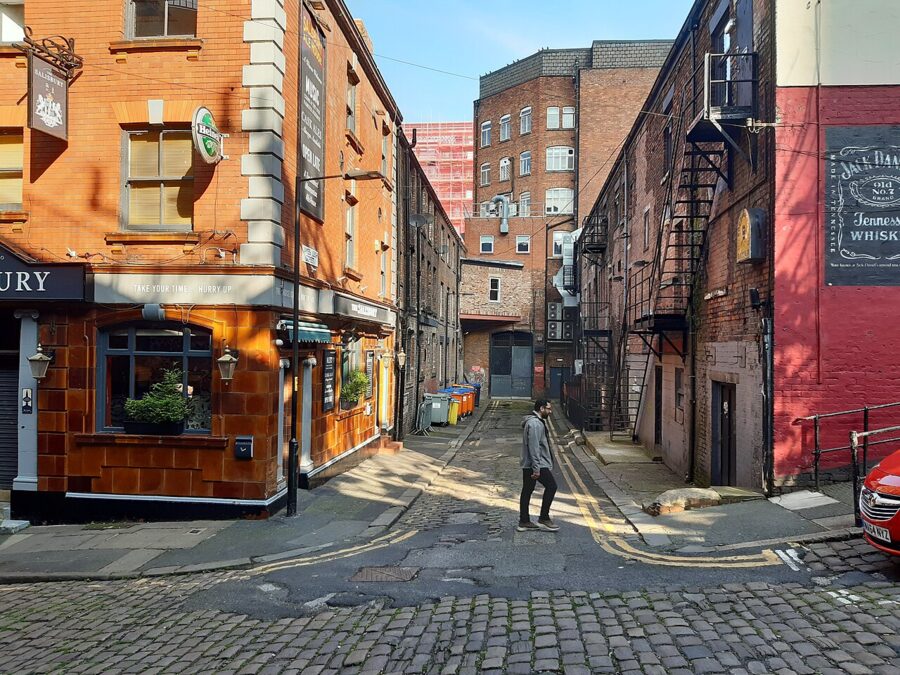
Portland Street: the Circus Tavern, the Grey Horse and the Old Monkey
The Circus Tavern is the smallest pub in Manchester and does not let you forget it. The building is a converted house one bay wide, early 19th century, with a corridor leading past a tiny servery under the stairs to two small rooms, one behind the other. It claims the smallest bar in Europe. Only one person can serve, so staff bring drinks to your seat, a reversal of the usual pub etiquette of ordering at the bar, and just as well, because forty customers fill it.
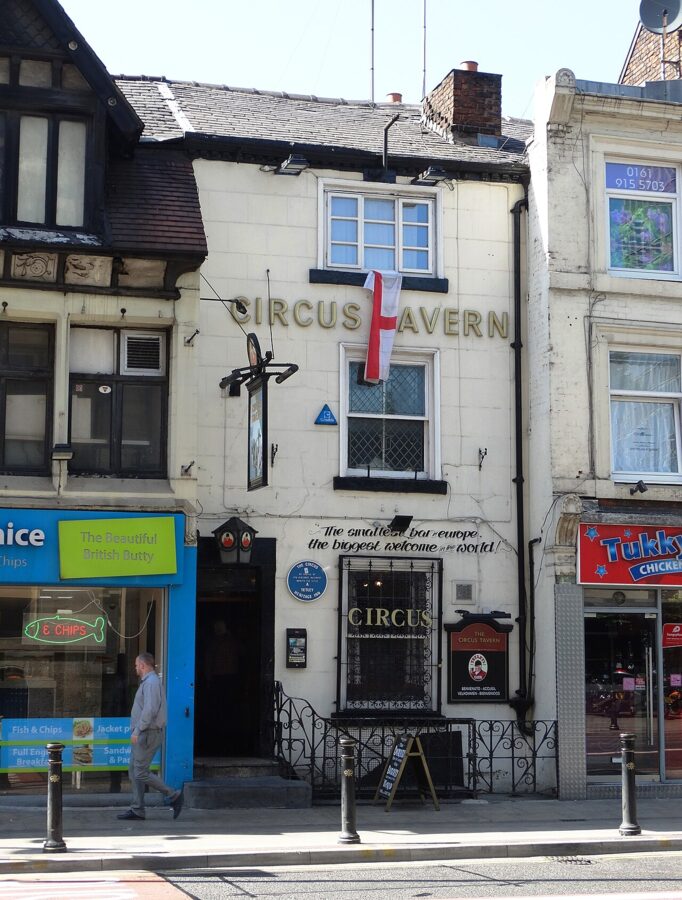

The front room has the TV and pictures of Manchester entertainers; the back room is given over to football, with Manchester United’s Best, Law and Charlton looking down. There are a couple of cask beers, recently Boddingtons. Hours run 12:00–23:00 early in the week and to 23:30 on Friday and Saturday, though CAMRA’s local branch warns that closing time depends on how busy it is. Make it a one-pint stop and move on.
Next door, the Grey Horse is almost as small: a single room in what were weavers’ cottages, selling beer since 1851 and owned by Hydes, who keep Original, Lowry and Dark Ruby on alongside a couple of the brewery’s rarer beers. It gets packed on match days.
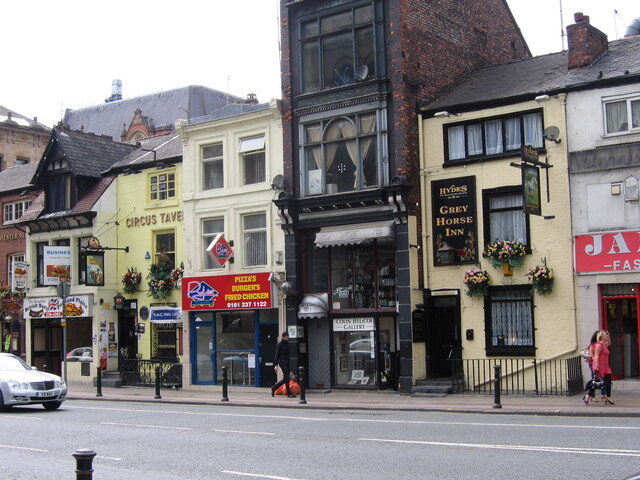

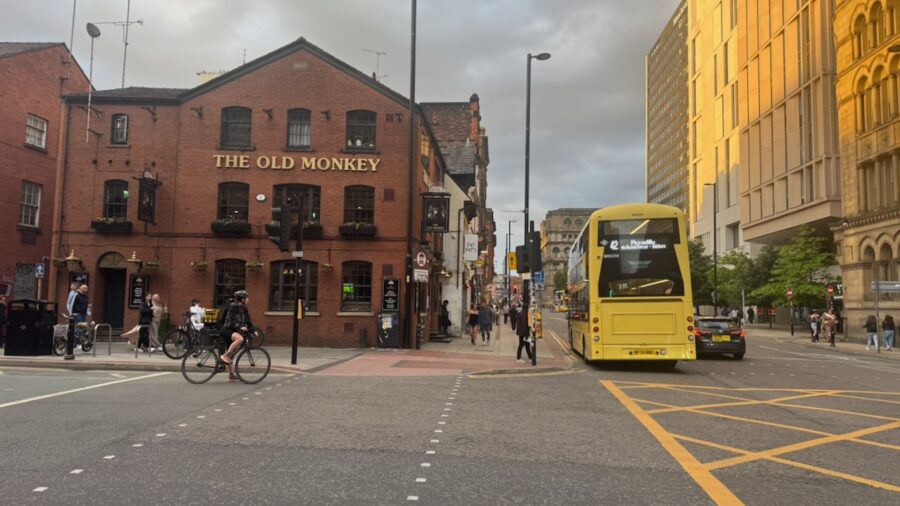
A few doors further along, the Old Monkey opened in 1993 as Holt’s first new-build pub in the city centre, a two-floor box that is never quiet downstairs, with Holt’s Mild on all year.

Kennedy Street and the Seven Oaks
Kennedy Street, behind the Town Hall, has two pubs next to each other. The City Arms is a compact two-room pub with eight handpumps, seven of them rotating, one always a vegan beer and one often a mild. CAMRA lists its interior as of special national interest: a tiled passage with a hatch to the back of the servery, two small rooms on different levels, and a front bar that was reworked as a Tetley “Festival Ale House” in the 1970s. Food is weekday lunchtimes only, with pies until they run out.
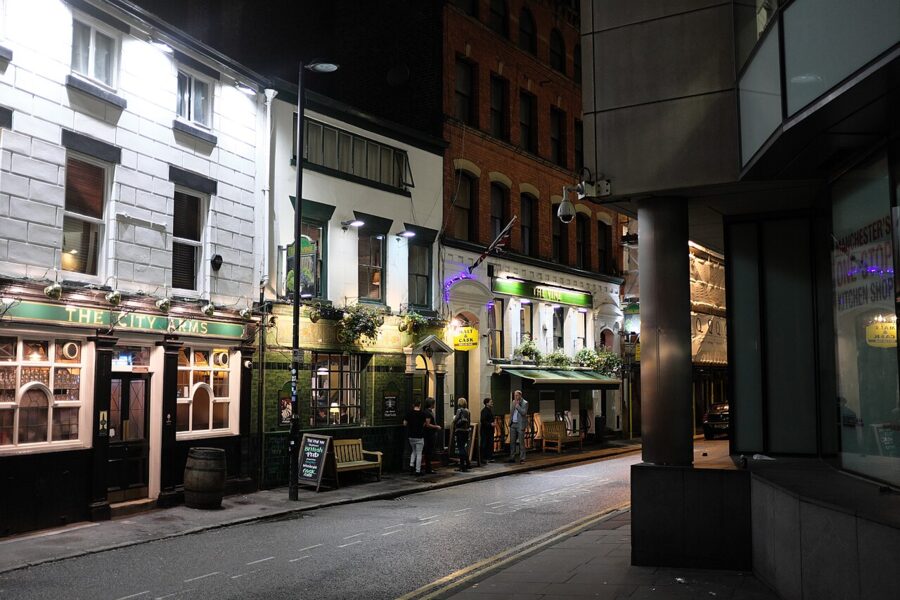

Its neighbour the Vine has a tiled front and stained-glass windows, three levels inside, and a rule against satellite sport that keeps it calm. A few streets east on the edge of Chinatown, the Seven Oaks has a white faience front with an iron tree on it, one well-furnished room up a few steps and a cheap house ale. It does no food, but you can bring a takeaway from the Chinese restaurants around it.
Cross Street, St Ann’s Square and the Shambles
The old town around the cathedral is where Manchester’s pubs get hungry. The two chop houses here are as much restaurants as pubs, both founded by the Studd brothers in the 1860s, and both worth booking if you want to eat rather than drink.
Mr Thomas’s Chop House
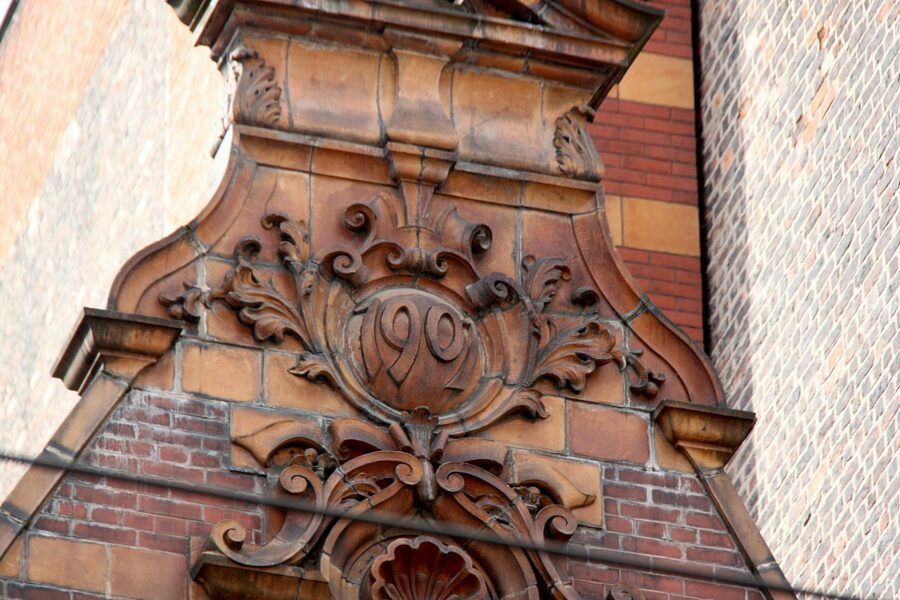
Thomas and Sarah Studd opened their chop house in 1867, and the tall Jacobean-style building on Cross Street went up in 1901. Inside, four rooms run one behind the other, divided by green tiled arches, with green dado tiles, cream tiling up to the ceiling in one compartment, black and white floor tiles throughout and a ceramic fireplace in the back room. The bar counter is mostly modern: the original servery stood further back, as an old photograph in the gents shows.
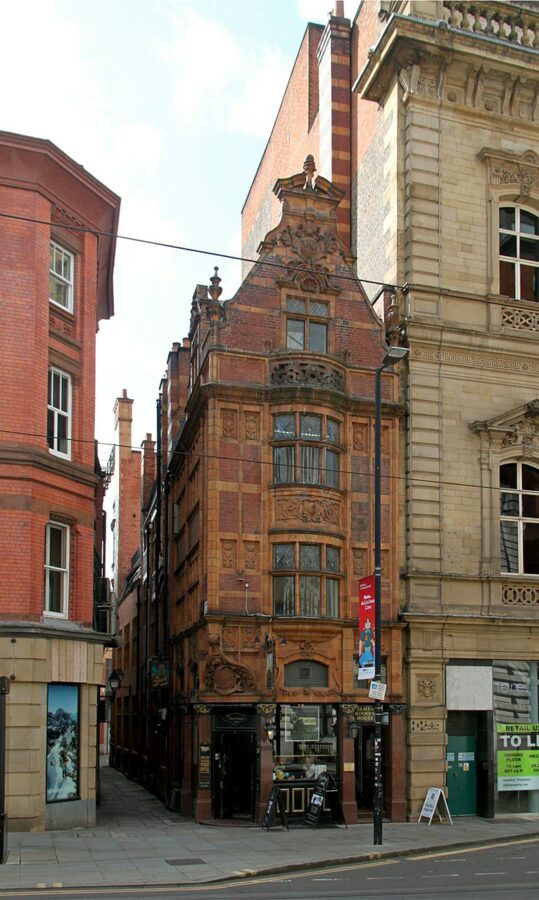

More than half the floor is restaurant. The front bar is the place to drink, with Timothy Taylor’s Landlord, Golden Best and Boltmaker on, and it is popular with audiences from the Royal Exchange Theatre. Food runs from 12:00 to 20:30 early in the week, 21:30 on Friday and Saturday. CAMRA gives it three stars for the interior, its highest grade.

Sam’s Chop House
Samuel Studd opened his own chop house a year or so later; the restaurant gives 1868. It has been in a basement off Chapel Walks since the 1950s, down a narrow stair from the street, with a low-ceilinged bar ahead of you and the dining room beyond. A life-size statue of L.S. Lowry sits at the bar, because he drank here too.
The house’s own favourites are corned beef hash and steak and kidney pudding, and the bar is a Lees one: Sam’s Special Bitter, Manchester Pale Ale and the revived Boddingtons. Food stops at 21:30 most nights and 18:30 on Sunday. Access is down narrow stairs, but staff can bring you in through a side entrance if you ring ahead.
The Old Wellington and Sinclair’s Oyster Bar
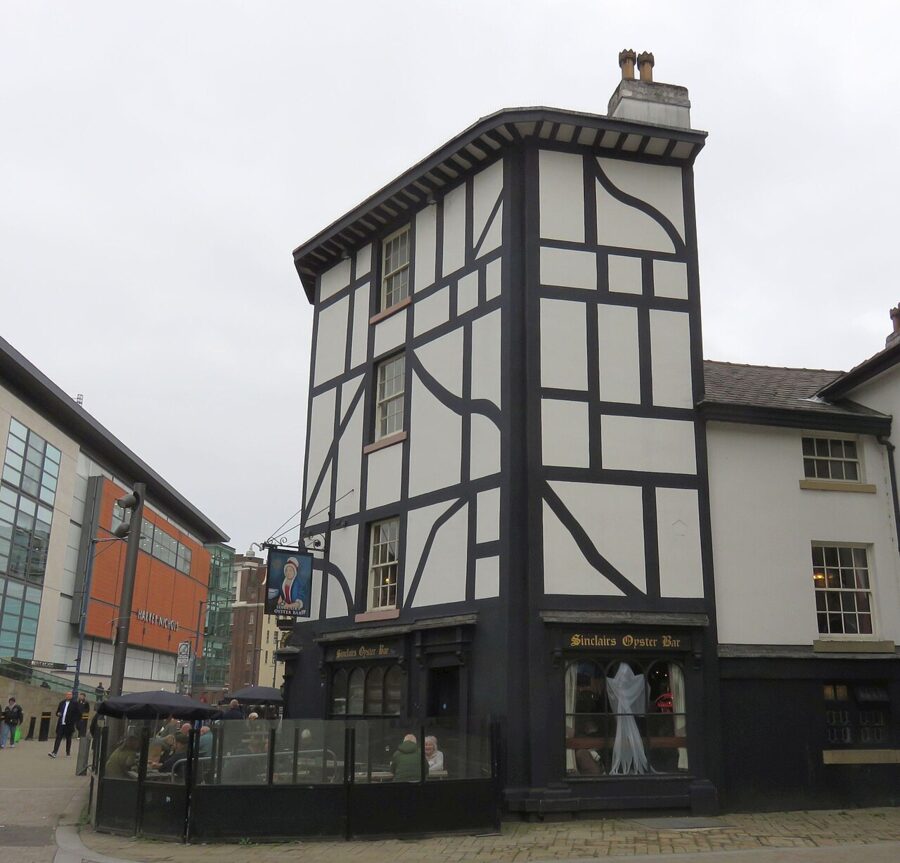
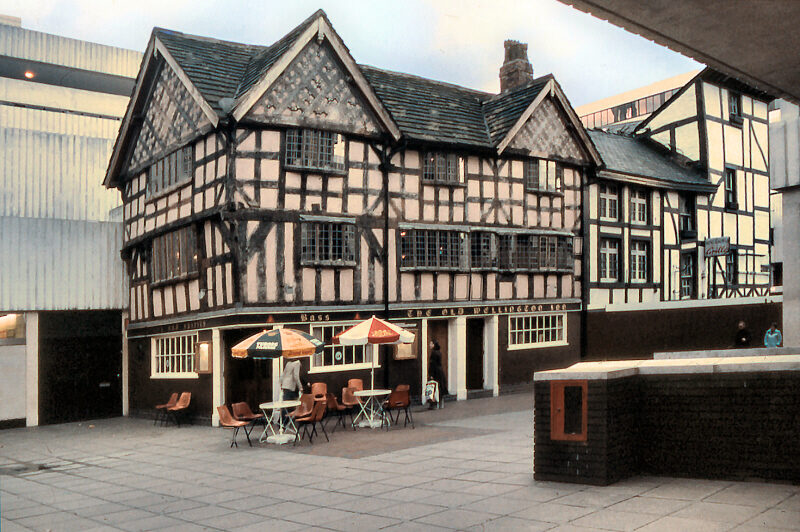
Up by the cathedral, the timber-framed Old Wellington is dated to 1552 and is the last timber-framed building of its kind in the city, though it only became a pub in the early 19th century. It has also moved more than most pubs. With Sinclair’s next door it was raised after the war and again in the 1970s onto a concrete platform, and after the IRA bomb of 1996 both buildings were taken down and rebuilt about 120 yards away in Shambles Square, reopening in 1999. The old timbers are real; the setting is new.
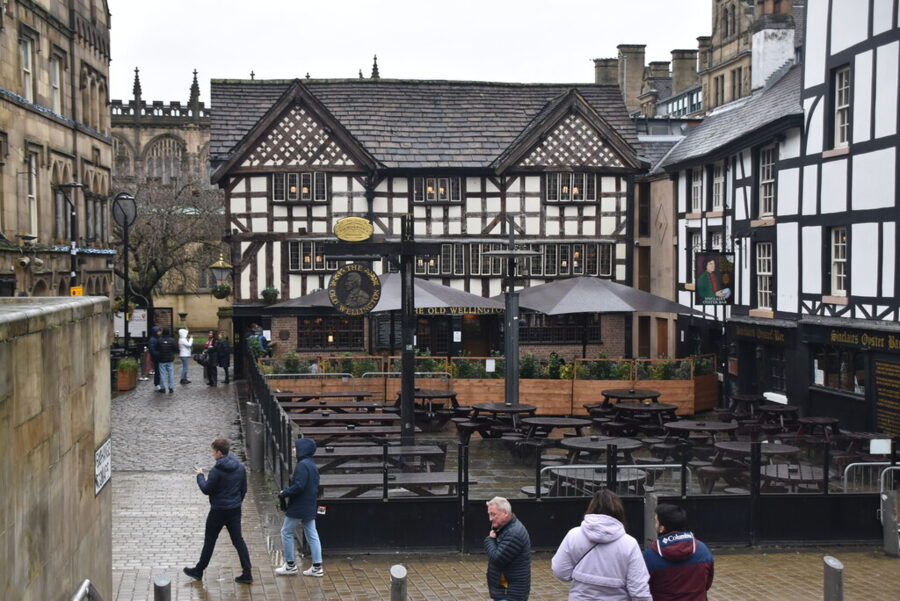

Sinclair’s, its neighbour, is the Samuel Smith’s house. Everything on its 26 keg lines is Sam Smith’s own, and since around 2020 it has also kept Old Brewery Bitter on cask. It is a cheap, reliable pint in a busy square. On a summer evening the shared courtyard in front of the two pubs fills early.

Around Deansgate and King Street
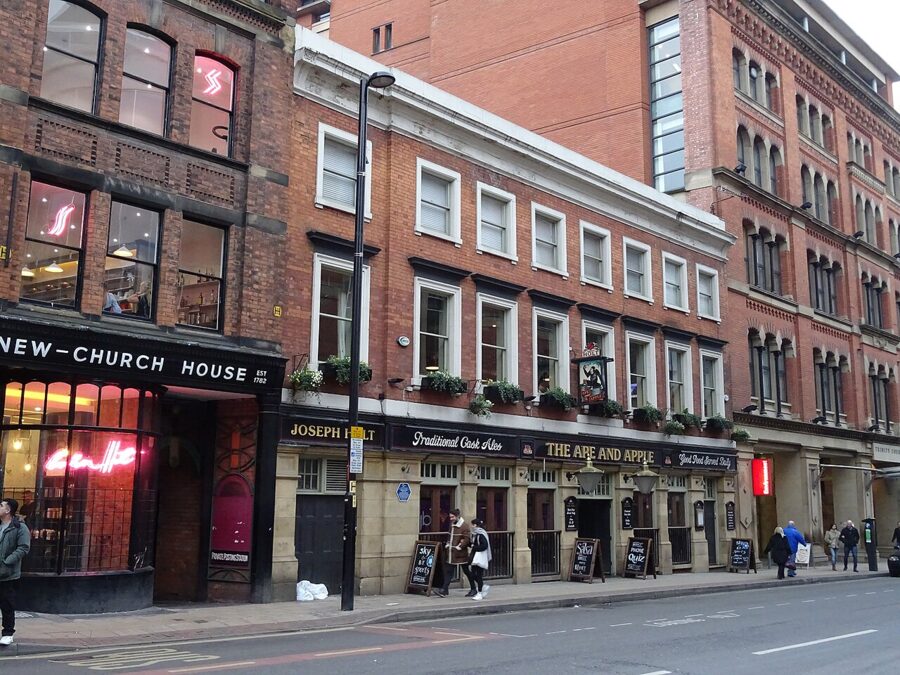
Three more stops if you are on this side. The Ape and Apple on John Dalton Street is a Holt’s pub in a former bank, refurbished in 2025, with a heated roof terrace, sport on the screens and a free comedy night every Wednesday.

Café Beermoth on Brown Street, off King Street, is the beer specialist: six changing cask beers, eleven keg lines including Augustiner Helles, and fridges holding several hundred bottles and cans; it was the local CAMRA branch’s pub of the year in 2026. And down a flight of steps on Bridge Street, the Gas Lamp sits in the white glazed-brick basement of a Victorian children’s mission, with four handpumps leaning towards its own Pomona Island beers and a late licence until 02:00 at weekends.
Shudehill and the Northern Quarter
North of Market Street the grid tightens into the Northern Quarter, old warehouses turned into bars and record shops, with Shudehill tram and bus interchange on its western edge. Most of the newer bars here do cocktails and loud music. The pubs worth your time are older, and three of them have interiors that CAMRA rates among the best in the country.

The Hare and Hounds and the Unicorn
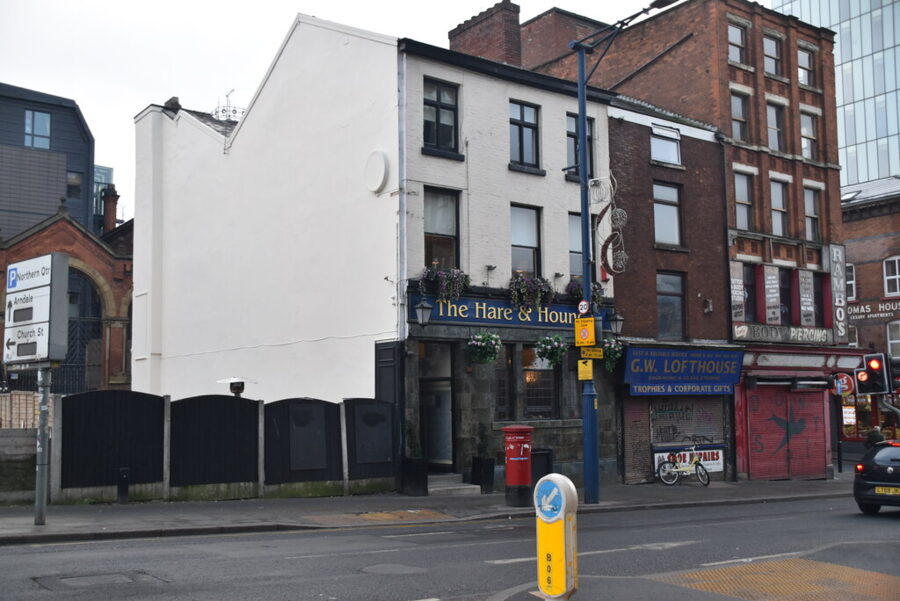
Opposite the Shudehill interchange, the Hare and Hounds is a building of about 1800 that was remodelled in 1925 and has barely changed since. There is a vault at the front, a lounge at the back and a drinking lobby in front of the bar, with tilework very like the Britons Protection’s. The beer is Holt’s Bitter and Ossett White Rat. Free-and-easy singalongs and Wednesday karaoke keep an older crowd coming in, and it opens at 11:00.

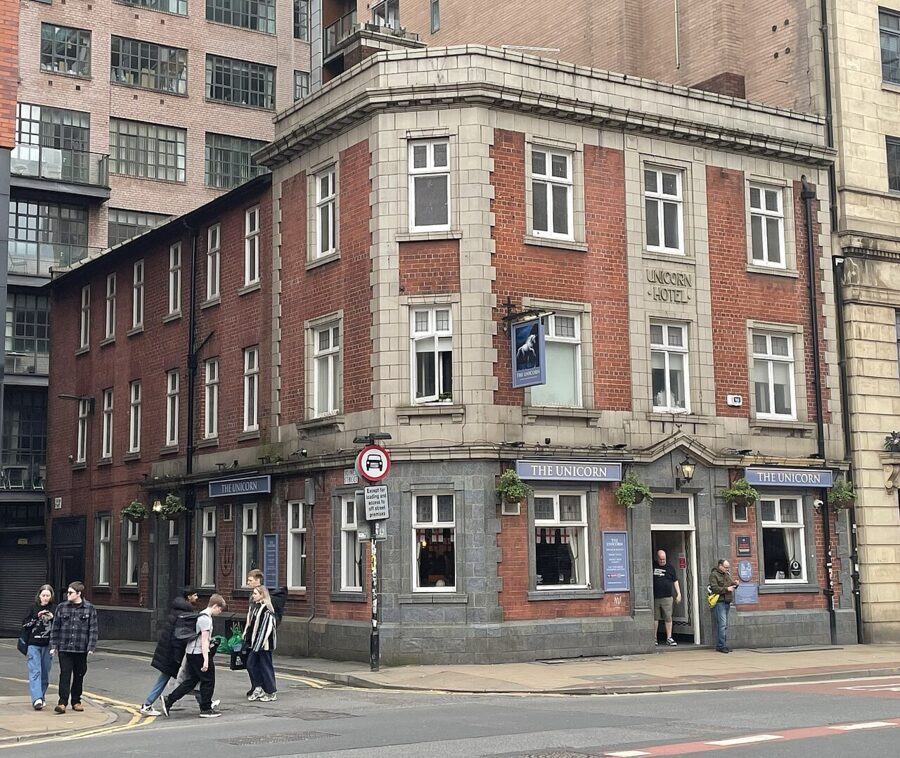
Round the corner on Church Street, the Unicorn was built in 1924 and keeps its island servery, service hatches, drinking lobby and three rooms finished in light oak panelling. It was listed in 2019 and has since been raised to full entry on CAMRA’s national inventory. It is the only pub in the centre selling Draught Bass, and it is busiest in the daytime with a loyal crowd of regulars. It opens at 10:00.
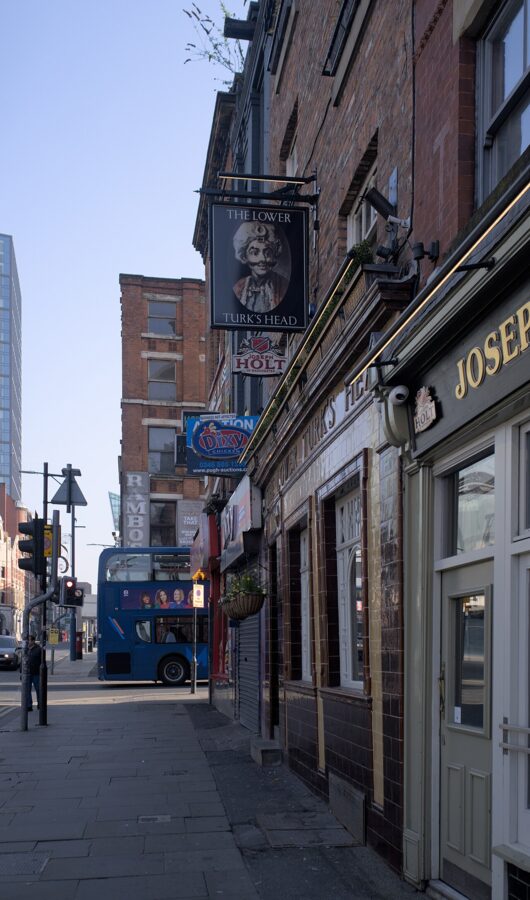
Between the two, the Lower Turks Head on Shudehill reopened under Holt’s in 2021 after years of closure. It has raised drinking pews opposite the bar, nothing like them elsewhere in town, a roof terrace upstairs and four bedrooms.

The Castle Hotel
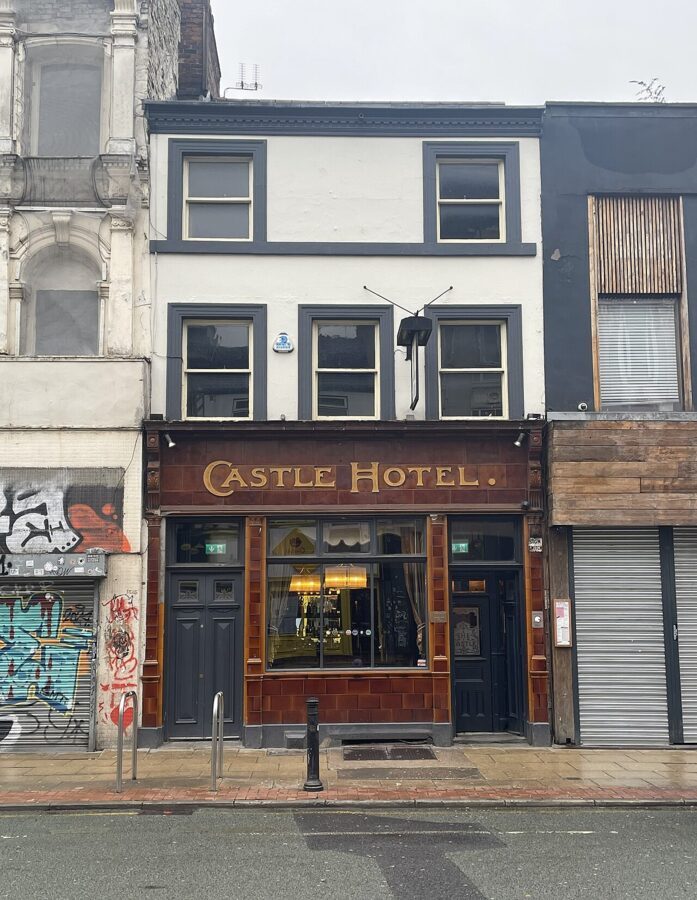
Halfway up Oldham Street, the Castle has been a pub since 1776 and wears brown glazed tiles outside and in. Its tiled bar counter is one of only a handful left in the country, and there is an Art Nouveau etched door to the bar parlour at the back.
Robinsons owns it and pours three of its beers, usually Unicorn, Trooper and Dizzy Blonde, plus two guests. The back room is a music hall that has put on small gigs since 2010, so check what is on before you go if you want a quiet pint. It opens 12:00 to midnight every day.
Port Street, Thomas Street and Swan Street
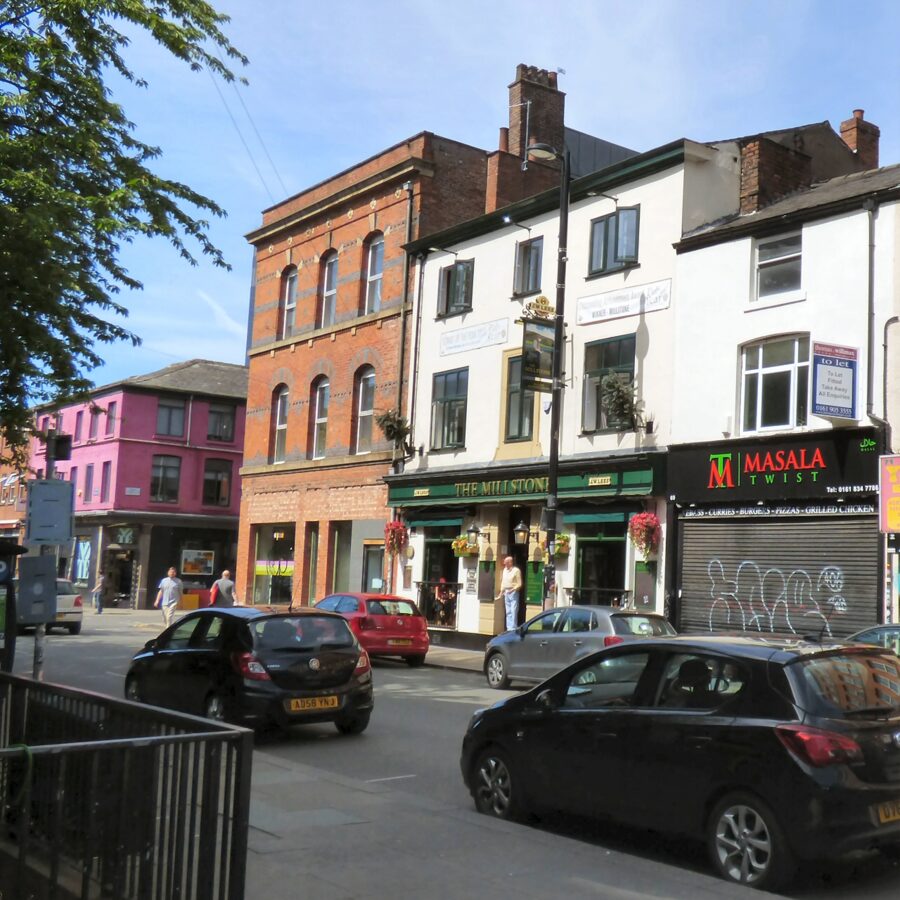
Port Street Beer House opened in 2011 in a former shop, one of the first of the city’s new-style beer bars. Seven handpumps carry mostly northern breweries, with a wall of keg and bottles behind them, and cask is 20 per cent off from 12:00 to 16:00 on weekdays. It is card only. On Thomas Street, the Millstone is the opposite: a JW Lees pub since 2004, with older regulars and singing that drifts out through the open windows.

On Swan Street, Smithfield Market Tavern is run by Blackjack, with six cask beers, four of them usually its own, bar billiards, darts and a shelf of board games in an old fireplace. It opens at 16:00 on Monday and 14:00 from Tuesday to Thursday. The team behind the Crown and Kettle also run two pubs here: the Rat and Pigeon on Back Piccadilly, which reopened in 2024, and the Badger on Dale Street, opened in May 2026 and much more about food.
Angel Meadow and the Marble Arch
Walk north from Shudehill and the towers start. Angel Meadow was a notorious slum in the 1840s, the area Friedrich Engels described as hell upon earth; it is now a district of new flats. Two pubs here are worth the walk.
The Angel
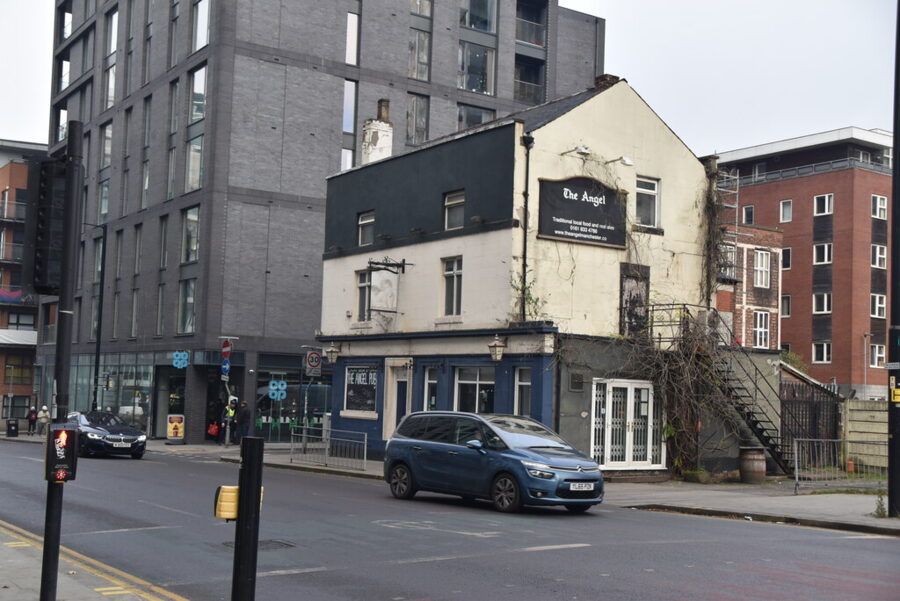
The Angel on Angel Street is a plain Victorian pub that marked its 175th birthday in 2026, with a real fire in winter and a big beer garden that fills on any sunny day. It keeps six changing cask beers and two ciders, plus a 3.9 per cent house bitter called Fallen Angel at about £4 a pint, cheap for the centre. The kitchen cooks from Wednesday evening to Sunday, and there are pies from a local butcher on the bar.

The Marble Arch
Up Rochdale Road, the Marble Arch is the city’s best pub interior and a good place to eat. It was built in 1888 by the architects Darbyshire and Smith as a showpiece for McKenna’s brewery, with Gothic detailing on the outside and an entrance faced in polished granite; the “marble” is actually Shap granite. Inside is one long room lined with glazed bricks in yellow, cream and green, a ceiling of glazed brick arches on iron girders, and a frieze naming the drinks the pub once sold. The mosaic floor slopes so markedly towards the bar that you feel it in your knees.
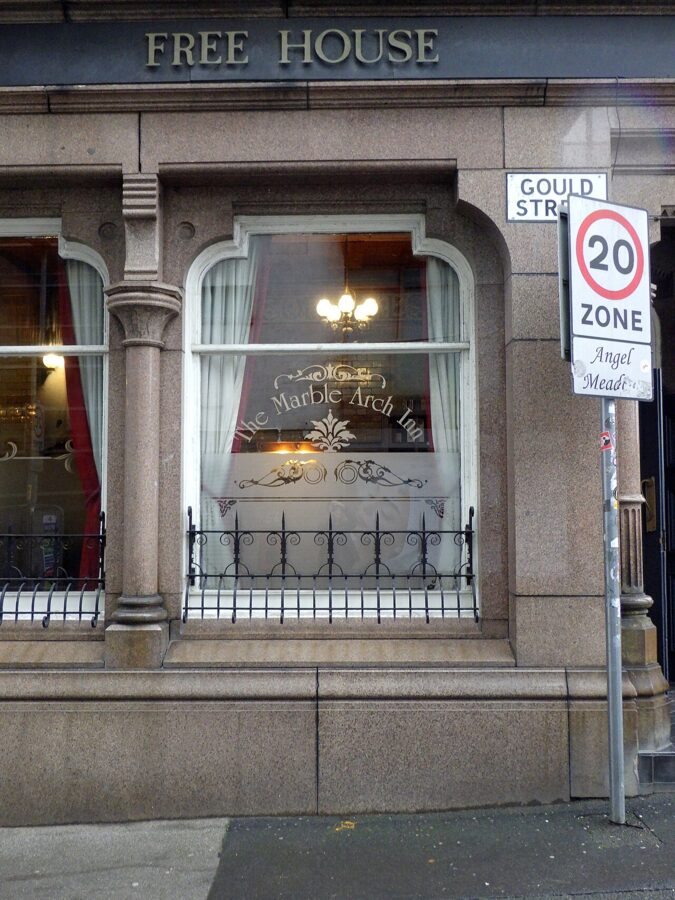

What you see is partly a rescue. A refit in 1954 covered the tiles and the floor, and they were uncovered only in 1989, when the present counter, fireplace and seating went in.
There are six cask lines and eight keg, mostly Marble’s own, with Manchester Bitter, Pint and the Stout as regulars. Food runs to 20:00 most days, and the Sunday roasts stop when they run out, so arrive early. The 2027 Good Beer Guide is the pub’s thirtieth in a row.
Sadler’s Cat
If you are heading back to Victoria from here, Sadler’s Cat on Sadler’s Yard is Cloudwater’s pub, a modern wooden building with three of the brewery’s cask beers and up to fourteen keg lines. The name honours James Sadler, who went up in a balloon near here in 1785, and the cat that, as the story goes, went with him.
Ancoats and the Piccadilly taprooms
East of the Northern Quarter, the cotton mills of Ancoats have been turned into flats over the last twenty years, and the pubs have followed. The breweries are a little further south, in the arches under Piccadilly station and on a trading estate beside them.
The Crown and Kettle
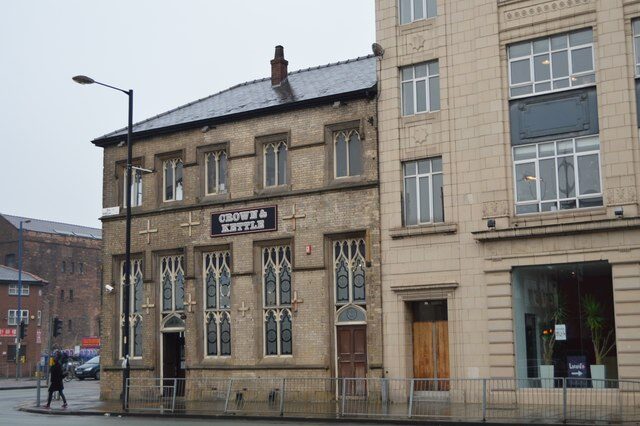
On the corner where Oldham Road meets Great Ancoats Street, the Crown and Kettle is a Grade II listed Gothic building from around 1800, on a site that has held a pub since at least 1734. The council closed it in 1989 after a fight between United and City fans, and it stayed shut for sixteen years until it reopened in 2005. Look up: the ornate plaster ceiling is the reason to come. There are six changing cask beers, pies and small plates, and a strict 18-and-over rule.

The Edinburgh Castle and the Spinner’s Rest
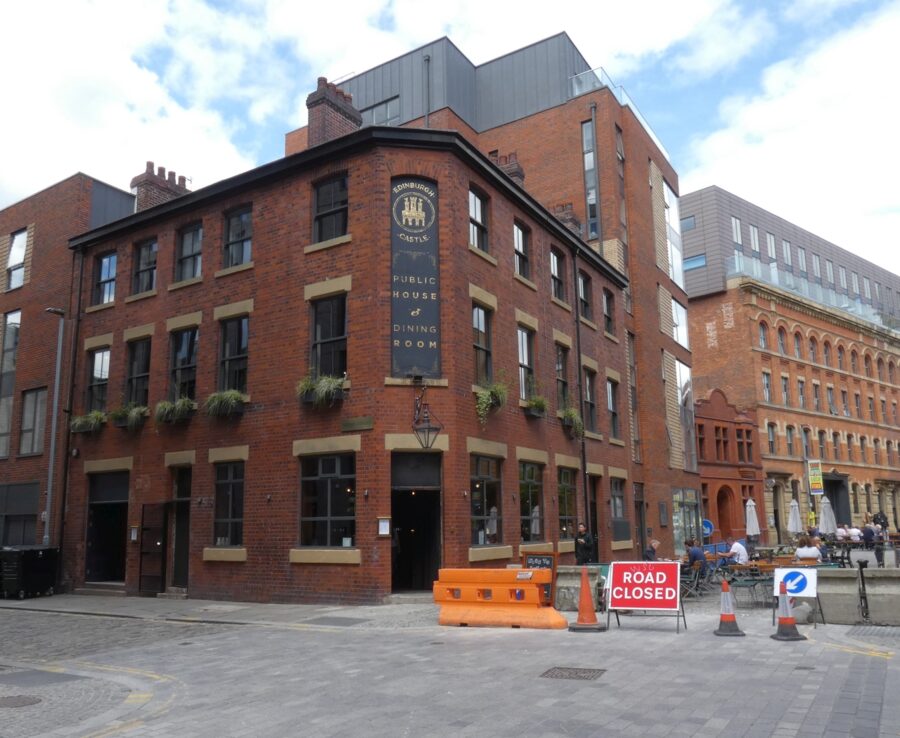
Two streets into Ancoats, the Edinburgh Castle on Blossom Street was a Whitbread pub closed for years before a careful restoration reopened it in November 2019. Now there is a long marble-topped bar, a dark panelled room behind and a restaurant upstairs, with up to three cask beers. It opens at 17:00 on Monday and Tuesday.

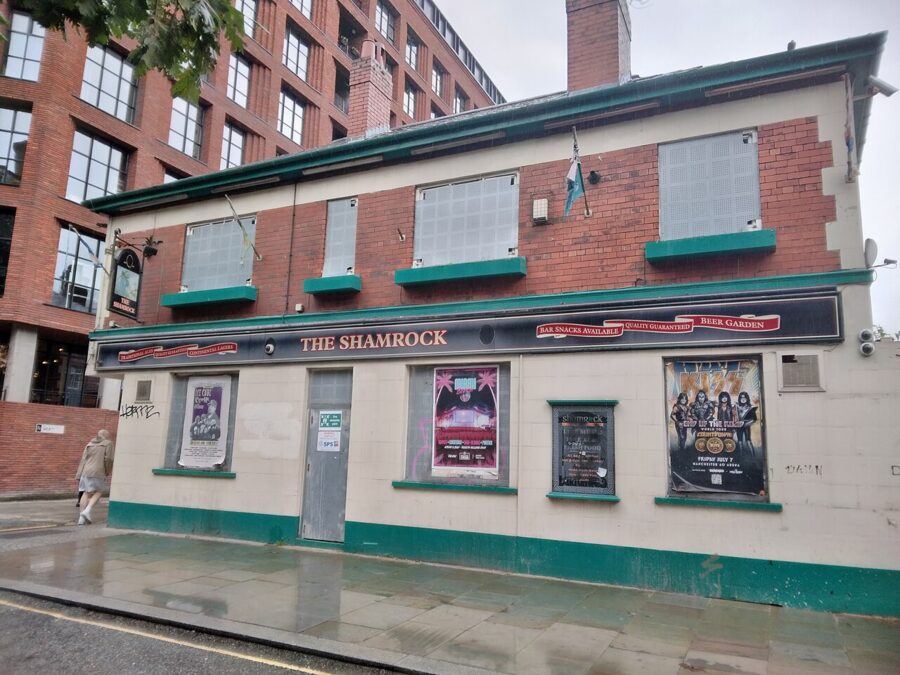
Round the corner on Bengal Street, Holt’s refurbished the old Shamrock and reopened it on 29 June 2026 as the Spinner’s Rest, named after a public vote. One handpump pours Holt’s Bitter from a wooden cask and another from a metal one, so you can taste the difference side by side. It was also the first pub to sell Holt’s Spun Gold IPA.
New Islington and the brewery taps
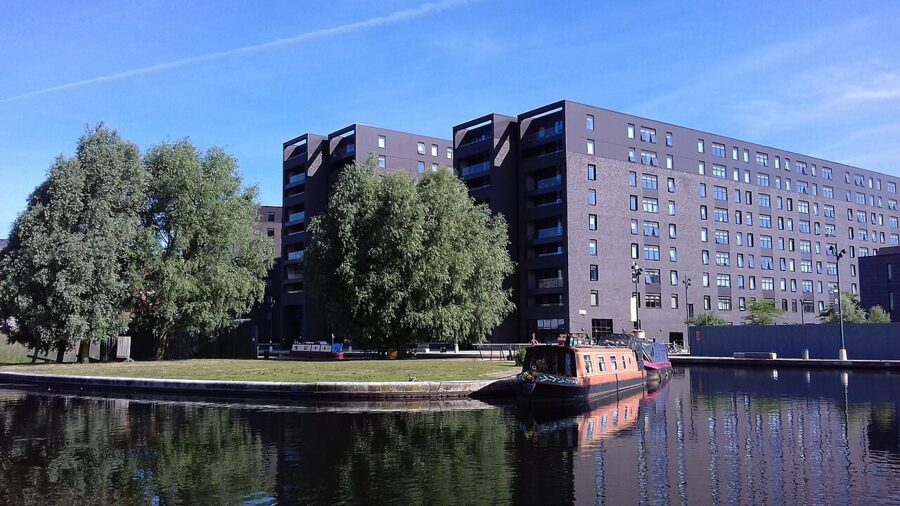
At New Islington, Cask sits on the ground floor of a new block on the canal, with four cask beers, a real cider and twenty keg lines leaning towards German lagers; the canalside tables are the place to be in summer. In the Ice Plant building nearby, Seven Bro7hers Beerhouse is all keg for now, with food and a long upstairs bar.

South of Great Ancoats Street, on the Piccadilly Trading Estate, Track’s tap has twenty keg lines and three handpumps in a big canteen-style room, with pizza from Wednesday to Sunday; it is closed on Mondays. Cloudwater’s Unit 9 next to its brewery has up to twenty keg beers and two handpumps, and it runs brewery tours at 12:00 on Saturdays if you book.
Under the Piccadilly station arches on Sheffield Street, Balance brews mixed-fermentation beers aged in barrels and opens Thursday to Sunday, and Sureshot pours its own beers a few arches along from Wednesday. Track and Cloudwater are card only. Manchester Union’s tap nearby has closed, though the brewery carries on.
Over the Irwell into Salford
Salford is a separate city, but the river is no wider than a big street and the best pubs are within fifteen minutes’ walk of Deansgate. Salford Central station is in the middle of them.
The New Oxford and the Kings Arms
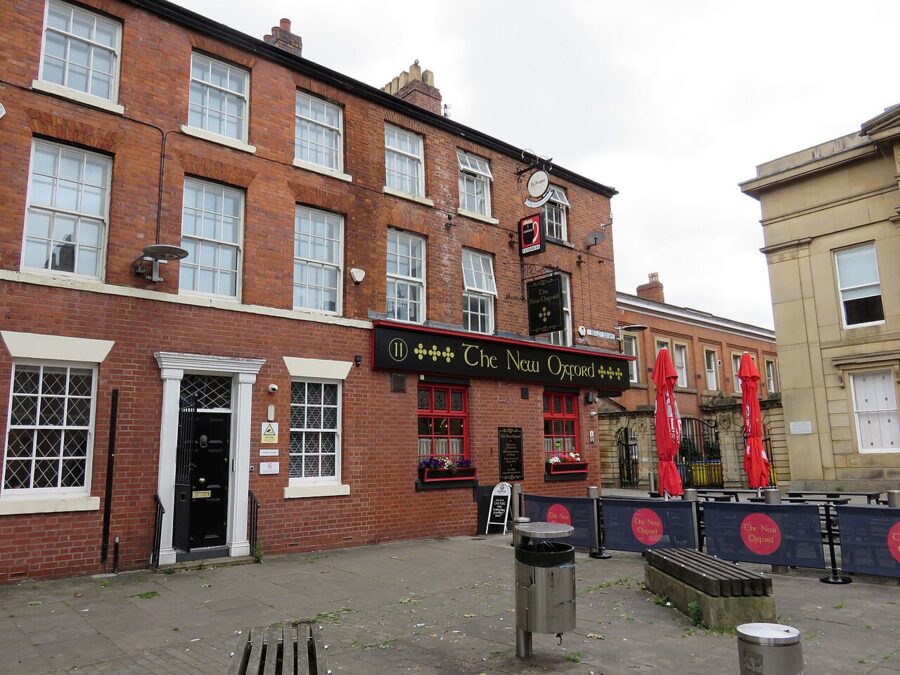
The New Oxford on Bexley Square is a two-room corner pub from the 1830s, restored with care, with eleven handpumps on its central bar and more than fifty Belgian beers. There is usually at least one dark beer on, and it opens to midnight most nights and 01:00 at weekends. In summer the tables spread out across the square.

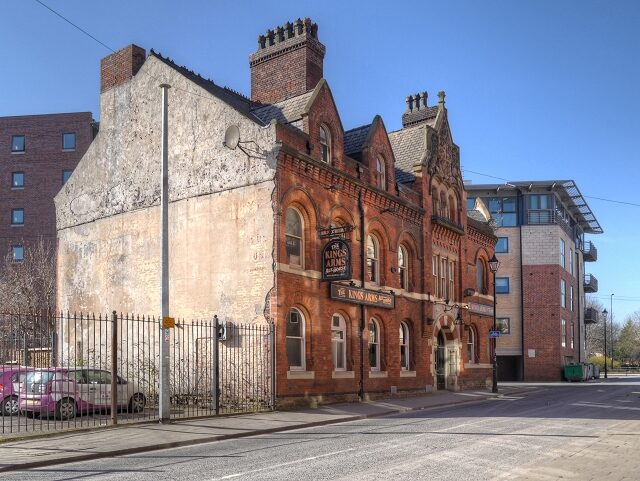
The Kings Arms on Bloom Street, 150 metres from Salford Central, has a snug off the corridor and a main room shaped like a racetrack, with a bench running three quarters of the way round. Its house beer, Queens Legs, is brewed by Brightside. Upstairs there are films and theatre, Wednesday is quiz night and Monday is needlecraft. It opens at 16:00 on weekdays.

The Eagle Inn and the Black Friar
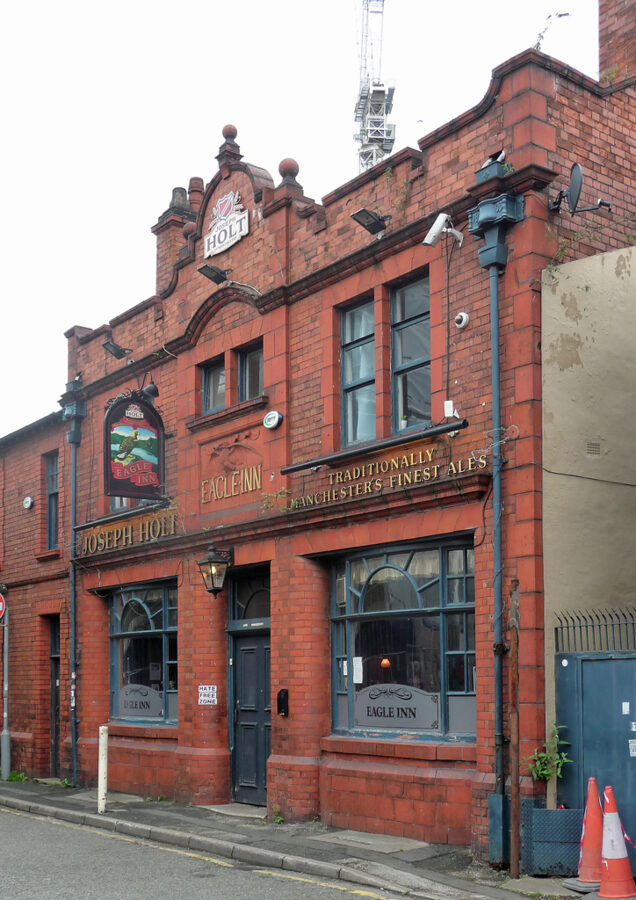
The Eagle on Collier Street is hard to find and worth finding. Known locally as the Lamp Oil, it was built in 1902 and keeps three rooms off a corridor, with a tiled lobby, an etched glass inner door and its original panelled bar counter. It is a Holt’s house with two of the brewery’s beers and Old Rosie cider on handpump. There is regular live music in the extension next door, and it stays open until 02:00 on Friday and Saturday.

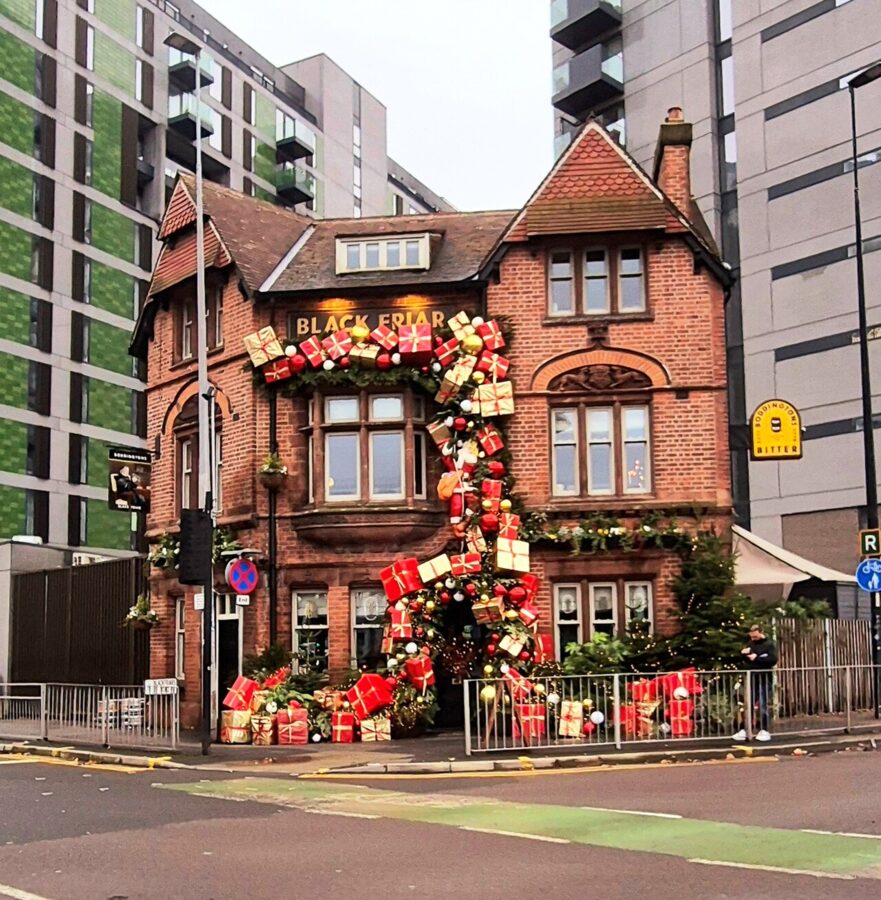
Nearby on Blackfriars Road, the Black Friar is a Grade II listed old Boddingtons pub that stood empty for years and reopened in 2021 as a big gastropub with a garden. There are two cask beers, usually from local brewers, and food until 21:00 most days.

The historic interiors, and what is genuine
CAMRA’s National Inventory of Historic Pub Interiors gives three stars to pubs of outstanding national importance. Central Manchester has eight of them within a twenty-minute walk: the Peveril of the Peak, the Britons Protection, the Circus Tavern, Mr Thomas’s Chop House, the Hare and Hounds, the Unicorn, the Castle Hotel and the Marble Arch. The City Arms, and the Eagle in Salford, have one star, for interiors of special national interest.
Most of them are listed Grade II, and most are younger than they look. The Pev is mid-Victorian with a 1900 facing and 1982 glass. The Britons Protection opened in 1811, but its interior is 1930s. The Hare and Hounds was remodelled in 1925 and the Unicorn built in 1924.
At the Marble Arch, the tiles are 1888 and the counter and seating 1989. None of that makes them less worth seeing; it just means the best of Manchester’s pub fabric is late Victorian, Edwardian and inter-war rather than Georgian.

The oldest claims need the usual pinch of salt, as with most of the oldest pubs in England. The Old Wellington is the oldest building in the city centre used as a pub, but it has been a pub for about two centuries and has been raised and moved more than once since the war. The Britons Protection, at 1811, is one of the oldest pubs in the city still trading on its original spot. The Castle’s 1776 date and the Crown and Kettle’s 1734 site come from the pubs and the local CAMRA branch, and I have not found anything better to go on.
Then there are the restorations. CAMRA also keeps a list of outstanding conversions and restorations, and Manchester does well there too, with the Crown and Kettle, the Edinburgh Castle, the New Oxford and the Rain Bar all on it. These are old buildings put back to work as pubs, and none of them pretends to be a time capsule.
One evening, Oxford Road to Victoria
This route takes in the best of the old pubs in about two miles of walking, south to north, and ends near Victoria station. It works best on a weekday, starting around 17:00. Do half a pint in each if you plan to finish.
Start at the Peveril of the Peak, five minutes from Oxford Road station, and sit in the front room. Walk two minutes west to the Britons Protection and take a back room. From there it is about eight minutes up Oxford Street and Portland Street to the Circus Tavern, with the Grey Horse next door if the Circus is full. Then seven minutes north to Mr Thomas’s Chop House on Cross Street, the place to eat if you are going to.
After that, cross Market Street and walk ten minutes to the Hare and Hounds on Shudehill, then five more to the Castle Hotel on Oldham Street. Finish at the Marble Arch, about eight minutes up Rochdale Road. Victoria station is a ten-minute walk back down from there, and the Angel is on the way if you need one more.
Stations, trams, late licences and match days
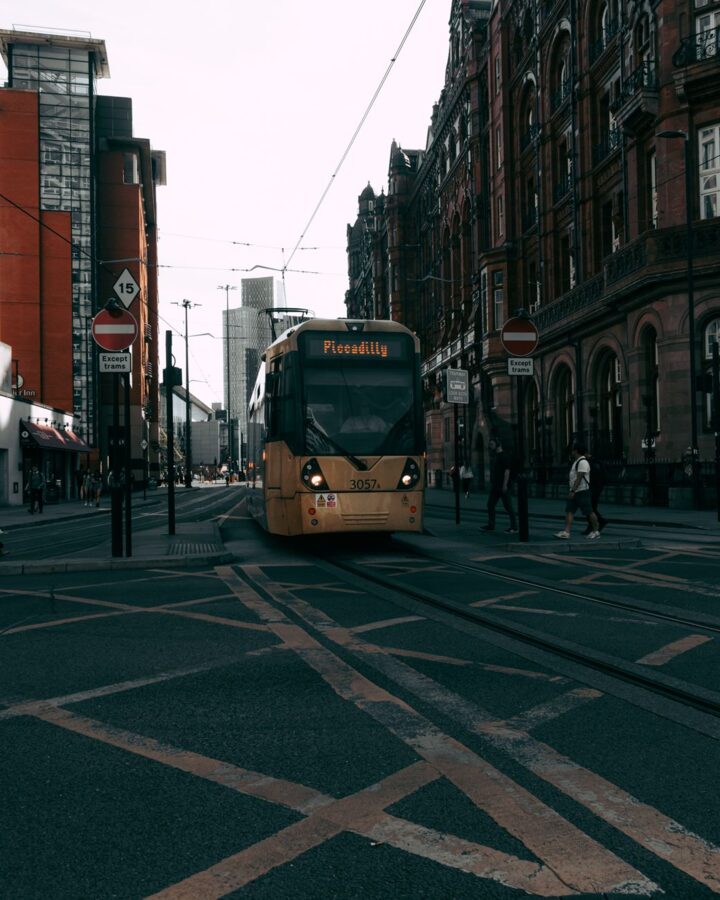
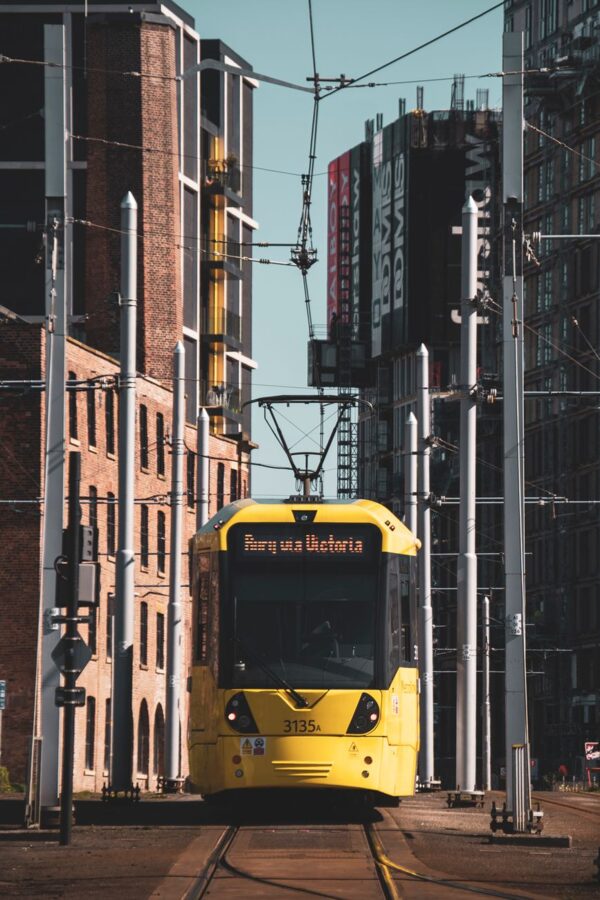
Manchester has four city-centre stations. Oxford Road and Deansgate serve the south side and the Pev, Piccadilly is the main station for London and the brewery taps, and Victoria serves the north, the Marble Arch and Salford. Salford Central is one stop from Victoria and the closest station to the New Oxford and the Kings Arms. Metrolink trams run through the centre, with stops at Deansgate-Castlefield, St Peter’s Square, Market Street, Exchange Square, Shudehill and New Islington.
Most pubs here close at 23:00 or midnight. For later drinks, the Salisbury opens until 02:00 on Thursday, Friday and Saturday, the Gas Lamp and the Eagle until 02:00 on Friday and Saturday, and the New Oxford and the Angel until 01:00 at weekends. Several of the newer places are card only, among them Port Street Beer House, the Smithfield Market Tavern, Café Beermoth, the Gas Lamp, the Salisbury and the Track and Cloudwater taps. Sinclair’s takes cash.
On match days the centre fills with football fans, and small pubs such as the Grey Horse get packed. If you want a quiet pint, the old town and the chop houses are calmer, and the Vine shows no satellite sport at all. Most pubs on this list take children until early evening, usually 19:00 or 20:00, but the Crown and Kettle is strictly over-18s. Dogs are welcome at most of them.
Book a table at Sam’s or Mr Thomas’s if you want to eat, especially before a show at the Royal Exchange, and turn up early for the Marble Arch roast. For everything else, just walk in, read the handpumps first, and remember that at the Circus you wait to be served at your seat.
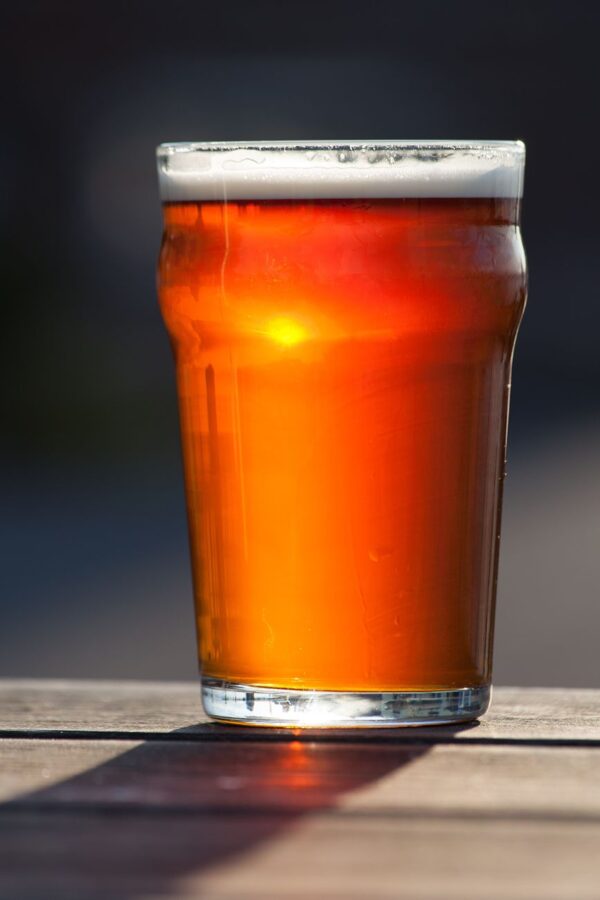
End where the beer started. Order a pint of Marble’s Manchester Bitter at the Marble Arch, find a seat on the uphill side of that sloping floor, and when it is time to go, walk down to Victoria for the last train.